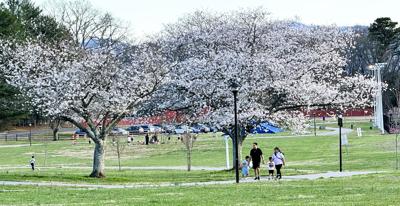
Temperatures in the 80s brought families out to Freedom Park on Wednesday. Early bloomers like these plum trees will get a rude awakening when lows plunge into the 20s next week.
Temperatures in the 80s brought families out to Freedom Park on Wednesday. Early bloomers like these plum trees will get a rude awakening when lows plunge into the 20s next week.
The winter of 2025-26 has been quite the rollercoaster ride for Burke County and guess what, brothers and sisters, it ain’t over yet.
We’ve had cold. We’ve had ice. We’ve had snow. And we’ve had quite a bit of premature warmth.
So, keep your seat belts fastened and hang on to the safety bar ’cause the coaster is about to take another plunge.
Been enjoying this three-week span with temperatures in the 70s and 80s? Haven’t we all? Well, we’re about to have a short pause.
Tuesday, March 17, also known as St. Patrick’s Day, gonna be a chilly one here in the Foothills. Low 28, High 48. Throw in a stiff breeze from the northwest and you’re gonna wish you hadn’t packed up those longjohns just yet.
Wednesday, March 18, is not gonna be a whole lot better. An even colder low than Tuesday at 24. An afternoon high that will struggle to leave the 40s. And that northwest breeze will still be blowing.
So, what’s going on? We turned to the National Weather Service in Greer, S.C., for an answer to that question.
“We’re still in mid-March,” answered meteorologist Andrew Kimball. “The first day of spring is Friday the 20th. It’s not unusual for the Foothills of Western North Carolina to have killing frosts up into May.”
Next week’s temperatures will be enough, Kimball said, to kill tender vegetation.
He also confirmed what all of us over the age of 60 already know — spring-like temperatures, budding trees, and sprouting grass come a whole lot earlier now than they did 50 years ago.
Damon Pollard, with the Burke Center of the N.C. Cooperative Extension, put it more succinctly: “We’ve basically skipped a month. In many ways, we’re where we should be in mid-April, not mid-March.”
As to the impact of the cold on large farm operations, Pollard said, “Corn and soybeans are two of our primary agricultural products. They have not come up yet, so they won’t be impacted.”
More susceptible to damage will be commercial growers of apple and peach trees.
“They are gonna get knocked,” said Pollard. “There’s gonna be some damage done. Other nursery crops are also likely to see damage, especially any type of flowering tree.”
So far as backyard gardeners go, Pollard urged them to be patient and let several more weeks pass before plunging seeds or fingers into the soil.
And as for next week’s cold snap, don’t worry, it’s not going to last very long.
After that chilly start to the week, high temperatures return to the mid- and upper-70s for the foreseeable future.
Keep it Clean. Please avoid obscene, vulgar, lewd,
racist or sexually-oriented language. PLEASE TURN OFF YOUR CAPS LOCK. Don't Threaten. Threats of harming another
person will not be tolerated. Be Truthful. Don't knowingly lie about anyone
or anything. Be Nice. No racism, sexism or any sort of -ism
that is degrading to another person. Be Proactive. Use the 'Report' link on
each comment to let us know of abusive posts. Share with Us. We'd love to hear eyewitness
accounts, the history behind an article.



























(0) comments
Welcome to the discussion.
Log In
Keep it Clean. Please avoid obscene, vulgar, lewd, racist or sexually-oriented language.
PLEASE TURN OFF YOUR CAPS LOCK.
Don't Threaten. Threats of harming another person will not be tolerated.
Be Truthful. Don't knowingly lie about anyone or anything.
Be Nice. No racism, sexism or any sort of -ism that is degrading to another person.
Be Proactive. Use the 'Report' link on each comment to let us know of abusive posts.
Share with Us. We'd love to hear eyewitness accounts, the history behind an article.