

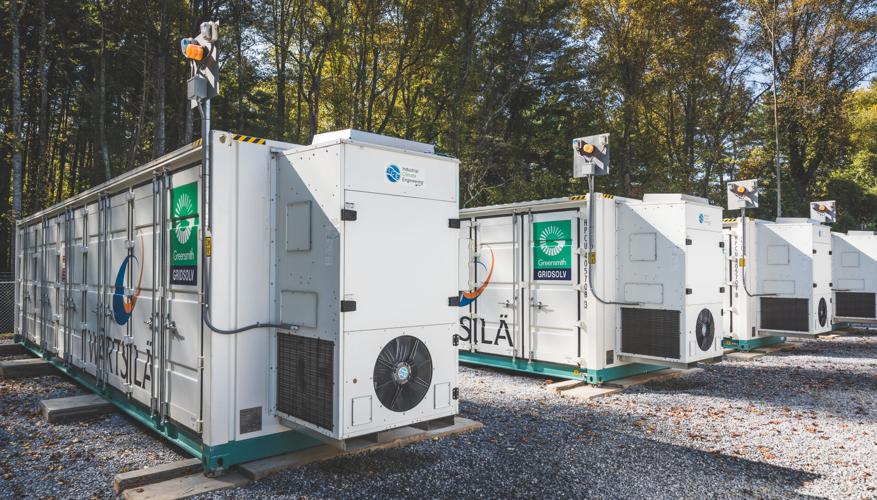

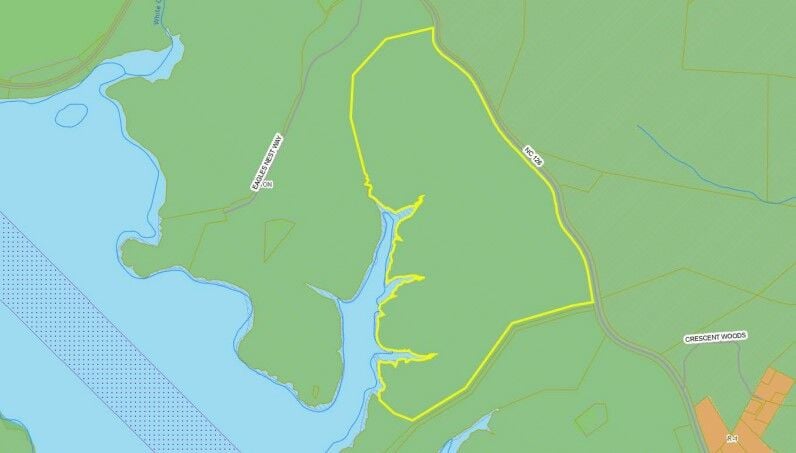


A lithium battery storage facility proposed by Duke Energy near Lake James promises more reliable power, especially in times of need — but some community members have expressed concerns about health and environmental risks.
The purpose of the project on 2.25 acres of land on Fish Hatchery Road is to help strengthen the grid to support power reliability while also expanding capacity to meet growing energy needs, said Garrett Poorman, spokesman for Duke Energy. Though construction for the project hasn’t started yet, Duke Energy plans to submit building permits later this year.
Work on the battery system will begin once all necessary permits are approved, and construction is expected to take between eight months and one year, Poorman said.
“During an outage, customers on the distribution power line connected to the Nebo Reliability Microgrid can continue to be served by the energy storage facility,” Poorman said. “The Battery Storage System (BESS) can also support the broader grid by providing energy when additional power is needed, like during times of peak usage.”
Duke University Professor Lee Ferguson studies the risk of PFAS release in relation to lithium-ion batteries. The main concerns, he said, lie with the manufacturing of the electrolytes and other battery components and the disposal and recycling of the batteries.
PFAS, which stands for per- and polyfluoroalkyl substances, are manmade chemicals that have been found in various products and industrial processes since the 1940s. They are used for their resistance to oil, grease, water and heat, but they are often referred to as “forever chemicals.” This is due to their persistence in the environment and the human body.
The subcomponents of the battery systems, Poorman said, are sourced globally.
The use, Ferguson said, which is what will occur at the Nebo facility, will have to be carefully monitored, but the likelihood of health risks from PFAS is low as long as the batteries are operating under normal conditions.
“Under normal conditions, the batteries are going to be sitting there, they’re sealed, they’re going to be in a climate-controlled environment, they’re going to be in a contained scenario, be charged and discharged,” Ferguson said, “really no more risk than if you’re sitting in a Tesla.”
The only concern, he said, when it comes to making sure the batteries are in a good environment, is making sure that they are sheltered from possible flooding and that there are measures in place to prevent a thermal runaway event.
A thermal runaway event occurs if a battery overheats. Then, it discharges too rapidly, causing a physical breakdown of the structure of the battery. With the damage, the release of stored energy causes the battery to get even hotter, which causes a chain reaction and can cause a fire to break out. If this occurs, Ferguson said PFAS can be released into the air, and if water is used to put out the fire, there are also concerns about further contamination. But these incidents are not common and are so rare that when they happen, it’s a newsworthy event.
Thermal runaway events can also be caused by flooding, Ferguson said, but he said this usually happens with battery-powered vehicles that are in floodwaters.
When it comes to safeguarding the facility, Poorman said that Duke Energy has several plans in place. Energy storage facilities will be monitored 24/7 by trained personnel who are prepared to maintain safety and respond to emergency events.
At the facilities, Duke Energy also uses industry-leading fire safety equipment and protocols to keep not just employees safe, but also communities and equipment safe. There will also be a monitoring system that will notify operators immediately when a battery is performing outside normal operations. Then, Poorman said employees can shut the battery down before an event occurs, adding that all batteries meet applicable industry safety standards.
Because battery fires require unique firefighting techniques, Poorman said that Duke Energy educates first responders on the risks and techniques, which include guidance to not use firefighting water on battery systems.
Each site, Poorman said, will have an emergency action plan in place that contains specific site details for local first responders and employees should an event occur.
“Our relationship with these first responders ensures that any event is handled as quickly and safely as possible,” Poorman stated.
MANUFACTURING AND DISPOSAL
“What is very unclear right now is how much potential there is for release when the batteries themselves are being manufactured … There’s almost no work on that,” Ferguson said, adding that the North Carolina Department of Environmental Quality is aware of the issue and is tracking battery manufacturing in North Carolina and what kind of materials are being used to understand whether there’s a risk for PFAS exposure.
During disposal, Ferguson said the concern is that elements could eventually end up in a landfill, and there’s also concern about what can happen during recycling as well. Poorman said that decommissioning the site will include all equipment and infrastructure removal, as well as grading and stabilizing the site per environmental regulations.
“Duke Energy will comply with all regulations to safely and responsibly dispose of battery systems when their useful life is over,” Poorman stated, adding that the battery equipment that will be installed for the Nebo Reliability Microgrid is expected to operate for up to 30 years.
Burke County has not received a building permit application from Duke Energy, so work has not started. The county approved the special use permit for the facility, according to Alan Glines, deputy county manager and director of the community development department.
The closest facility similar to the Nebo facility is in Hot Springs, but Poorman said that Duke Energy has similar projects not only in North Carolina, but Florida as well.


























(0) comments
Welcome to the discussion.
Log In
Keep it Clean. Please avoid obscene, vulgar, lewd, racist or sexually-oriented language.
PLEASE TURN OFF YOUR CAPS LOCK.
Don't Threaten. Threats of harming another person will not be tolerated.
Be Truthful. Don't knowingly lie about anyone or anything.
Be Nice. No racism, sexism or any sort of -ism that is degrading to another person.
Be Proactive. Use the 'Report' link on each comment to let us know of abusive posts.
Share with Us. We'd love to hear eyewitness accounts, the history behind an article.