


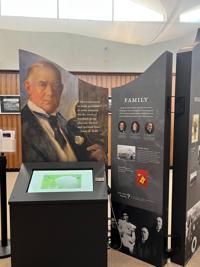
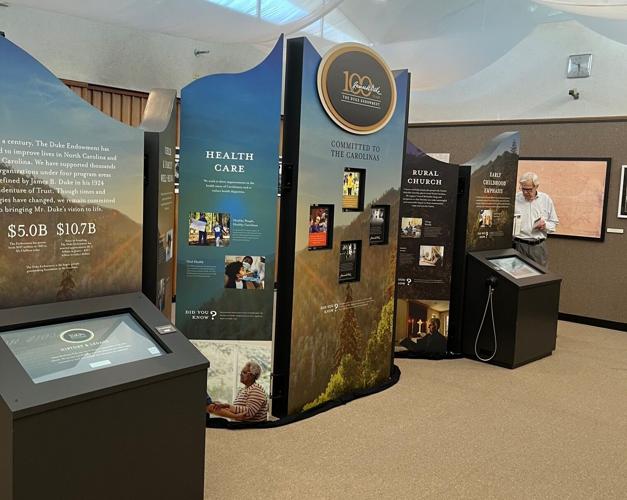

Staying true to its founder’s original intentions while remaining relevant in today’s world is chief among the challenges faced by the Duke Endowment.
But a century into the process, the charitable foundation — one of the largest in the United States — seems to be accomplishing both.
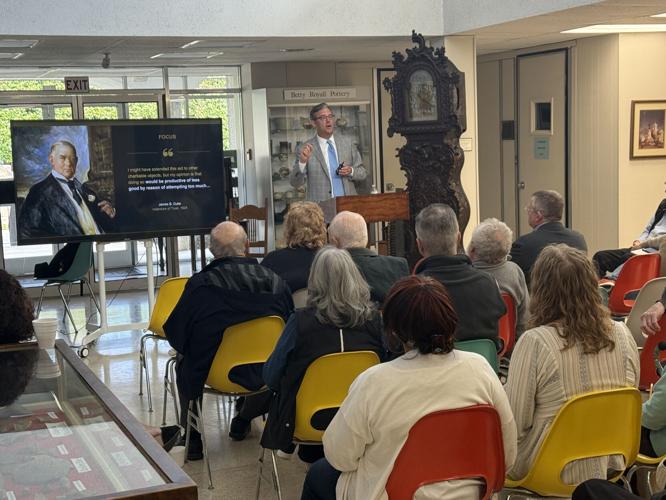
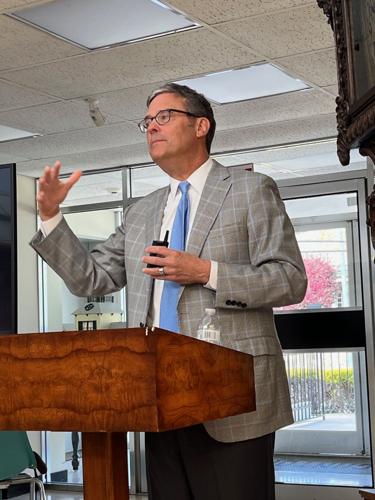
Rhett Mabry, who has served as the endowment’s president since 2016, spoke at length about the history and goals of the philanthropic organization at the History Museum of Burke County’s Coffee at the Museum program Thursday morning.
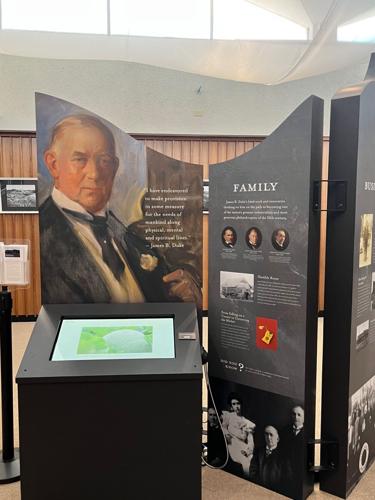
The museum is currently hosting a traveling exhibit that traces the history of the Duke family and the endowment that carries their name. The exhibit will remain on display until early April.
The endowment was founded in 1924 by James Buchanan Duke, who amassed two fortunes around the turn of the last century, one in tobacco and the other in hydroelectric power.
Duke’s initial endowment was $40 million, and another $67 million was added after he died unexpectedly in 1925.
Since then, the endowment has given away more than $5 billion — $12 billion in today’s dollars — in North and South Carolina. Its assets total $5 billion, and Duke expects to distribute that much in grants over the next 15 years.
Among the Burke County entities the endowment helps are UNC Health Blue Ridge and Southmountain Children & Family Services. Duke has also committed $20 million to parts of Western North Carolina and South Carolina damaged by Hurricane Helene last September.
“We’re a foundation committed to our founder’s intent,” Mabry said. “Per Mr. Duke’s instructions, we read the trust indenture of the Duke Endowment aloud to the full board once a year, as he required.”
Although the endowment maintains Duke’s original vision, the founder had the foresight to give the board full discretion, which Mabry said was forward-thinking on the magnate’s part.
“We know that we have to make adjustments along the way to remain relevant 100 years later,” Mabry said. “The world has changed in ways Mr. Duke could never have imagined.”
Still, the group’s four primary focus areas haven’t changed.
As James Duke decreed, the endowment supports higher education, childcare and family well-being, health care, and North Carolina’s rural United Methodist churches.
Much of the foundation’s education funding goes to its flagship institution, Duke University. But the endowment also supports Davidson College, Furman University, and Johnson C. Smith University, a historically Black college (HBCU).
Mabry said the organization has been committed to racial equity from the very start. “The Duke family was very progressive,” he said. “The Dukes were unequivocal about their commitment to serving all Carolinians, regardless of race.”
In the childcare and family arena, Mabry said Duke’s focus is on groups that provide intensive assistance for kids during the first few years of their lives.
“One adaptation that we made in 2017 was our board adopted an emphasis in early childhood, zero to 8,” Mabry said. “And in doing so, our board was compelled by the emerging brain science that shows just how critical the early years are for the development of a child and the formation of a family.”
In terms of health care assistance, Mabry said the trust must be especially judicious in its spending. Even though Duke donates $50 million a year to healthcare related causes, that amounts to “a drop in the bucket” compared to the $200 billion Carolinians spend for health care each year.
“I would argue that we believe that innovation naturally occurs,” Mabry said. “We’re kind of like stock pickers. We want to find those innovations that we think have particular promise. We want to vet them further and make sure they produce reliable outcomes and impact.”
Regardless of how much the endowment donates, Mabry said all the grantees have one thing in common.
“Our grantees are the ones that are doing the work,” he said. “They’re the ones who are waking up every day to take care of a child and a family, to attend to a health care need, to educate a child, to educate a young adult, to provide spiritual guidance and counsel and help someone in crisis. They’re the ones that are doing that. So, we are but one piece of the equation.”
The History Museum of Burke County is at 201 W. Meeting St. in Morganton. Hours of operation are 10 a.m. to 4 p.m., Tuesday-Friday; 10 a.m. to 3 p.m., Saturday; and closed Sunday and Monday. Admission to the museum is free.



























(0) comments
Welcome to the discussion.
Log In
Keep it Clean. Please avoid obscene, vulgar, lewd, racist or sexually-oriented language.
PLEASE TURN OFF YOUR CAPS LOCK.
Don't Threaten. Threats of harming another person will not be tolerated.
Be Truthful. Don't knowingly lie about anyone or anything.
Be Nice. No racism, sexism or any sort of -ism that is degrading to another person.
Be Proactive. Use the 'Report' link on each comment to let us know of abusive posts.
Share with Us. We'd love to hear eyewitness accounts, the history behind an article.