

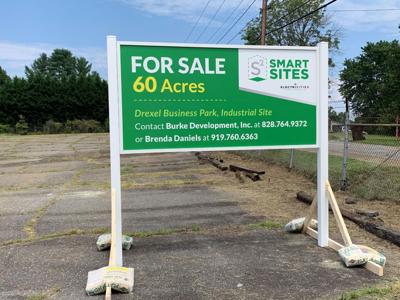

The Town of Drexel’s attempt to turn the site of the former Drexel Furniture Company into the cornerstone of its economic future has been a decade-long journey.
It’s approaching a critical milestone, but there are a few bumps left in the road.
There is still some work to do and a sizable funding gap, but Town Manager Bill Carroll hopes the project can advance to the earth-moving phase before the end of the year.
Carroll told the town’s Board of Aldermen at its meeting Feb. 4 that Drexel had around $3.2 million in funding for the site. That amount only added up to about half of the lower of two bids the town received for grading and constructing a 450,000-square-foot pad.
Wednesday, Carroll said he’s confident the town will be able to secure enough funding to make up the difference and begin grading in 2025.
“This year, barring some sort of serious delay that I don’t anticipate, we will begin the process of rough-grading and demolition of the majority of the site,” he said.
Carroll has been with Drexel for a little more than a year, which makes him a relative newcomer to the project. Alan Wood, president and CEO of Burke Partnership for Economic Development (BDI) has been working on it for 10 years.
During that decade, the 100-acre site has sat vacant while the wheels of development turned.
Wood explained that’s not uncommon for projects of this size, especially if they involve brownfields — areas previously used by industries and may have been polluted as a result. “You have to go through the process,” Wood said. “That’s just the way it’s done.”
“It’s not unusual for projects such as this, especially brownfield projects, to have that kind of timeline,” Wood said. “Most municipalities don’t have the money to just go in and attack something like that by themselves, so you have to depend on allies.”
Wood summed up the process.
First, the site had to be assessed by the Environmental Protection Agency (EPA) and a large amount of asbestos had to be removed. Wood said applying for grants to cover those costs and then completing the removal took more than four years.
At that point in the timeline, the COVID-19 pandemic hit, slowing down development projects everywhere.
Along the way, Wood said, there has been an exhaustive grant-seeking campaign. Drexel has secured funds from a variety of sources, including Community Development Block Grants (N.C. Dept. of Commerce), the Appalachian Regional Commission, and the General Assembly.
Drexel and BDI have also teamed up with ElectriCities and the Western Piedmont Council of Governments for grant-writing and development expertise.
In all, the partnership has garnered around $5 million since the initiative began.
Carroll said the Board of Aldermen is anxious to begin the long-awaited final phase of getting the site ready for an industrial tenant and is fully on board with the program.
“We do have a bit of a funding gap there, so we’re working on getting that filled,” Carroll said. “But we’re working in the background on some other options to get the project done and over the finish line. Right now, our goal is to push forward, because we’re tired of waiting.”
Carroll said he hopes to give the board good news about the remainder of the funding at its next meeting in March. He said going back to some of the initial grant providers is one strategy he plans to employ.
Despite the lengthy evolution of the site, it has a number of points in its favor:
The site is larger than most in western North Carolina.
It’s owned by the town, which cuts down on red tape.
Water and sewer infrastructure are already in place, which drastically reduces costs for a prospective client.
It’s in close proximity to a rail line, and Wood said Norfolk Southern has told him a spur line could be built to the pad from either direction.
Since there is no plan for a speculative building of any sort, the site has a great deal of flexibility and could accommodate one large business or multiple industries.
The site topography is relatively level, cutting down on grading costs.
Wood said one drawback is that the intersection of Interstate 40 at the Drexel Exit (107) isn’t designed to handle constant truck traffic, and that fact could play a part in what kind of client might eventually settle there.
But both men agreed the positives far outweigh the negatives, and hope that will attract a game-changing industry to the town.
“If you can put something there that would bring in just a couple of hundred people a day, that’s going to make a world of difference for our downtown,” Carroll said.
“When that factory closed down, it metaphorically ripped the heart out of downtown, and now, we’re trying to put something back.”























(1) comment
Yes, please! When I lived in upstate New York and would come acorss Drexel furniture, I felt pride because I knew it was quality furniture that came from a place I knew. I even had relatives and friends who worked there and helped make that furniture. It was such a waste when that furniture factory closed. Please do make this a place to be proud of again, where quality products are made.
Welcome to the discussion.
Log In
Keep it Clean. Please avoid obscene, vulgar, lewd, racist or sexually-oriented language.
PLEASE TURN OFF YOUR CAPS LOCK.
Don't Threaten. Threats of harming another person will not be tolerated.
Be Truthful. Don't knowingly lie about anyone or anything.
Be Nice. No racism, sexism or any sort of -ism that is degrading to another person.
Be Proactive. Use the 'Report' link on each comment to let us know of abusive posts.
Share with Us. We'd love to hear eyewitness accounts, the history behind an article.