

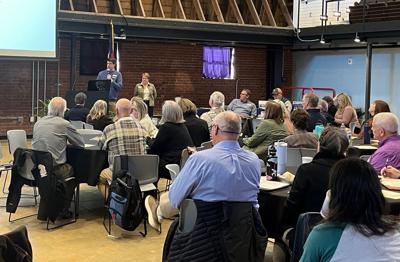
Catawba Riverkeeper Policy Manager Ryan Carter dipped into his knowledge of ‘80s pop music to describe Charlotte’s attempts to double the amount of water it takes from the Catawba River Basin.
“Charlotte can’t keep partying like it’s 1999,” Carter said, referencing Prince’s hit song to describe the Queen City’s attempts to appropriate additional water resources in support of its projected growth.
Fighting the proposed increase in the amount of water Charlotte can take from the Catawba via the 2002 interbasin transfer agreement (IBT) is one of several goals for Riverkeeper in the 2025-26 legislative cycle.
Carter outlined some of the conservation nonprofit’s priorities in a presentation at the fourth annual Lake James Watershed Symposium last week at the N.C. School of Science and Mathematics in Morganton.
Charlotte already draws up to 33 million gallons per day (MGD) from the Catawba chain, which runs through Burke County and into the Wateree system in South Carolina.
Citing the explosive growth the Charlotte area is experiencing, leaders there want to double the amount to as much as 66 MGD.
The Western Piedmont Council of Governments (WPCOG) has organized numerous counties and municipalities in the upper Catawba region to oppose the request.
Riverkeeper is an ally in the fight. “Waters of the Catawba/Wateree River should stay in the Catawba/Wateree River,” according to the group’s legislative agenda.
The battle is expected to be a long one and will intensify sometime in 2026 when Charlotte releases the Environmental Impact Study (EIS) required by the state Division of Environmental Quality (DEQ) as part of the process.
FLOOD PLAIN BUYOUT
Carter said Riverkeeper is also dedicated to soliciting legislative funds for a flood-risk reduction program for homes, farms, and businesses severely impacted by Hurricane Helene last fall.
He said building back in some areas won’t be possible, and both private and municipal victims of the flooding should be compensated as part of the recovery.
“It’s a bad phrase to say, but I think this is a safe space to say it, but this translates to floodplain buyout,” Carter said. “We know that there are folks in these communities where their property value has been absolutely destroyed along with the flooding, and we have to have a mechanism in place to help stabilize those property value markets, provide relief, and help get people and critical infrastructure out of the way (of future flooding).”
In addition, Carter said the massive flooding associated with Helene and points to the continuing need for stream bank stabilization and restoration. These focuses have long been a priority for Western North Carolina conservation groups and is even more important in the wake of the devastating hurricane.
He said $75 million has been allocated for stream bank restoration as part of the $500 million relief bill passed late last month. “We’ll keep working on that, but that’s a good start,” Carter said.
Carter pointed out that Rep. Dudley Greene (R-85), who serves McDowell County, is co-chair of the House Select Committee on Helene Recovery, while Rep. Hugh Blackwell (R-86), who serves Burke, is a committee member.
Having the two elected officials on the committee gives the area a much-needed voice in the legislature.
“Lake James is in a really good place,” Carter said. “Y’all have got a great lake delegation.”
STATE TRAIL STATUS
Carter said he hopes to secure State Trail status for the Upper Catawba Trail, which would require approval by the General Assembly. The waterway was established by the WPCOG in 2004 but has yet to be recognized as part of the state’s official program.
As a result, there is no park ranger for an 82-mile system that begins in the headwaters of the system in McDowell County, runs through Burke, and continues through parts of Caldwell, Catawba, and Iredell counties.
Likewise, there is no centralized trail hub where boaters can obtain information about the trail and the flows being released from lakes upstream.
“What we know is that there needs to be communication, there needs to be coordination, there needs to be some central place that we can go for information as to how do I navigate all of this?” Carter said. “Also, what are some safety levels of what is the cubic feet per second (flow)?”
“There’s a certain threshold where it’s OK to take your 2-year-old tubing, and then there gets to a point where it’s not safe to be doing that, and we need to have that communication as well.”
The current legislative session began Jan. 8 and will end July 31.

























(0) comments
Welcome to the discussion.
Log In
Keep it Clean. Please avoid obscene, vulgar, lewd, racist or sexually-oriented language.
PLEASE TURN OFF YOUR CAPS LOCK.
Don't Threaten. Threats of harming another person will not be tolerated.
Be Truthful. Don't knowingly lie about anyone or anything.
Be Nice. No racism, sexism or any sort of -ism that is degrading to another person.
Be Proactive. Use the 'Report' link on each comment to let us know of abusive posts.
Share with Us. We'd love to hear eyewitness accounts, the history behind an article.