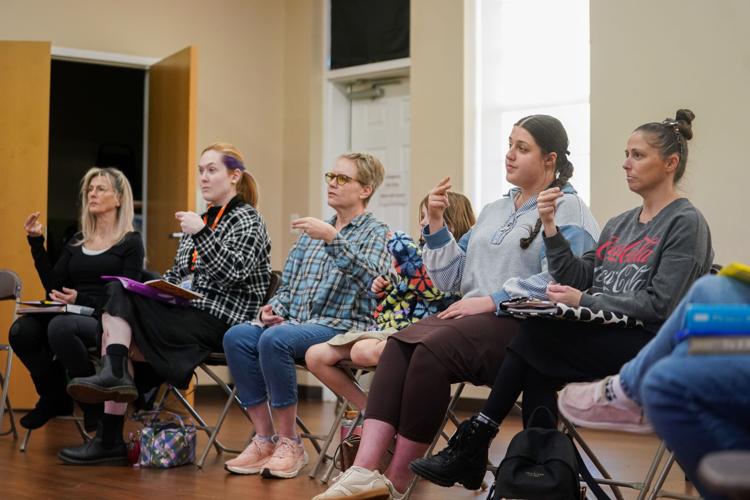
Those who signed up for the 17-session ASL course imitate instructor Fletcher Woodel as he teaches them new signs. From left: Annette Clontz, Logan Hill, Lynette Ebel, Sawyer Bustle, Hannah Bridges, and Amy Bridges.
Those who signed up for the 17-session ASL course imitate instructor Fletcher Woodel as he teaches them new signs. From left: Annette Clontz, Logan Hill, Lynette Ebel, Sawyer Bustle, Hannah Bridges, and Amy Bridges.
LISA PRICE / THE PAPER
All eyes are on the instructor as he moves his hands to shape the word “clock” in American Sign Language (ASL), tapping his pointer finger on the opposite wrist before drawing both hands up to his chest and holding his pointer fingers and thumbs several inches apart to imply a circle.
Every student wears a look of concentration as they copy him, practicing the motion several times as Fletcher Woodel repeats the sign and the spoken word in his quiet, relaxed voice.
Throughout the lesson, Woodel weaves in ASL fun facts and information about deaf culture. A whole section of the lesson is dedicated to deaf culture near the end, something Woodel is well-versed in having grown up in a deaf family.
Twice a week, Woodel — a certified ASL interpreter — teaches a 45-minute to one-hour ASL class for beginners at the Valdese Public Library. The class was designed as a $20 course offered through the Valdese Recreation Department from Jan. 5 to March 5.
Woodel and recreation department staff have a common goal: making the world a more accessible and inclusive place, one sign at a time.
EXPANDING ACCESSIBILITY
Starting the ASL program was another step towards making the Valdese Recreation Department more accessible, said Director David Andersen.
“We’re trying to make efforts as a department, albeit a small department, to bring things on so that we really do offer true, entire community involvement. We’re not letting some people slide behind, we’re trying to do what we can to continue to incorporate offerings for more and more members of the community,” Andersen said.
Alex Bustle, the Aquatics and Fitness Supervisor who also holds a recreational therapy certification, was instrumental in the department getting two accessibility grants, Andersen said.
One $500,000 grant not only helped fund the pool dome but also covered the price of installing ADA ramps and handrails at the recreation center. The other grant, worth $1,000, helped fund the ASL course.
Recreation should be accessible to all, Bustle said. Andersen agreed.
Fletcher Woodel, a certified American Sign Language (ASL) interpreter, teaches an ASL class twice a week at the Valdese Public Library.
LISA PRICE photos / THE PAPER
Lynette Ebel, 55, is one of 17 students taking the ASL course. She has worked at the Valdese Recreation Center in the fitness department for three years.
“We have quite a few of our members and sweet people in the town that come in who are in our local deaf community, and I only know one or two signs, and just always wanted to be able to chat with them more and make the place feel more welcoming,” Ebel said.
Another student, 19-year-old Hannah Bridges, has been interested in ASL since she was little when she was part of her church’s sign team.
Logan Kulinski and Vickie Kulinski practice signing, following ASL instructor Fletcher Woodel’s example.
LISA PRICE / THE PAPER
“I’ve been trying to talk my best friend into (taking an ASL course), because I think the more people that know sign language, the more inclusive you can be. And I think everyone deserves to have a chance to communicate with each other,” Bridges said.
Andersen said the class filled within a week of opening registration. There were originally 15 slots, Bustle said, but two people were on the waiting list. With it being so few, Bustle said they let them in.
Bustle is also taking the course along with his 7-year-old daughter.
Bustle said his daughter taught her friends at school how to sign words she learns from ASL instructor Woodel.
MAKING A DIFFERENCE
Woodel is a hearing person but was raised by deaf parents. Much of his extended family is also deaf.
“I would like the world to be a little more deaf-friendly,” Woodel said.
Woodel currently studies at Western Piedmont Community College and is one class away from earning an associate’s degree. He hopes to earn a doctorate’s degree and eventually participate in deaf research studies as well as develop deaf-friendly apps. He works at Hillandale Elementary School in Flat Rock as an ASL facilitator to help deaf children develop language skills.
Although he is happy to teach ASL in Valdese, Woodel’s feelings on being an instructor are complex.
“There are not many opportunities for deaf people to teach, or to have opportunities in the community as a whole,” Woodel said. “I feel like, for example, when you take a Spanish class, the best teacher is going to be a native Spanish speaker. ... For sign language, you want as native of a speaker as you can get.”
Woodel said although he is a native speaker, “it doesn’t get any better than straight from a deaf person.”
“I don’t feel any shame in teaching the class or anything, I’m very proud of who is showing up and everything that they’re learning, it’s just I feel I almost took an opportunity away from a deaf person that could have fulfilled this role better.”
Woodel said hearing people commonly speak louder or over-exaggerate their mouth movements when trying to communicate with a deaf person. Neither are helpful.
Exaggerating mouth movements is unhelpful because it makes lip reading more difficult, Woodel said.
“(Deaf people) just want hearing people to try,” Woodel said. “They don’t want you to be perfect, they just want you to try instead of just whipping out a pen and paper or going and getting someone, they want you to just try and treat them like a human being.”
Woodel said that back in the 1960s or so, deaf people were categorized as mentally ill and a number of things were attempted to cure their deafness, from taking them to church to flying in an airplane performing loops to “knock the eardrums back into place.”
“There’s a lot of history of oppression for deaf people,” Woodel said. “So that’s why we just want people to gesture or even just try to do a little something to treat us like we’re equal. Instead of trying to get us to play on your field, you come play on our field.”
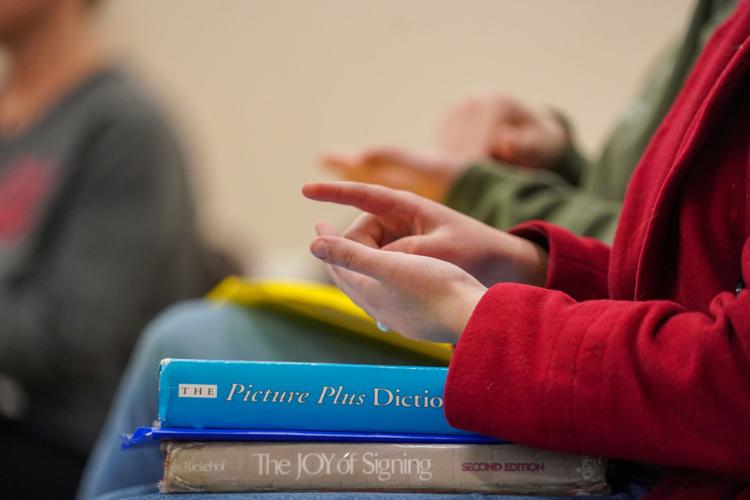
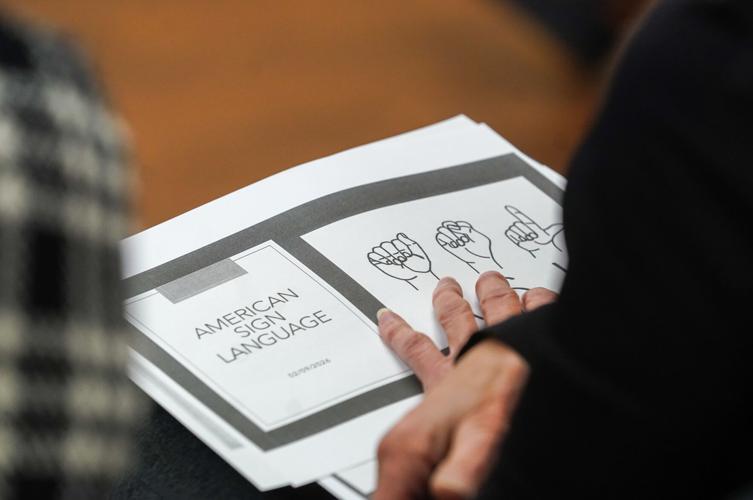
A student holds the handout of ASL teacher Fletcher Woodel’s PowerPoint showing the signs he taught that session.
LISA PRICE / THE PAPER
Woodel said he would like to create an app like FaceTime, but for deaf people. One major feature would be integrating AI to read name signs so people would not have to finger spell a whole name to call someone.
Deaf people create name signs for each other as shortcuts to refer to one another by name.
If someone beat him to creating an app like that, Woodel said he would not mind.
“I just want it to be out there,” Woodel said. “I’m not out here trying to make a million dollars. I’m just trying to make a difference.”
Keep it Clean. Please avoid obscene, vulgar, lewd,
racist or sexually-oriented language. PLEASE TURN OFF YOUR CAPS LOCK. Don't Threaten. Threats of harming another
person will not be tolerated. Be Truthful. Don't knowingly lie about anyone
or anything. Be Nice. No racism, sexism or any sort of -ism
that is degrading to another person. Be Proactive. Use the 'Report' link on
each comment to let us know of abusive posts. Share with Us. We'd love to hear eyewitness
accounts, the history behind an article.























(0) comments
Welcome to the discussion.
Log In
Keep it Clean. Please avoid obscene, vulgar, lewd, racist or sexually-oriented language.
PLEASE TURN OFF YOUR CAPS LOCK.
Don't Threaten. Threats of harming another person will not be tolerated.
Be Truthful. Don't knowingly lie about anyone or anything.
Be Nice. No racism, sexism or any sort of -ism that is degrading to another person.
Be Proactive. Use the 'Report' link on each comment to let us know of abusive posts.
Share with Us. We'd love to hear eyewitness accounts, the history behind an article.