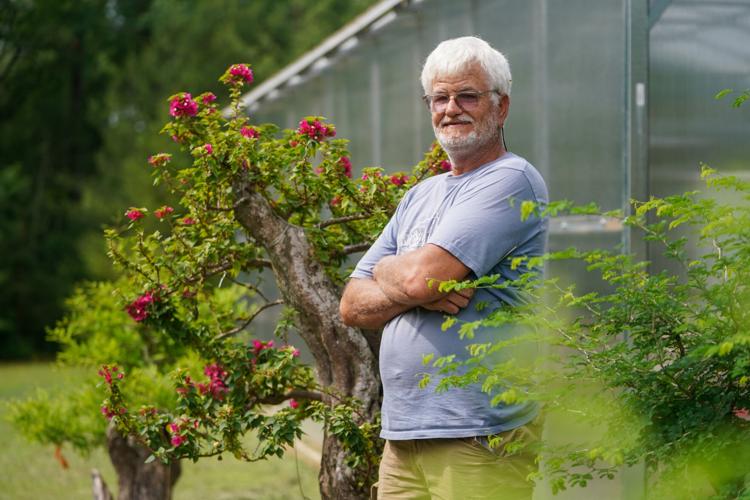
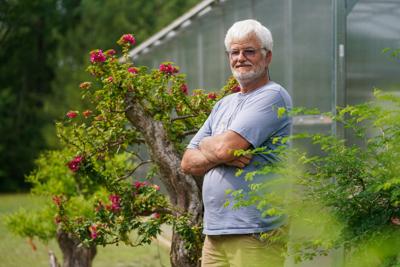
BamBam Bonsai’s Joe Winkler moved from Florida to Burke County about a year ago. He has been growing and selling bonsai for 35 years and his oldest is a Bougainvillea, which (pictured) is about 75 years old and is known for its brilliant papery bracts.
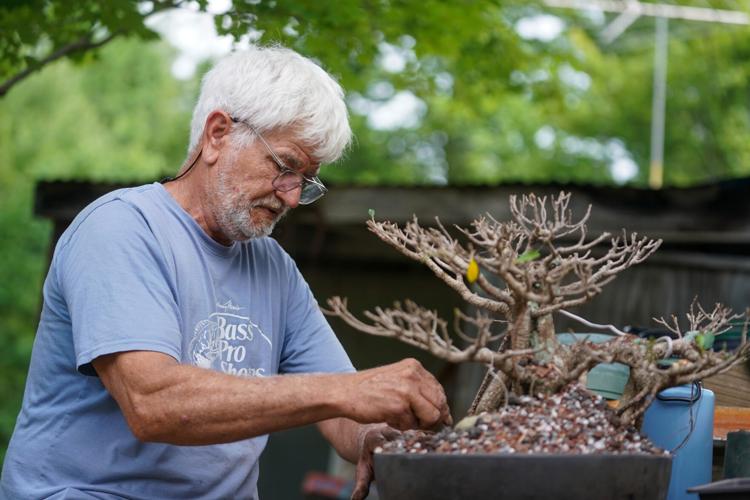
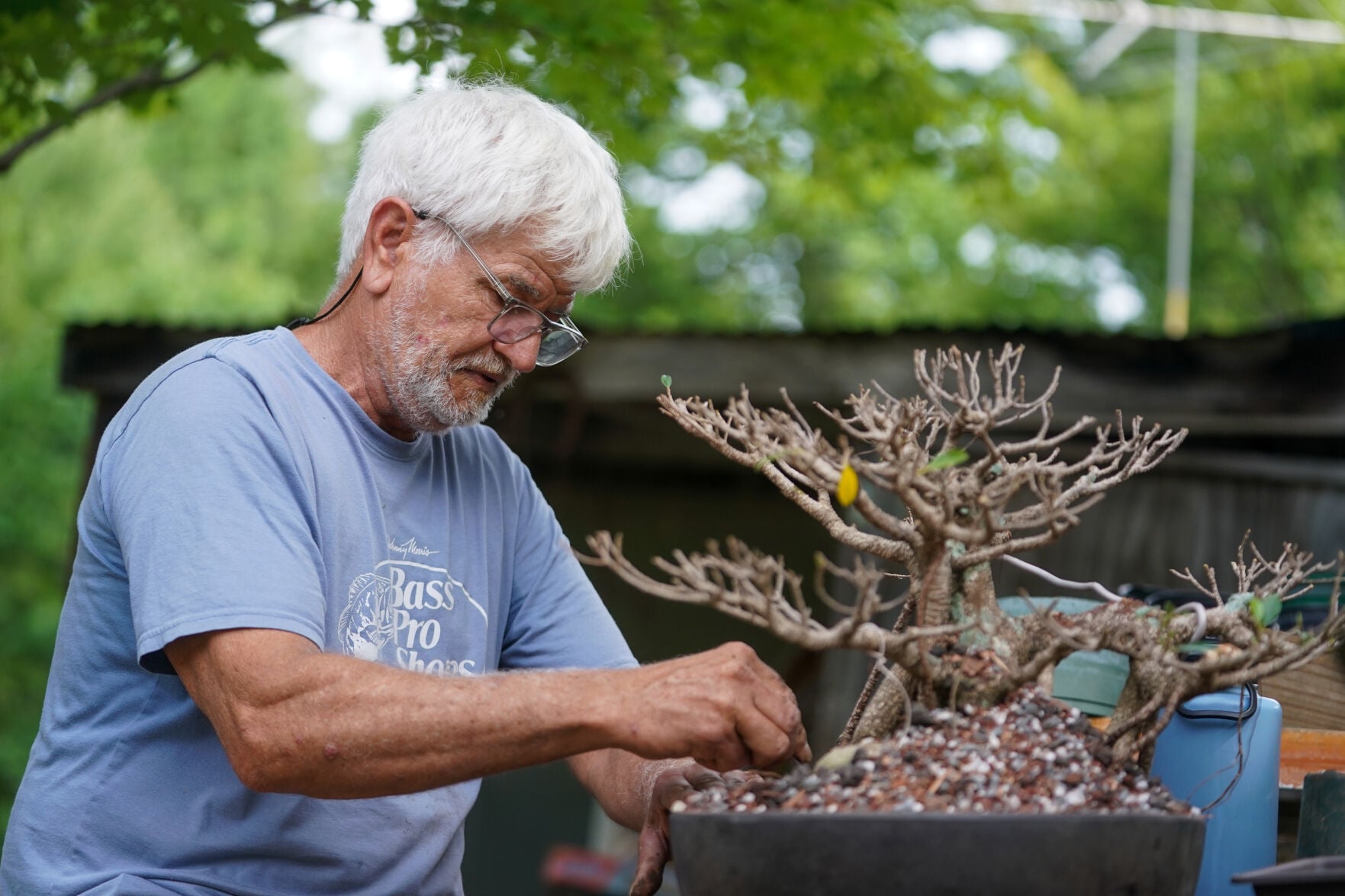
Joe Winkler demonstrates how to repot a bonsai. Once the special mixture of lava rock, slate, pumice, and pine bark is in the pot, he uses a chopstick to remove air bubbles, making sure the plant’s roots are protected.
BamBam Bonsai’s Joe Winkler moved from Florida to Burke County about a year ago. He has been growing and selling bonsai for 35 years and his oldest is a Bougainvillea, which (pictured) is about 75 years old and is known for its brilliant papery bracts.
Tucked away on a winding road in the foothills of the Blue Ridge Mountains, BamBam Bonsai’s Joe Winkler tends to nearly 1,000 bonsai trees. From a distance, the setup appears like a typical nursery with a large greenhouse and rows of plants, but up close, twisted trunks and carefully shaped branches reveal an art form with roots stretching back thousands of years.
Winkler’s collection is the product of 35 years of learning, growing, and selling bonsai. The art is all about time, he said. When someone buys a bonsai, they’re buying the years, if not decades, that it took for the tree to achieve its unique shape.
While “bonsai” is a Japanese term, the art of growing miniature trees in pots originated in China over 2,000 years ago. After moving from Florida to Burke County about a year ago, Winkler brought BamBam Bonsai and decades worth of experience with him.
But bonsai wasn’t always part of Winkler’s plan. Before moving to North Carolina, Winkler owned a company where he offered landscaping services to multi-million-dollar property owners, including the family behind Martin Marietta, John Walsh from “America’s Most Wanted,” and CEOs of Heinz.
His search for large plants for his landscaping business eventually led him to Jim Smith, one of the country’s most respected bonsai artists. When he approached Smith about learning the craft, the answer was always the same: join the club.
After hearing the same response for months, Winkler decided to take matters into his own hands.
“I came to pull weeds, and I’m just gonna watch you,” he recalled telling Smith.
Smith began teaching him the fundamentals of bonsai and Winkler quickly immersed himself in the art form. He went on to manage Smith’s nursery for three years. Smith’s bonsai collection is now on display at the Heathcote Botanical Gardens in Fort Pierce, Fla.
“It’s probably the biggest public tropical bonsai display in the country,” Winkler said.
Winkler made connections throughout Florida and beyond for his work with Bougainvilleas, and from Sea Hibiscus to Jade plants, Winkler’s nursery offers a variety of different species. The only tree that can’t transform into a bonsai is a palm, he said, adding that they’re too top-heavy. Prices for his bonsai range from $50 for a starter up to the thousands for a more mature tree.
Joe Winkler demonstrates how to repot a bonsai. Once the special mixture of lava rock, slate, pumice, and pine bark is in the pot, he uses a chopstick to remove air bubbles, making sure the plant’s roots are protected.
LISA PRICE / THE PAPER
“When you buy a bonsai, you’re buying time,” Winkler said.
Winkler pointed to several trees in his collection as examples of the patience bonsai requires. He has been growing the same Willow Leaf Ficus for 35 years and owns a Bougainvillea that he said is about 75 years old. The plant, which is native to South America, is tropical vine or shrub that’s known for its vibrant papery bracts.
When it comes to learning how to care for a bonsai, the art comes with several unique practices, like using a chopstick to remove air bubbles and using a specific mixture of lava rock, slate, pumice, and pine bark as soil. Other aspects like watering and repotting are more dependent on the plant itself.
“What I tell everybody is learn the horticulture of the plant you like or the plant you bought,” Winkler said.
For example, a Spiny Black Olive can't be worked on until night temperatures are above 70 degrees. With a Divi Divi, which is from Aruba, if it gets down to 40 degrees, the tree will die, he said, adding that he lost the top half of a tree because it got below that in the greenhouse.
Since moving to the foothills, he has started the Morganton NC Bonsai Society, a group that meets monthly to share knowledge, work on trees, and introduce newcomers to the hobby.
Winkler said he doesn’t want beginners to get discouraged by the perception that bonsai is only for experts or wealthy collectors. While some plants can sell for thousands of dollars, he believes that those starting out can go for something simple and affordable.
“It’s better to start off and have a person who will spend $50 or $100 on a tree figure it out,” Winkler said.
He often helps newcomers find starter trees and is exploring opportunities to host workshops at local breweries and wineries, where participants could learn the basics.
“Anybody who is into bonsai and can maintain it, can grow it,” Winkler said. “So, in 20 years, they’ll have a nice tree.”
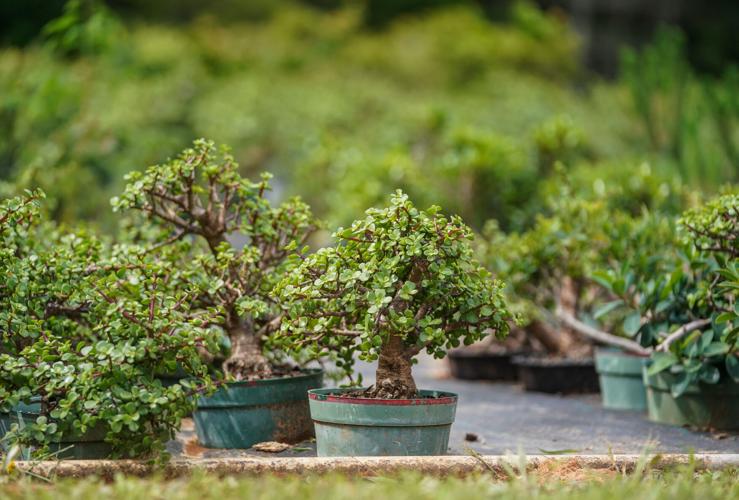
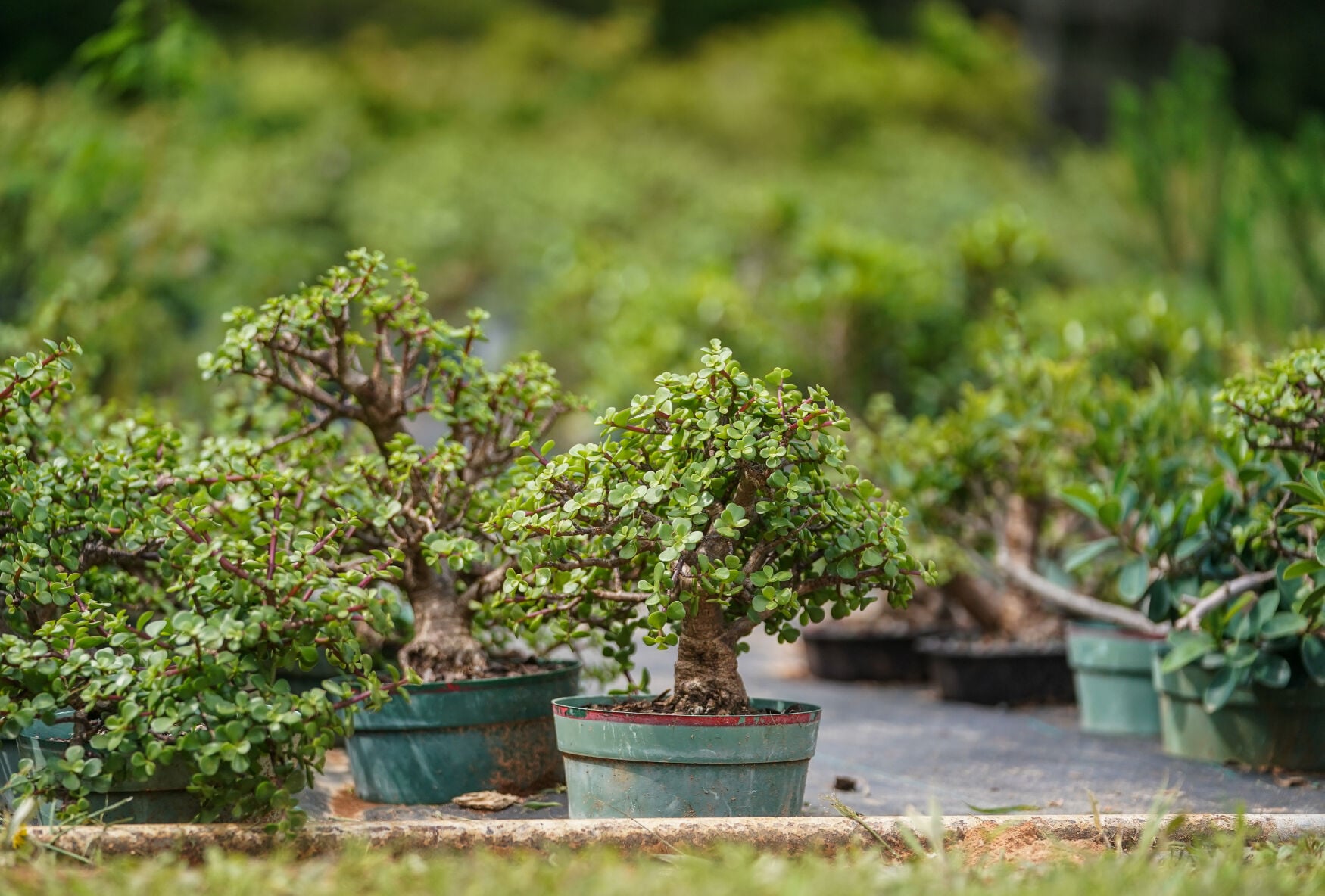
Winkler has a bulk of Jade bonsai, which he said are a customer favorite.
LISA PRICE / THE PAPER
In North Carolina, he’s branching out to new people through shows learning seminars, including the most recent “Bonsai in the Blue Ridge,” hosted by the American Bonsai Society. Next, he plans to attend Winter Silhouette in Kannapolis in December.
For those interested in learning more, Winkler encourages them to go to a Bonsai Society meeting, even if they don’t currently own a tree.
“You don’t have to have a tree,” he said. “That was me. I knew how to cut grass.”
Keep it Clean. Please avoid obscene, vulgar, lewd,
racist or sexually-oriented language. PLEASE TURN OFF YOUR CAPS LOCK. Don't Threaten. Threats of harming another
person will not be tolerated. Be Truthful. Don't knowingly lie about anyone
or anything. Be Nice. No racism, sexism or any sort of -ism
that is degrading to another person. Be Proactive. Use the 'Report' link on
each comment to let us know of abusive posts. Share with Us. We'd love to hear eyewitness
accounts, the history behind an article.

























(0) comments
Welcome to the discussion.
Log In
Keep it Clean. Please avoid obscene, vulgar, lewd, racist or sexually-oriented language.
PLEASE TURN OFF YOUR CAPS LOCK.
Don't Threaten. Threats of harming another person will not be tolerated.
Be Truthful. Don't knowingly lie about anyone or anything.
Be Nice. No racism, sexism or any sort of -ism that is degrading to another person.
Be Proactive. Use the 'Report' link on each comment to let us know of abusive posts.
Share with Us. We'd love to hear eyewitness accounts, the history behind an article.