

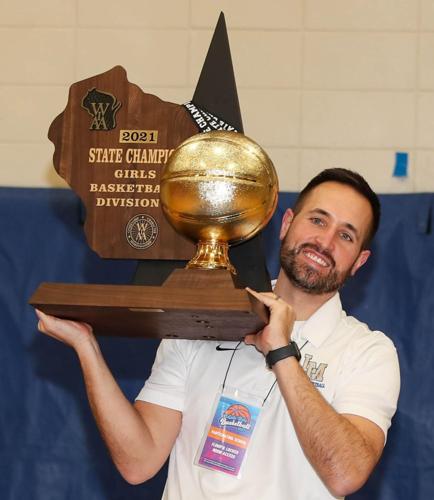

The win-loss record during basketball coach Brandon Siska’s time in Burke County was not indicative of what kind of coach he was or is.
Instead, Siska was laying the foundation for a still-fledgling Draughn High School boys program that would go on to enjoy its greatest level of success shortly after he returned home to the Midwest.
A 28-year-old Siska moved down to North Carolina to take the Wildcats’ job prior to the 2013-14 season, with Draughn coming off a 5-20 season, not having ever won an NCHSAA state playoff game, and with two of its three top scorers from the previous season headed out the door.
His first Draughn varsity roster featured more freshmen (four) than seniors (three), and to make things more challenging, the Wildcats were set for a four-year run in the rugged South Mountain 2A/3A Conference, of which Draughn was the smallest school by enrollment.
The SMAC was not only DHS’ first (and to date, only) venture into a league with 3A classification schools, it also featured schools like Crest and Kings Mountain that had about double DHS’ enrollment and established programs like Shelby and East Rutherford that had both won 2A state championships in the preceding five years.
Still, Siska guided the Wildcats to win improvements in each season, capped by a 14-12 campaign (9-7 SMAC) in 2016-17 that earned him SMAC coach of the year honors.
In his final game as coach at DHS, Siska’s Wildcats played eventual state champion North Surry to a single-digit game through three quarters, featuring a youthful roster that was primed for success.
But the Indiana native Siska left that summer to be closer to home, taking the Lake Mills High School girls basketball head coaching position in Wisconsin while his former Wildcats assistant coach, Yates Jensen, moved to the helm and reaped the success from what the Siska-led staff had sown in the years prior.
Under Jensen in the Northwestern Foothills 2A Conference, Draughn recorded its first 20-win season, won its first state playoff game, and claimed its first regular-season league title and first two league tournament crowns.
Don’t feel sorry for Siska, though. He took over a struggling Lake Mills program and within three seasons with the L-Cats, the program won a Wisconsin Interscholastic Athletic Association Division 3 regional title and made a state tournament appearance before that season was halted by the COVID-19 pandemic.
Siska after that winter was named girls high school basketball state coach of the year by four separate associations: the Wisconsin Basketball Coaches Association (WBCA), The Associated Press, the Wisconsin State Journal, and the National Federation of High Schools.
The following year, in 2020-21 with seniors who were starting as freshmen in Siska’s first season, Lake Mills won the program’s first state championship.
He stayed at Lake Mills one more season as the L-Cats won 20 or more games for a fourth straight year, then left to take over the Bryant & Stratton (Wisc.) College women’s hoops program, where his teams also enjoyed a great deal of success.
Bryant & Stratton won 29 games in his first season, finishing fifth nationally in the National Junior Collegiate Athletic Association Division II ranks, and followed with a 21-win season in 2023-24 that earned Siska the junior college women’s basketball coach of the year award from the WBCA.
After a 30-60 overall win-loss record in Valdese, Siska’s Lake Mills teams were 91-34 in five seasons, and his Bryant & Stratton squads are 63-31 through three seasons.
Earlier this week, Siska discussed various topics with The Paper. Here’s some of what he had to say:
Q: When and how did you get started in the sport of basketball?
Siska: “I grew up in northwest Indiana. People in North Carolina would argue that they’re the basketball state, but I think Indiana’s the basketball state. My youngest uncles were still playing basketball at my high school, and my dad has always done sports media stuff for high school football and basketball games on the radio and sometimes some baseball and softball. So I grew up in the gym, and when I was a kid, Indiana was still a single class.
“So we were always at sectionals, regionals, and state and would always be at packed gyms and got to see guys like Glenn Robinson, Carson Cunningham, Shawn Kemp, and Alan Henderson and some of those big names from the early 1990s. I got to see Bryce Drew play quite a few times in high school. So kind of grew up spoiled from that sense, seeing some really good basketball, and basketball has always kind of been in my blood.”
Q: How did you get into coaching, and what brought you to Burke County?
Siska: “I played basketball through high school and then actually played a year of football and a year of baseball in college. I had already started coaching basketball by helping with my sister’s AAU team when I was in high school. I also coached seventh-grade football, which is the spring time here, as well when I was still in high school. I actually thought I was going to be a head football coach.
“That’s kind of what I was working towards was coaching at the lower levels, had a lot of success with the lower grades and as a varsity assistant, and that led to me getting the Draughn job, where I started out helping with football and took the head boys (basketball) job down there.
“My wife and I now — when we were dating then — we wanted to try something different with some warmer weather, and her sister was finishing up her doctorate degree as a psychologist and ended up getting posted down there at a prison in North Carolina for work. So, I saw the job open at Draughn and applied and landed that.
“Being in my 20s, first head coaching job, moving halfway across the country, it brings a lot of challenges, but I also have a lot of great memories from my job down there.”
Q: Do you take pride in what those younger guys were able to accomplish in the years shortly after you had left?
Siska: “I did. I kept track of them there for a few years until Eli (Poteat) and Jaylen (Abee)’s group graduated, and I still hear from a lot of those guys. You know, you put the groundwork in — obviously it’s the kids in and staff as a whole that gets everything turned around. I think that was one of the hardest parts about leaving. I weathered the storm of the rebuild and didn’t really know what I was walking into schedule-wise, obviously murderer’s row and a brutal schedule, and you’re the smallest school on the floor every night, a school that had been struggling for a couple of years before I got there too, so it took some time.
“But after we had our first child, that 10-hour drive was getting to be a lot, so that was the big part of it was getting closer to family. It was really awesome to see what they did: first conference tournament championship, first conference championship, I think they broke the (program) wins record, first playoff win.
“All those guys I got to coach, and a lot of them started for me. A lot of coaches leave when the cupboard’s bare, and it was good timing from that standpoint that that thing was built up, and they were ready to make a run and were going to have at least two or three good years there after I had left.
“It was awesome to see Jaylen’s highlight at the conference tournament championship, where he had the game-winner (against Hibriten in 2019). I even had some of the parents reaching out, and I try to stay in touch with the kids as much as possible.
“I’m really happy for those kids that they were able to kind of bring a new standard to the program there, and Yates deserved a head coaching job. Part of when my decision was completely final was that it had been arranged, I’d talked to Yates, really wanted him to take the thing over and keep (assistant coach) Ethan (Hildebran) aboard. I wanted some consistency for the kids and not wholesale changes because I felt that the groundwork had been established and they were ready to take the next step.”

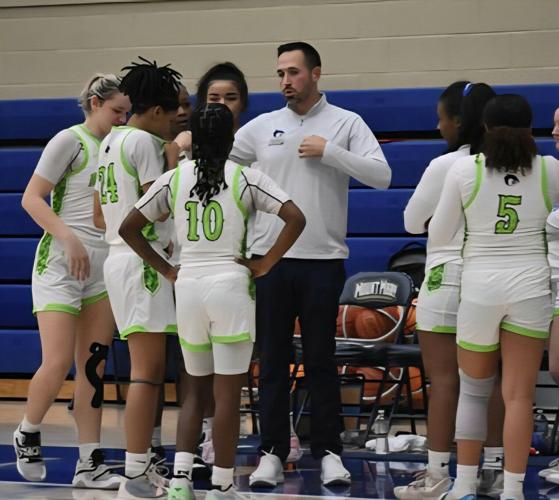
Head coach Brandon Siska (center) talks with members of his Bryant & Stratton College women’s team during a timeout. Siska led the junior college program to 50 total wins over his first two seasons there, including a fifth-place national finish during the 2022-23 season.
FOR THE PAPERQ: How do you reflect on your time at Draughn? Do you feel like you learned and grew as a coach there?
Siska: “Oh yeah, absolutely. The first year, especially, was really tough being an outsider, first head coaching job, we’re struggling, not winning games, But I did have a really good support system with some of the administration and teachers there, and the younger group of parents that were coming up I think saw what I was trying to build and believed in it. You need that. It takes a village to get a program going, and the changes were hard for the older group because they were used to playing.
“But we wanted the kids that were in the gym, putting the work in during the offseason, that were unselfish and wanted to be good, and who were more worried about the program and turning things around.
“As far as learning coaching stuff, I reached out to one or two coaches for successful programs every year at the end of the season and picked their brains, watched a lot of basketball, and then I learned from how I handled certain situations. I’m way more flexible (now) with what we’re going to do on offense and defense, and making sure we’re adjusting to the players.
“When you’re young, you think you know it all. And it’s funny, I’ve had a lot of success at this point, and I wouldn’t say less confident now, but I was super confident in my decisions in my 20s as opposed to now. I think you see the whole picture on things, and you grow and start to understand that you don’t know everything. I think that’s a big part of it.
“But the support system there, and just learning from their losses and trying to figure out how to improve as a coach … there’s a lot of lessons there that I learned that have led towards the success I’ve been fortunate to have.”
Q: Catch me up on the teams you have coached since leaving here?
Siska: “I spent five years at Lake Mills, and we still live here in Lake Mills. I took over a program that had never won a conference championship, had only won three regionals in program history. They had won two games a year before I got there and went winless in conference play, and we won a playoff game every year I was there. Started five freshmen pretty much that first year there, which obviously led to a lot of emails and complaints from parents, but we were trying to get the culture changed.
“We won four conference championships, three regionals, two sectionals, and one state title. The year we won state, we graduated 10 seniors. That following year, we had no seniors on the team and we still managed to win conference again, win a regional, and win 20 games.
“The reason I left there was it was an opportunity for a college job where we didn’t have to relocate. It was a new challenge. And then (Lake Mills) had basically our team back for two more years, and it had been very successful. So it was a really good situation for whatever coach was walking into a state-caliber team for a couple years. You want to leave the program in better shape than you found it, and I know I did that with both places that I was at.
“I’m very fortunate to have had a super supportive administration at Lake Mills, great parents, and really good kids that believed in what I was trying to do, and I was able to put together a really good staff as well. It’s not just one person, you need good assistants and really good kids.
“My first year there, we won 29 games, broke the (program) wins record, and went to the Elite 8. We won 21 games in year two. Last year was a bit of a struggle, but we’ve been very unfortunate with the amount of injuries that we’ve had.”
Q: How is coaching high school boys, high school girls, and now college women different, and how is it the same?
Siska: “All three are very different. Basketball is basketball from that standpoint as far as fundamentals and strategy, gameplay, practice all those things are very similar. At the college level, especially at the junior college, you’re having a lot of other stuff that you don’t deal with personality-wise at the high-school level. You’re typically having that challenge of conflicting personalities, and a lot of times when they’re at the junior college it’s somewhat because of not necessarily the talent level, but the attitude and effort stuff. I think at the junior college level, it takes a lot more coaching.
“And personalities are a lot different when it comes to boys and girls. Girls I think in general are tough, but they’re pleasers, so they want to listen to you. On the boys side, you’re having a little more with the egos, trying to manage that, but a lot of times the boys will run through a wall for you. So they all bring their different positives and challenges, and I have enjoyed all of it.”
Q: How has living closer to home been a positive experience for you and your family?
Siska: “Me and my wife of 10 years, Bridget, have two children, a son Brady, who is 8, and our daughter Lyla, who’s 6. I’m helping coach all their teams. I get asked to be the head coach for all of it when I tell them I do that for a living. So I’ll help out and show up and assist, but we’ll let somebody else run the show for now.
“My parents and my brother and sister are still in northwest Indiana, so it’s a little under a three-hour drive. I’m able to get home on weekends, and my parents come up quite a bit when my wife’s schedule and my schedule conflict just to help babysit and take care of the dog. So I get to see them way more frequently than when we were down in North Carolina. I have some family up north on a lake that I get to see quite a bit too. It’s a great location, we live in a really good town. I can get to Madison in just under 40 minutes, and we can get to Milwaukee in just under an hour, and we’re about two hours from Chicago.”
NOTE: Excerpts of this Q&A were edited for brevity and clarity.














(0) comments
Welcome to the discussion.
Log In
Keep it Clean. Please avoid obscene, vulgar, lewd, racist or sexually-oriented language.
PLEASE TURN OFF YOUR CAPS LOCK.
Don't Threaten. Threats of harming another person will not be tolerated.
Be Truthful. Don't knowingly lie about anyone or anything.
Be Nice. No racism, sexism or any sort of -ism that is degrading to another person.
Be Proactive. Use the 'Report' link on each comment to let us know of abusive posts.
Share with Us. We'd love to hear eyewitness accounts, the history behind an article.