


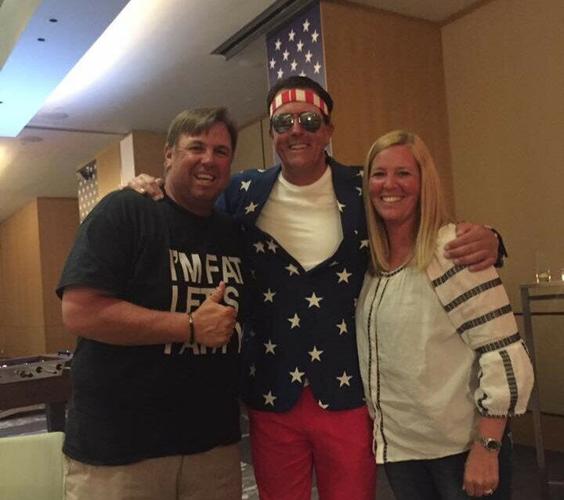

Duane Bock started the sport of golf at age 4.
In the 49 years since, there’s not much associated with the sport that he hasn’t done.
From a humble beginning in the sport, he played in high school nationals as a senior, played and coached collegiate golf, became a top-10 ranked amateur golfer, played professionally for 12 seasons, and was a putter rep of the PGA Tour before he switched to caddying full-time.
He’s the current caddie for PGA Tour pro Kevin Kisner, a role he’s held for 14 years.
Bock said he was recently told that duration of time made he and Kisner the longest-tenured caddie-player duo currently on the PGA Tour, surpassing Jim Furyk and Mike “Fluff” Cowan, who are at 20-plus years but onto the PGA Tour Champions now, and Kevin Na and Kenny Harms, who had one year on “Team Kiz” but now play with LIV Golf.
Bock had already caddied for five pros when he met Kisner in 2007 as the two played a practice round before a U.S. Open qualifier.
In 2009, after Kisner was through two of three rounds of the PGA Tour Qualifying Tournament, also known as “Q-School,” Bock came on the bag to stay.
In the time since, Kisner has had his PGA Tour card all but two years; won seven times, including four PGA Tour wins among 18 career top-three finishes and 46 career top-10s; reached as high as No. 14 in the Official World Golf Rankings; held the lead after rounds at majors six times including a career-best tie for second place at the 2018 Open Championship at Carnoustie; played on two winning U.S. teams in the Presidents Cup; and shot a career-best round of 60 at the Sony Open in Hawaii in January 2017.
How has it all worked out so well for so long Kisner and Bock?
“Kevin’s 39 and I’m 53,” Bock said. “I’m not quite old enough to be his dad, but I’m not quite young enough to be one of his boys. I’m sort of stuck in the middle. So I think with me being a family man there are certain situations where he can look up to me, maybe as a father figure if he has questions as he starts with a young family.
“At the same time, we can have fun together celebrating something or going on a golf trip or hunting trip together. I’m still young enough to be able to hang with him when it’s time to do that on the social side of things, so that’s a pretty cool balance.”
It’s said that opposites attract, and Bock believes that’s another key to his and Kisner’s lasting bond.
“If things aren’t going well, he tends to rev up and want to do things faster whereas I want to do things a little bit slower, more methodical, get that process the same,” Bock said. “When we’re in stressful situations and have to get things done, those two mirror up and we complement each other. I think that has a lot to do with why we’ve been together so long.
“He may get irritated because I’m not throwing that information out there fast enough for him sometimes, but there’s a purpose behind that … and he understands that.”
Any relationship can have those irritations. It’s how they’re dealt with that matters. And Bock sees he and Kisner’s “freedom to criticize each other without taking it personal” as another key to their success.
“I feel like I can handle whatever it is,” Bock said. “If it’s me (who’s made a mistake), I’m not afraid to say, ‘Sorry, I will do better.’ … You see it with a quarterback yelling at a wide receiver for running the wrong route. It’s nothing personal, it’s just sports. We’re trying to get the best out of each other.
“I love what I do, and I think he sees and understands that passion. I know he’s trying to play the best golf he can for me and my family. And he honestly knows that I’m doing the best that I can so that he can provide for his family as well. There’s a lot of mutual respect in that.”
Bock’s on-course roles
So aside from the roles of part-psychologist, part-friend, part-coach, and part-teammate, what else does a caddie do other than carry the bag and give the pro the yardages?
It’s a bit different in each case based on what the player needs.
“The way I look at it is a caddie’s job is to help your player think his way around the course by providing him information,” Bock said. “My job when I get to a tournament, especially if it’s a golf course we don’t know, is to gather as much information as I can about the course that’s going to be beneficial to Kevin.
“That way, whatever situation you’re in, you’re relaxed. We get into a position to try to win a golf tournament, we’re ready to go and handle it from there.”
That information-gathering process starts with Bock knowing fairway width at the preferred landing spot based on often-time multiple tee locations that will be used during a tournament.
“When I’m a tee box, I always want to find the center of the fairway at 290 yards because I know that’s basically where he’s going to hit it, and then he works off the center of the fairway,” Bock said.
During practice rounds, Bock surveys the areas around the greens probably more than he does the greens themselves. Bock describes Kisner as “one of the best putters in the world,” and as such, Kisner generally reads putts himself.
“Once I get around the green, we’ll try to figure out where we think the four pin placements will be for the week,” Bock said. “And then we will figure out if a pin is in a certain quadrant of the green, where do we want to leave (the approach shot) to have the best opportunity for par or birdie. Then I’m also figuring out if we’re out of position of the tee, where not to hit it.
“I do pay attention a lot to the firmness of the greens though, how much a ball is releasing after it lands. Is it going forward, is it spinning back, how much of either one it’s actually doing.”
The match-play master
Of Kisner’s PGA Tour wins, the one that stands out most was the WGC Match Play in 2019. He has excelled in that event in other years as well, reaching the championship match in the 64-man field in 2018 and 2022 as well.
And in his first Presidents Cup appearance, Kisner was 2-0-2.
What is it about match play that often brings out Kisner’s best?
“Kevin’s a very good situational golfer,” Bock said. “He likes to know exactly where he stands when he’s playing. Hell yeah, he’s looking at the leaderboard. He wants to know what he has to do. And in match play, he knows exactly what he has to do.”
Bock continued: “On the PGA Tour, he could be playing well, be 2-under, 3-under through nine holes on a Thursday, and he looks up there at the leaderboard and somebody in the morning has already shot 9-under. I believe in my mind, we haven’t talked about it, but I think he looks up and goes you know, wow, I’m six back. Well we’re OK. We’ve only played nine holes, plenty of golf left for the week. But I’m sure it can be frustrating because he wants to get in the lead, he wants to go.
“Match play affords him the opportunity to do that. As soon as we tee off, he knows exactly where his opponent is, exactly where he is. He can decide how aggressive he wants to be based on the situation on every hole.”
Kisner is also a bulldog, and not just in the sense that the Aiken, S.C., native played at the University of Georgia, where he was part of the men’s golf program’s 2005 NCAA title.
“He’s all of 5-9, 5-10, about 155, 160 pounds or whatever, but the mentality is ‘I’m going to find any way I can to beat you,’” Bock said. “He’s also the type when he has somebody down, he wants to step on their throat. If he’s four or five up, he wants to get six up.
“He’s always had to prove himself along the way. In junior golf, he was competing against Dustin Johnson. He was always trying to beat the giant. In college, he was always fighting his way to get on that team. He’s never been given things. … He’s taken down some big names in that match play, and he’s never intimidated. He wants to play against the very best.”
And the feeling of always being in contention for the title in match play adds an element that a stroke-play tournament often doesn’t afford.
“You can see it in his eyes. You can sense it, that focus that he has,” Bock said. “He loses some of that some weeks when the opportunity to win has gone by the wayside. He’s not interested in (just) making cuts. He wants to win golf tournaments. And when he gets in that setting, you can see that focus narrow and there’s no backing down.”
It’s certainly been a stellar match-play career, though it has one omission Kisner would still like to fill: Kisner has not played in a Ryder Cup.
Bock said he and Kisner sit down and listen to each other at the end of each year to figure out how they can improve, and in their 2017 session after the duo’s first Presidents Cup, Kisner said his goal was to make a U.S. squad for an international event every year.
It would almost certainly hold special meaning for Bock as well, who made the tough decision to go pro and turn down a likely spot on the U.S. Walker Cup squad some 30 years ago.
“It’s an experience you don’t get any other time of the year,” Bock said of being on a U.S. squad. “You get 12 guys together plus all the caddies, the captains, vice captains. You’ve got around 30 guys working for one goal, and you’re working out together, eating together, practicing together.
“The last couple times, it’s been disappointing. He’s had to rely on (Ryder Cup captain’s) picks, felt like he would be one of the better picks to be on one of those teams. But that turns into, we’ve got to earn our way on. It’s a goal of his and something that he really wants to do.”
Speed golf, beer, calves
Kisner’s preferred pace of play won out over Bock’s in the final round of the 2021 Open Championship at Royal St. George’s. Playing by himself in the first group out, Kisner shot a 2-under round of 68 in 2 hours, 31 minutes.
Bock said on four or five holes, Kisner walked back from a green to the next tee by himself with driver in hand and Bock met him on the fairway.
“Because we’ve been there all week, he knows where he has to hit it,” Bock said. “It’s links style, so the wind’s not swirling around the trees, he knows which direction it’s coming from. (In the fairway) I already had him the yardage, the target, he’d pick the club, go through his routine and hit the shot.
“But he never rushed. He never hit a shot without discussing it. … And he had one of the lowest rounds that day if I remember correctly.”
Of course, there’s a back story, even for a fast golfer like Kisner.
“We showed up in the morning, and he told me he had a flight out of London at like 2:30,” Bock said. “And London was 2½, 3 hours away, so we need to get this done. Now I’m not the fastest walker in the world. I don’t think the bag came off my back the entire round.”
Bock’s self-described lack of speed must be a result of age, not diminished leg strength. His super-size calf muscles once spawned their own Twitter account. He still isn’t sure who started the spoof account, which has quieted down in recent years after having been a hot topic on several golf podcasts.
“It’s genetics though, believe me, not because I get up every morning at 4 a.m. and work out my calves,” Bock said.
But Bock was also nearly an Olympic athlete … sort of.
“When golf became an Olympic sport, Kevin based on world ranking had a shot to make the team,” Bock said. “They sent out a bunch of information to me that I had to fill out and send back in because caddies are also considered Olympic athletes. So I’m filling it out and told my wife, ‘I bet you never knew you had married a potential Olympic athlete, did you?’
“This career has produced a lot of things. Men’s Health did a thing about my calves. I was almost in the Olympics twice. And now I’m part of one of the fastest rounds of golf in major history. That’s quite an accomplishment for a 300-pound nobody.”
Kisner, meanwhile, via social media has developed a bit of a “people’s champ” reputation. It was once said that if beer and music were involved, Kisner would never lose.
Kisner once was scolded by his club back home for racing golf carts and banging them into each other a bit, Bock said.
“He’s the average, fun-loving guy when he’s home on an off week. People think he just drinks beer and plays golf,” Bock said. “But he’s one of the hardest workers if not the hardest worker out there with the time that he puts in. He takes his fitness, his nutrition, his golf game, he takes everything so seriously when he’s preparing for a tournament whether he’s at home or on the road.”
PGA vs. LIV
During Kisner’s first decade on the PGA Tour, things were relatively quiet. At least compared to what’s taken place in professional golf over the last 12 months, when the controversial, Saudi-funded LIV Golf tour has taken away several of the PGA’s top names.
Bock doesn’t see LIV as a total negative when it comes to how it has and will continue to affect the PGA Tour though.
“I think in a way it’s bad for the sport,” he said. “The bottom line, the golf fan wants to see the best players in the world playing against each other at the same time, and you know that’s going to happen at the majors. But you would hope that it’s going to happen more than just four times a year.
He said while he feels the tours will never work together, due if nothing else to their very different tournament setups, LIV may push the PGA toward some improvements.
“I think competition is good,” Bock said. “The PGA Tour, as a kid growing up playing golf, is really the ultimate goal. And I do think the younger kids coming up still want to play on the PGA Tour. I may be wrong, we’ll see in a year or two.
“You see in just about every other sport, guys are getting guaranteed money. In baseball, a pitcher’s contract says he makes $20 million, he has a bad year, he still makes $20 million. On the PGA Tour, you’ve got a guy who plays outstanding and makes $5-7 million a year doing that. So I think it’s opened up the door for the PGA Tour to bring purse money up and take care of their top players better.”
Still, aspects of LIV will never match what the PGA represents, at least to Bock. The traditions like late-afternoon Sunday leaders’ starts while they try to figure out how to spend the first part of their day, the low scores from guys out earlier playing catch-up, the changing greens later in day, the wind that is more common later in the day that makes scoring harder …. those all disappear with shotgun starts in LIV’s 54-hole tournament setup that also involves a team aspect.
Bock said he “loves LIV,” but called it an “exhibition tour for lack of a better term”.
“These guys like Phil Mickelson, Ian Poulter, Lee Westwood, they have proven themselves. They’re world-class players. But it’s basically a Champions Tour, except rather than starting at age 50, they’re starting at 40 or at 35.”
It’s a fickle game
Kisner in the 2021-22 season posted five top 10s, including at the Sentry Tournament of Champions and The Players Championship, an event he lost in a four-hole playoff with Rickie Fowler (and for the first three holes, Sergio Garcia) in 2015.
Then at the RSM Classic in November 2022 – the site of his first PGA Tour win in 2015 – and the AT&T Pebble Beach Pro-Am in February 2023, he ended with three straight rounds in the 60s, finishing tied for 29th and 34th.
But he hasn’t broken 70 in 15 competitive rounds since then, has missed cuts in five of 11 events this season and withdrew from the RBC Heritage last month after one round.
He’s currently 188th in the PGA Tour FedEx Cup rankings; only the top 125 golfers are assured of 2023-24 PGA Tour cards as full-time members.
Kisner told reporters at this year’s Masters that he’s struggling with his driver and has been for a year. When asked how he could fix it, Kisner didn’t sound sure.
"Man, I go hit 8,000 drivers after this round and stripe every one of them and then push cut it in the right bunker on 1 and get pissed off for the rest of the day,” he said. “That's pretty much how it goes."
He will look to turn his season around next week at the PGA Championship at Oak Hill Country Club is Rochester, N.Y.
EDITOR’S NOTE: See next week’s edition of The Paper for more of this story.





















(0) comments
Welcome to the discussion.
Log In
Keep it Clean. Please avoid obscene, vulgar, lewd, racist or sexually-oriented language.
PLEASE TURN OFF YOUR CAPS LOCK.
Don't Threaten. Threats of harming another person will not be tolerated.
Be Truthful. Don't knowingly lie about anyone or anything.
Be Nice. No racism, sexism or any sort of -ism that is degrading to another person.
Be Proactive. Use the 'Report' link on each comment to let us know of abusive posts.
Share with Us. We'd love to hear eyewitness accounts, the history behind an article.