

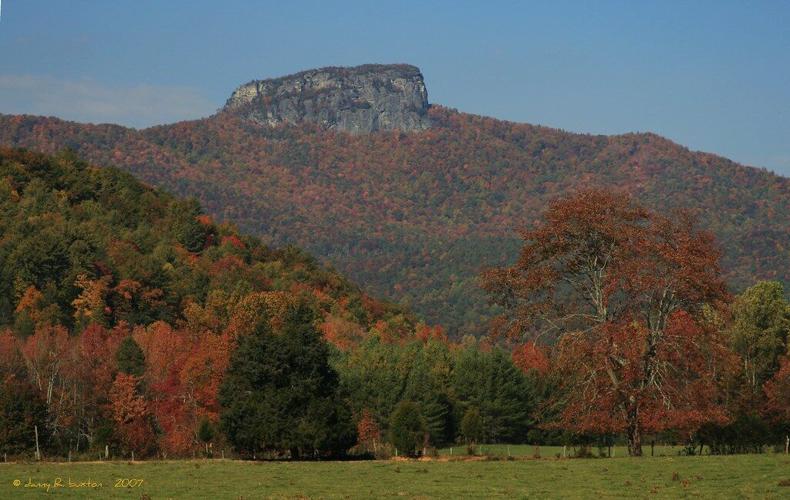

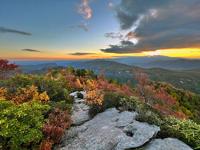

If you’ve ever watched the last streaks of sunlight fade behind Table Rock Mountain, you’ve seen the same view that once inspired one of the world’s great storytellers.
In 1904, French novelist Jules Verne — author of “20,000 Leagues Under the Sea,” “Around the World in 80 Days,” and “Journey to the Center of the Earth” — set part of his final adventure, “Master of the World,” right here in the Blue Ridge Mountains above Morganton.
In the opening pages, Verne describes a great, flat-topped mountain “distinctly seen from the little town of Morganton on the Catawba River.” He calls it the Great Eyrie — a mysterious peak said to rumble and glow with strange lights at night.
From the valley below, townspeople whisper about earthquakes, volcanoes, and worse. Readers familiar with this part of North Carolina don’t need to guess long which mountain he meant. There’s only one that fits so perfectly: Table Rock.
Before Grandfather Mountain, Mount Mitchell, or the Smokies were widely celebrated, Table Rock itself was once considered the most famous mountain in all of North Carolina.
Nineteenth-century travel writers compared its massive cliffs to a fortress and even called it “the Gibraltar of America.” That reputation — of a mountain set apart, impossible to ignore — made it a natural fit for Verne’s imagination.
Jules Verne never visited North Carolina, yet he managed to capture its tone and terrain with uncanny precision.
He names Morganton outright, sends his fictional investigator, John Strock, along the Catawba River toward the nearby village of Pleasant Garden, and sets the entire mystery against a backdrop of forested ridges and narrow mountain roads.
In Verne’s story, reports of explosions and flashes from the Great Eyrie reach Washington, D.C., prompting Strock to travel south and determine whether the commotion is natural or man-made.
His journey takes him through our region in what feels like an early blend of mystery, science fiction, and Southern Gothic.
What he finds in the mountains — a secret inventor named Robur hiding in a fortress built into the cliffs — becomes one of the author’s most haunting finales.
The fact that Verne could so vividly imagine a place he’d never seen says something about how alive this landscape must have sounded to him.
He wrote “Master of the World” near the end of his life, when he was turning from pure adventure toward something more introspective. The Blue Ridge became, in a sense, his symbol for the border between the known and the unknown.
Anyone who’s looked northwest from Morganton has seen Table Rock — that dramatic granite bluff standing like a fortress above Linville Gorge.
Its steep sides, flat crown, and wild surroundings make it easy to believe Verne’s imagination might have settled here.
Even the name — “The Great Eyrie” — fits the mountain’s appearance. An “eyrie” is an eagle’s nest built high on an inaccessible ledge, and Table Rock certainly looks the part.
What makes the mountain even more remarkable is the land it rises from. Linville Gorge, carved by the Linville River, is one of the oldest and deepest river gorges on the East Coast, shaped over millions of years.
The dramatic scale of the gorge — and the way Table Rock stands as its crown — has inspired writers, explorers, and painters since long before Verne put pen to paper.
Table Rock has also served as a landmark during moments of real history. During the Civil War, Union officers navigating the rugged landscape described Table Rock in their journals as the “sentinel peak,” using its unmistakable profile as a guide when maps were unreliable or nonexistent.
Local folklore has long wrapped Table Rock in mystery. There are stories of fires seen flickering on its summit, of distant rumblings echoing through the gorge, and of the mountain once believed to be a volcano.
Verne may never have heard those exact tales, but his story feels as though it was written to explain them. Modern history added its own chapter in 2013, when the Table Rock wildfire lit up the cliffs so dramatically that the flames were visible as far away as Hickory — an eerie, real-world echo of Verne’s imagined mountain glowing in the night.
The mountain’s wild character is not just visual. Table Rock is home to two of the rarest plants in the southern Appalachians: the Heller’s Blazing Star and the Mountain Golden Heather.
Both survive only on a scattered handful of windswept, quartzite ledges in this part of North Carolina, with Table Rock among their most important refuges.
For botanists, these tiny, cliff-dwelling species make the mountain not only a scenic landmark, but a sanctuary for life found nowhere else on Earth.
Table Rock’s pull on the imagination isn’t limited to Verne. Generations of hikers, writers, and artists have found inspiration there.
Former U.S. Sen. and Morganton native Sam Ervin once said he chose to retire in Morganton so he could “watch the sunsets over Table Rock.”
Local painters have filled galleries with its likeness. On clear days, the view of the mountain from town feels less like scenery and more like a living landmark — a reminder that nature here has personality and history.
It’s not hard to picture Verne’s story playing out in that setting: night falling over the gorge, a sudden flash of light on the summit, and whispers running through Morganton that something extraordinary was happening in the hills.
The idea that our quiet valley could serve as the starting point for one of Verne’s great adventures adds an unexpected sparkle to the local skyline.
“Master of the World” may not be as famous as “20,000 Leagues” or “Around the World in 80 Days,” but it gave Morganton a rare distinction.
Few American towns appear by name in Verne’s fiction, and fewer still are described with such care. His portrayal of our community — tucked beside a river, watched over by a flat-topped mountain — turned a real place into a piece of literary legend.
Today, hikers and climbers who make the trek to Table Rock’s summit can stand where imagination meets geology. From that perch, the gorge drops away in all directions, eagles circle on rising air, and the Catawba Valley lies stretched out below.
Looking across that endless view, it’s easy to see what Verne must have sensed from his desk an ocean away: Some landscapes don’t just invite stories — they create them.


















(0) comments
Welcome to the discussion.
Log In
Keep it Clean. Please avoid obscene, vulgar, lewd, racist or sexually-oriented language.
PLEASE TURN OFF YOUR CAPS LOCK.
Don't Threaten. Threats of harming another person will not be tolerated.
Be Truthful. Don't knowingly lie about anyone or anything.
Be Nice. No racism, sexism or any sort of -ism that is degrading to another person.
Be Proactive. Use the 'Report' link on each comment to let us know of abusive posts.
Share with Us. We'd love to hear eyewitness accounts, the history behind an article.