



A recent weekend trip found me visiting my brother, a police officer for the town of Mt. Pleasant, S.C.
Nearby Charleston, affords two young men ample opportunity for some mischief — exploring historic sites like Fort Sumter, devouring piles of steamed oysters, and wandering the night life of King Street.
Instead, our day resembled something from a Hallmark movie starting with coffee at Bitty & Beaus, then browsing the historic open-air market. It ended at the Charleston battery, flanked by centuries’ old homes as crisp air blew through the Spanish moss dangling above narrow, cobblestone streets. In my brother’s words, “Nathanael, this has been great, but I wish I’d brought a girl.”
Unexpectedly, the most impactful part of my trip was when we accidentally stumbled upon the Gibbes Museum of Art. The museum’s main exhibit is currently a showcase of generative NFT art from creator Beeple.
NFTs, or Non-Fungible Tokens, are digital assets stored on a blockchain. Unlike a traditional digital image, which can be copied infinitely, NFTs are coded with unique identifiers, making them rare and verifiable — like a digital certificate of authenticity. The value of an NFT lies in its scarcity and ownership, much like a signed Van Gogh or vintage baseball cards.
Generative art, on the other hand, is created when the artist uses algorithms, artificial intelligence, or interactive programming in their creative process. Some pieces evolve over time or change based on external factors, making them living works of art rather than static images.
Charleston happens to be home to one of the biggest names in the NFT world: Mike Winklemann, better known as Beeple. Originally a graphic designer, Beeple gained worldwide attention with his project “Everydays,” where like the name suggests, he created a piece of digital art once a day for over 13 years.
The project culminated in the piece Everydays: The First 500 Days, a collage of his daily work that sold at auction for almost $70 million and skyrocketed Beeple to the forefront of the NFT art movement.
NFTs have sparked heated debate over art ownership and value, but generative art takes the conversation even further. What I saw at the Gibbes Museum was more than just static art; it was a glimpse into a future where art is interactive, fluid, and ever-evolving.
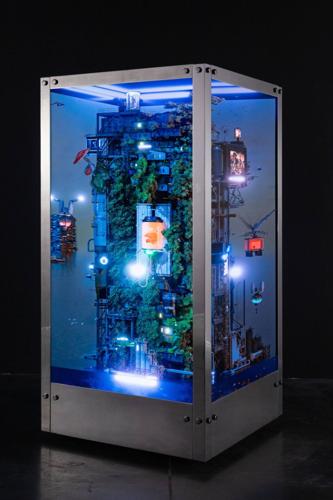
Walking into the museum’s main exhibition space, I imagined the walls lined with pieces from Beeple’s portfolio. Instead, the three exhibition halls each housed one polished aluminum kinetic sculpture with four video screens.
These screens projected the sci-fi dystopian landscapes and surreal, humor-filled generative imagery Beeple is known for.
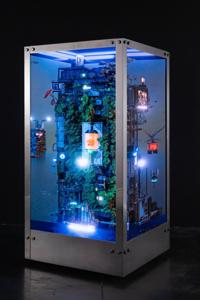
One of the pieces I really enjoyed was Beeple’s S.2122 which brings the viewer to a world of a hyper advanced society grappling with the consequences of climate change complete with hovering drones and floating mushrooms.
The piece is uniquely programmed so that the water level will rise slightly every five years, permanently altering its appearance. Eventually the piece’s central skyscraper will be fully submerged, yet its inhabitants will continue to live and adapt.
The concept of artwork that responds to the passage of time fills me with an eerie sense of realism. It made me think about how our world, like the digital one, is in a constant state of flux.
As we continue to confront the effects of human progress throughout my lifetime, landscapes, like the Outer Banks, will physically change or disappear.
The central piece of the exhibition was Beeple’s Tree of Knowledge. Because of the piece’s generative nature, it is able to change in ways that even Beeple cannot predict. The interactive piece pulls in news headlines and data from the ever-changing daily news cycle to reflect the noise and unpredictability of the world we live in.
Viewers are invited to engage with two distinct realities: “Signal” a serene, peaceful digital Garden of Eden or the overstimulation of “Noise.” In the latter, at the turn of a dial, the piece transforms from pastoral to frenetic with ever changing live news feeds, social media posts, and stock market fixtures flashing on four screens accompanied by blaring electro punk music and strobe lights.
The piece posed a powerful question to me: which reality will you choose to live in? No one forced me to amplify the noise — it was entirely my choice. It was a hard truth I needed to ponder. I can choose to live in the noise of my day to day, or I can put my phone down and reconnect with nature and the people that matter to me.
The Tree of Knowledge also offers a third darker choice: chaos. A limited number of viewers — exactly 666 — are granted the opportunity to permanently transform the piece at a push of a button.
With some persuasion on my part, my brother became one of the few to engage this reality. I watched as he turned a key, flipped the safety switch, and pressed a button titled “choose violence.” In that moment, we resembled missile operators preparing to unleash devastation.
The screens erupted into dystopian imagery, a chaotic vision of our collective choices leading the world to ruin. As I watched, I realized that we are all capable of destruction. At any point, my brother, or I could have stopped. And yet we didn’t.
NFTs and generative art raise important cultural questions. Is art still art if it exists only on a screen? Does blockchain ownership make an artwork more valuable or just more exclusive? And if an artist creates something that changes forever, can they ever truly claim ownership of their work?
Some critics argue that NFTs are a speculative bubble, turning art into digital stock. Others see them as a revolution, democratizing art ownership and providing new avenues for creators. To me, it doesn’t matter. Whether it’s oil on canvas or pixels on a screen, art at its best challenges, provokes, and inspires.
For the rest of that evening, I wasn’t thinking about work, tweets, or headlines. I was laughing, laughing at old childhood stories, college escapades, recent bad dates, and our unfortunate luck due to the temporary closing of the Charleston battery for repairs.
For that evening the noise didn’t matter.
















(0) comments
Welcome to the discussion.
Log In
Keep it Clean. Please avoid obscene, vulgar, lewd, racist or sexually-oriented language.
PLEASE TURN OFF YOUR CAPS LOCK.
Don't Threaten. Threats of harming another person will not be tolerated.
Be Truthful. Don't knowingly lie about anyone or anything.
Be Nice. No racism, sexism or any sort of -ism that is degrading to another person.
Be Proactive. Use the 'Report' link on each comment to let us know of abusive posts.
Share with Us. We'd love to hear eyewitness accounts, the history behind an article.