




Every community has its legends.
In the mountains, you have the Brown Mountain Lights and Bigfoot, among others.
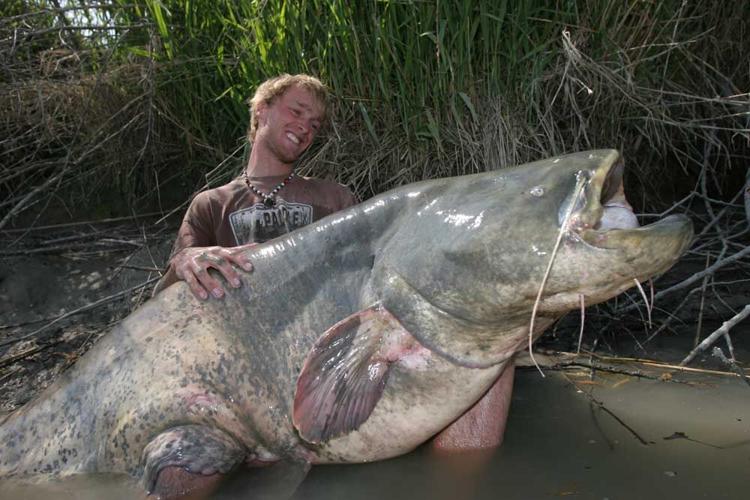
Here in the Foothills, one of the most enduring is the legend that somewhere in the deep waters of Lake James lives a catfish of unbelievable size. Whether it’s fact, folklore, or a little of both depends on who you ask.
If you grew up anywhere around Morganton, Glen Alpine, Marion or Nebo, you’ve probably heard the tales.
“They’re as big as Volkswagens.”
“I saw one from the dam.”
“The divers won’t go down there anymore.”
“My uncle saw a skeleton in the spillway.”
I’ve been hearing these stories for as long as I can remember. The interesting thing is that they almost never come from someone claiming to have caught one.
Instead, they usually begin with, “A friend of mine ...” or “A Duke Power worker told me ...” or “Someone swimming around the dam ...”
Like all good folklore, the details change, but the ending is always the same: there are giant catfish in Lake James.
The funny thing is, there really are some very large catfish in the lake. Back in 2010, McDowell County angler Ervin Smith landed what was then one of the largest fish ever documented from Lake James — a blue catfish weighing nearly 75 pounds and measuring almost four feet long.
It narrowly missed the North Carolina state record, but it proved that truly impressive fish live in these waters.
Blue catfish are capable of growing well beyond four feet in length and can exceed 100 pounds under the right conditions. So, if 70-pound fish exist, what happens after another twenty or thirty years in deep water?
Lake James certainly offers plenty of places for fish to disappear. Created in the early 1900s as Duke Power’s first Catawba River reservoir, the lake stretches across nearly 7,000 acres and reaches depths of around 120 feet near the dam.
Between submerged timber, rocky ledges, old river channels and deep water, it’s easy to imagine a fish living a long, quiet life where very few people ever see it.
If there were ever a place for an old catfish to grow enormous, Lake James would seem to qualify.
Of course, the fish aren’t the only things hidden beneath Lake James. Long before the reservoir was created, this valley was home to farms, roads, bridges and small communities that disappeared beneath the rising water.
The old landscape still rests on the lake bottom, preserved beneath the surface. Perhaps that’s another reason these stories have endured.
A lake with a hidden past seems like the perfect place for people to imagine hidden giants.
Then there are the divers’ stories. I’ve heard them my entire life. Some claim Duke Power divers encountered fish so large they refused to return.
Others insist enormous catfish skeletons have occasionally been seen in the spillways after periods of high water.
Unfortunately, I’ve never met anyone who could produce a photograph, nor have I ever found an official report documenting such discoveries.
Still, I’ve spoken with enough otherwise reasonable people who repeat these stories that it’s difficult to dismiss them entirely.
Whether they’re describing an actual fish, an exaggerated memory, or simply passing along a story told by someone before them, the legend refuses to die. That’s often how folklore works.
Interestingly, Lake James isn’t unique. Nearly every large lake in the South seems to have its own version of this tale.
Some lakes supposedly hide catfish the size of pickup trucks. Others claim Volkswagens. A few even graduate to school buses. The details vary, but the fish always gets bigger, and somehow everyone knows somebody who saw it.
I’ve often wondered whether these stories grow the same way fish stories always have. Perhaps one person really did see an exceptionally large catfish. They told their friends.
Those friends retold the story, adding just a little to it. Over decades, a fish that may have weighed 80 or 90 pounds slowly became something far larger than life.
Or maybe … just maybe … there really is an old blue catfish somewhere in the depths of Lake James that has simply managed to avoid every hook ever cast.
Personally, I kind of hope the answer remains somewhere between fact and folklore. Not because I necessarily believe there’s a catfish the size of a Volkswagen hiding beneath the surface, but because every community deserves a good mystery.
Stories like these become part of the places we call home, passed from one generation to the next around bait shops, campfires, and kitchen tables.
After all, if someone actually hauled a 300-pound catfish out of Lake James tomorrow, we’d lose one of Burke County’s greatest legends.
Until then, every ripple near the dam, every shadow slipping into deep water, and every fisherman who quietly says, “You should’ve seen the one that got away,” helps keep the story alive.
I hope it stays that way.
























(0) comments
Welcome to the discussion.
Log In
Keep it Clean. Please avoid obscene, vulgar, lewd, racist or sexually-oriented language.
PLEASE TURN OFF YOUR CAPS LOCK.
Don't Threaten. Threats of harming another person will not be tolerated.
Be Truthful. Don't knowingly lie about anyone or anything.
Be Nice. No racism, sexism or any sort of -ism that is degrading to another person.
Be Proactive. Use the 'Report' link on each comment to let us know of abusive posts.
Share with Us. We'd love to hear eyewitness accounts, the history behind an article.