




A house bill passed last year is temporarily blocking Charlotte Water’s request to double its withdrawal from the Catawba River, but regional leaders say the underlying fight over interbasin transfers is far from over.
On Monday evening Anthony Starr, executive director for the Western Piedmont Council of Governments, asked the Morganton City Council to engage with the district state legislators and educate the community, while an interbasin transfer study is ongoing at the state level. Starr has been leading the coalition of local governments that are against Charlotte’s request.
“The next 50 years of growth in our region will be determined by this issue,” Starr said.
House Bill 850, sponsored by Hugh Blackwell and other area representatives and signed in July 2025, placed a moratorium on large interbasin transfers exceeding 15 million gallons per day until March 2027. The bill also directed the North Carolina Collaboratory at UNC Chapel Hill to study the statutory process for the approval of surface water transfers, and provide recommendations to the North Carolina General Assembly in 2027.
Starr said the coalition requested two policy options to be considered in the study. The first would be a “shot clock” for large interbasin transfers, where the initiator has a 15-20-year period to build the infrastructure necessary to eliminate an IBT or avoid it.
The second recommendation, Starr said, is that a portion of the project’s income be set aside in a drought mitigation fund for affected communities if an IBT is approved in the basin. Those funds could be used to lower water system intakes or create interconnections between utilities, allowing systems to operate during drought emergencies.
BACKGROUND ON THE ISSUE
Charlotte’s goal is to take 30 million gallons per day more than it already receives through its 2002 interbasin transfer agreement (IBT), according to Starr. That would bring the total water taken from the Catawba River Basin to 63 MGD if approved by the North Carolina Environmental Management Commission.
After treatment, the water that Charlotte uses would be discharged into the Rocky River/Yadkin basin. Multiple local governments throughout Burke, Alexander, Caldwell, Catawba, and McDowell counties have joined in coalition to oppose the request. Their concerns are that the transfer could have serious impacts during drought periods and could hinder growth.
Star said the Catawba has been named one of the most endangered river in America, citing exponential population growth as the basin is one of the smallest in the state but serves the most people. He also pointed to suffering during periods of extreme drought.
In 2001-2002, Starr said Lake James could not reach target elevations necessary to sustain downstream water needs. By the summer of 2002, Duke Energy said water intakes in some reservoirs would be above the water line if the drought lasted another year.
“And what we saw in the previous droughts is that Lake James is our last line of defense when it comes to surviving severe droughts,” Starr said. “It is our fail-safe. And so if we pull down too much water, that’s our Alamo in terms of water supply.”


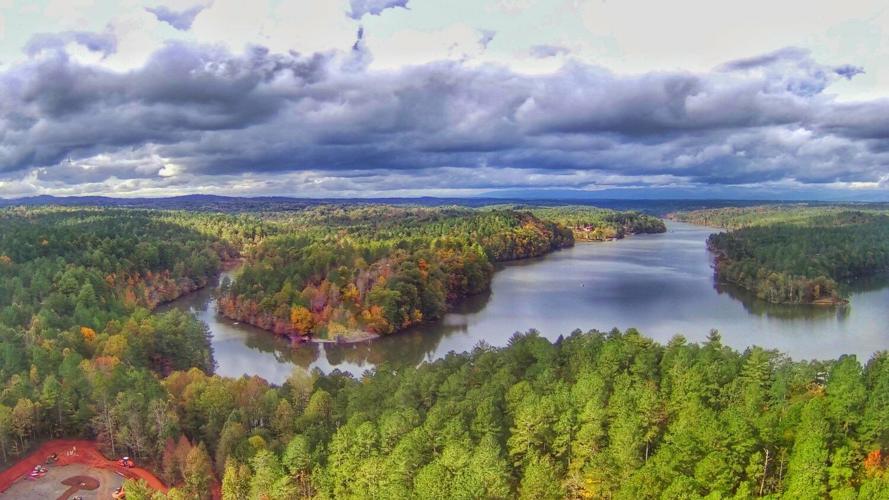
Lake James remains Burke County’s last line of defense when it comes to surviving severe droughts, Starr said.
LISA PRICE / THE PAPERWHAT’S THE SOLUTION?
Charlotte’s request was long anticipated, Catawba Riverkeeper Brandon Jones said. Back in 2002 when the city’s current interbasin transfer agreement was created, the expectation was that Charlotte would reach its cap around 2030.
“We’re at 2030, and now they’re expecting more allowance, and that’s just not a sustainable path forward,” Jones said. But the issue isn’t just isolated to Charlotte’s demands. It’s Mooresville, Fuquay-Varina, and other bustling towns all across the state.
“Really, it’s a global problem, but we need to start solving it now, and we can’t just keep kicking the can down the road, and that’s currently what’s being proposed,” Jones said.
But what has been done, and what can be done? Jones said that municipalities in the Catawba-Wateree Water Management Group have made real progress in efficiency, leak reduction, and source water protection. However, conservation alone can’t offset growth without broader planning and infrastructure investment.
Jones said municipalities need to buckle down and prioritize long-term, watershed-scale planning and regionalization. Options like reuse, recycling, pumping water across ridgelines, and creating regional water systems are more expensive than simply allocating more water, but they’re more suitable long term.
Mitigation is also an important aspect to look at. If water must be transferred out of a basin, there should be efforts to increase water availability elsewhere, he said. The concept isn’t new, and exists in other environmental policy areas such as wetland mitigation, though he said results have been mixed.
Jones also noted that municipalities need to pay close attention to the type of development they are incentivizing as not all water use has the same impact. Charlotte just permitted a new data center in the university area, and data centers have been popping up throughout the state.
“And so, again, with this finite resource, is this how we want to use it? Because you can build a lot of houses in the Catawba Basin, and the vast majority of the water that they use is returned,” Jones said, though the same can’t be said for data centers or certain types of industry.
Currently, there’s still a lot to be determined, Jones said, with research underway by the Research Triangle Institute. But some of the initial data that has been released shows that the most concerning impacts during droughts could be in South Carolina portions of the Catawba River, including areas like Lake Wylie.
In general, communities downstream would be more impacted than communities upstream, Jones said. Duke Energy’s heavily engineered system moves water through two major reservoirs that hold the vast majority of the water in the system. Those reservoirs are Lake James and Lake Norman.
“With that huge reservoir on Norman, they’re going to be able to continue to move water through Lake Hickory, Lake Rhodhiss, Lookout Shoals, for much longer than they’ll be able to move water through the lower systems because of the geography,” Jones said.
Whether water is transferred to another basin or consumed within the Catawba, downstream communities are affected if it doesn’t return. “We have a permit system for IBTs, and that’s really important, but if that water is being used in the Catawba side or going over to the Yadkin side, it really doesn’t matter to the communities downstream how it gets used as long as it’s not coming back. So, that net consumption is what’s really important, but that’s not what is being regulated in this case.”
The environmental impact statements have not been produced for the Charlotte IBT, and the state Collaboratory still has to finish its study. But Jones said the most important thing is for people to consider the broader picture.
“We’re not expecting to get much less water in the next 50 years. It looks fairly consistent,” Jones said. “We are expecting to get that water, though, in fewer, larger storms,” so concentrating on capturing storm runoff is important.
“This is a long fight. … It’s not just Charlotte versus the world,” Jones said. “This is every community that lives on a ridgeline, and there’s a lot of those in the basin. We live in a wonderful place, and people are moving here, and all these communities are growing.”
“And so we need to be thinking to solve this problem, not just for Charlotte, but for everybody moving forward,” Jones said.

















(0) comments
Welcome to the discussion.
Log In
Keep it Clean. Please avoid obscene, vulgar, lewd, racist or sexually-oriented language.
PLEASE TURN OFF YOUR CAPS LOCK.
Don't Threaten. Threats of harming another person will not be tolerated.
Be Truthful. Don't knowingly lie about anyone or anything.
Be Nice. No racism, sexism or any sort of -ism that is degrading to another person.
Be Proactive. Use the 'Report' link on each comment to let us know of abusive posts.
Share with Us. We'd love to hear eyewitness accounts, the history behind an article.