

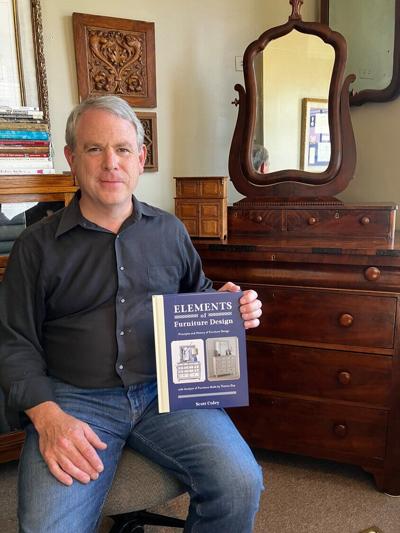

Scott Coley and I strike common ground shortly after I enter his office on the upper floor of the Ervin Building on South Sterling Street with its commanding view of the Old Courthouse Square.
His family’s heritage in the furniture business goes back for generations while my grandfather John Poteat was one of Drexel Furniture Company’s original employees, a cabinet maker by trade.
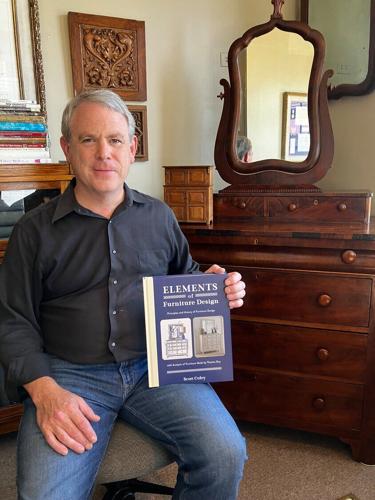
My visit and our conversation are prompted by a magnificent accomplishment — publication of a book conceived and written by Coley, “Elements of Furniture Design.”
The book, more than four years in the making, was produced by Schiffer Publishing of Atglen, Pa., edited by Ian Robertson, and with cover art by Morganton’s Denise Riddle.
Published in May, the book has already been added to the required reading lists at the Kendall College of Art and Design in Grand Rapids, Mich., of which Coley is a graduate.
The hardcover work, lavishly illustrated and numbering just over 250 pages, is divided into four sections.
Section One — The Furniture Designer, is “an overview of the furniture designer and gives a view of the profession from a broad lens.”
Section Two — The Elements of Furniture Construction, provides “an overview of the construction of furniture from a furniture designer’s perspective. This will allow a designer to understand how to draw the basics for construction."
Section Three — Ornamentation, provides an overview of the ornamentation of furniture. This will help a designer understand how and why to use ornament in their design.
Section Four — The Elements of a Furniture Collection, is “an overview of how to design furniture for the furniture industry. This will allow a designer to understand the design process and start creating furniture designs.”
The book also examines the life and furniture creations of Thomas Day, a free Black man who owned one of the most successful furniture operations in the country in the decades prior to the Civil War in the tiny North Carolina town of Milton.
Coley has been a successful furniture designer for some three and a half decades, producing collections for La-Z-Boy Furniture, Bernhardt Furniture, Henredon Furniture, and Thomasville Furniture, and Drexel Heritage Furniture.
So why did a renowned furniture designer decide to add “esteemed author” to his professional resume?
And when I use “renowned” as an adjective to describe Coley, the professional awards are there to back it up: six Pinnacle Awards from the International Society of Furniture Design, and 12 times a finalist for the same award.
But back to his answer. “I wrote the book for three reasons: to retain a knowledge base that (otherwise) might slip away; because I am passionate about giving of my time and talents; and because I love books, both as a resource of information and as a decorative accessory.”
“The teaching of furniture design has changed greatly at schools and colleges,” Coley continued. “And there have been many changes in the industry. The methods that many furniture designers in Morganton and elsewhere have used are not being taught in the ways they were in the past. The COVID-19 pandemic allowed me the time and the space to put together information that was important to retain for future generations of people interested in furniture design.”
Coley began work on the book in the summer of 2019, not knowing that early in the next year COVID-19 would bring an end to much of his travel and provide him the time necessary to concentrate on drawing and writing.
Coley said that he worked on the book very methodically. “I created an outline and I stuck to it,” he recalled. “When I started to go off on a tangent, I kept going back to it.”
So, who is the market Coley hopes to reach with the book?
“I wrote thinking of craftsmen and how they might get some ideas and some knowledge here about building their own furniture,” Coley answered. “I was thinking of other designers, like furniture designers, industrial designers, and interior designers who might be interested in my ideas. And certainly, anyone with an interest in furniture history and marketing.”
The publication of “Elements of Furniture Design” is more than a professional triumph for Coley. The finished product represents yet another victory over the learning difference he was diagnosed with as a child, dyslexia.
“Dyslexia made school difficult at times,” Coley said. “But my parents got me involved in tutoring through Appalachian State University at a young age. I had a good bit of tutoring as I progressed. One expert told my parents I would not finish high school, but I can say that with the right help, anyone with dyslexia can accomplish whatever they are called to do, and furniture design came naturally to me.”
“I’m very proud of the book,” he concluded. “I had a fantastic editor, Ian Robertson, and he made my book better, but it remains my work. Good or bad, it has my voice.”
"Elements of Furniture Design" is available locally at Thornwell Books on 202 S. Sterling St. in Morganton, as well as at major chains such as Barnes & Noble and on the internet.
Bill Poteat, who worked the long hot summer of 1976 in the finishing room at Drexel Furniture, is editor emeritus of The Paper. He may be reached at 828-445-8595 or via email at bill@thepaper.media.


























(0) comments
Welcome to the discussion.
Log In
Keep it Clean. Please avoid obscene, vulgar, lewd, racist or sexually-oriented language.
PLEASE TURN OFF YOUR CAPS LOCK.
Don't Threaten. Threats of harming another person will not be tolerated.
Be Truthful. Don't knowingly lie about anyone or anything.
Be Nice. No racism, sexism or any sort of -ism that is degrading to another person.
Be Proactive. Use the 'Report' link on each comment to let us know of abusive posts.
Share with Us. We'd love to hear eyewitness accounts, the history behind an article.