

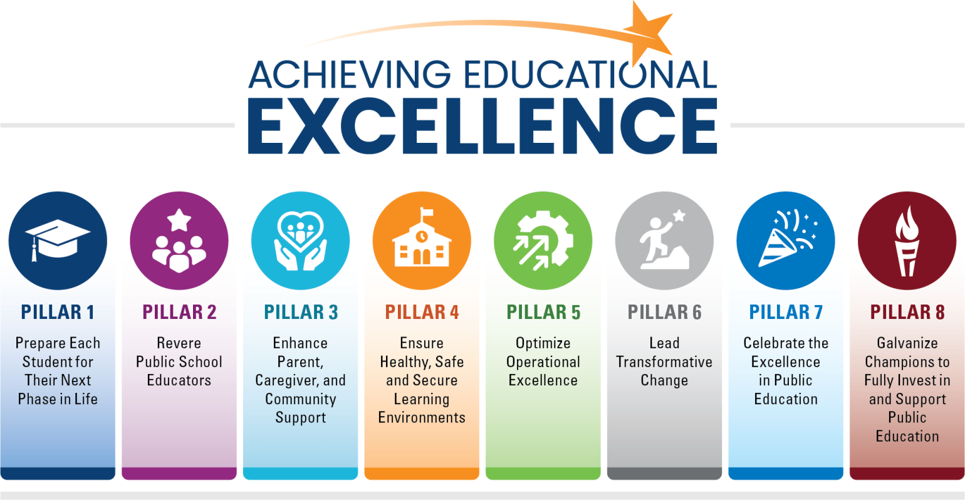



Editor’s Note: This is the first in a series of stories illustrating how Burke County Public School’s All-in Promise strategic plan aligns with the eight pillars outlined in the state’s blueprint, Achieving Educational Excellence.
“When you’re saying we’re trying to be best in nation, we’ve got to have it all,” State Superintendent Mike “Mo” Green said in October while discussing the Department of Public Instruction’s (NCDPI) strategic plan for Achieving Educational Excellence.
The State Board of Education (SBE) developed the plan’s eight pillars, which act as thematic goalposts that direct decision making.
While school districts across the state are encouraged to follow the pillars of the SBE plan, Burke County Public Schools (BCPS) is a few years ahead, releasing its own strategic plan — All-in Promise — in 2022.
UNDERSTANDING THE DIFFERENCE
The All-in Promise consists of three main goals: Academic Opportunities for All, All-around Well-being, and All Schools Connected to the Community. These three focal points cover the 2023-2028 time period and overlap with the eight pillars across the board.
While the All-in Promise doesn’t necessarily break down into action items, the initiatives and decisions made during Board of Education meetings point back to the plan’s three objectives.
Compared with the simplicity of the BCPS plan, the eight pillars focus on preparing each student for their next phase in life; revering public school educators; enhancing parent, caregiver, and community support; ensuring healthy, safe, and secure learning environments; optimizing operational excellence; leading transformative change; celebrating the excellence in public education; and galvanizing champions to fully invest in and support public education.
The SBE plan sets launch dates for each action item, with public rollouts scheduled from earlier this year to June 2030.
The first two pillars in the SBE’s plan have action item launch dates spanning August 2025 through August 2028. The majority roll out throughout the end of this year and most of 2026.
PILLAR 1
Prepare Each Student for Their Next Phase in Life
The first pillar breaks down into subsections focused on expanding pre-K and early childhood education; strengthening digital education and responsible artificial intelligence (AI) integration; supporting public schools through the development of AP classes, Career and Technical Education (CTE), and other advanced learning opportunities; and the construction of Career Development Plans.
At BCPS, preparing for the next phase begins at the pre-K level. BCPS Public Relations Officer Cheryl Shuffler said the school system offers STEPS (Strategically Teaching and Engaging Preschool Students) Academy to children as they turn 3. The program consists of 2.5-hour classes twice a week.
As students hit 4 years old, they can enroll in NC Pre-K through their respective elementary schools and begin learning ahead of other students who enter at the kindergarten level.
“At the end of each school year, teachers from the student’s current grade to the student’s rising grade meet to discuss each student,” Shuffler said. “We also hold parent and student transition nights as students advance from elementary to middle and from middle to high. Those students also take field trips to their new school and start meeting with counselors at their new school.”
According to Shuffler, as BCPS students hit high school, school counselors assist in future planning, reviewing interests, and encouraging specific electives and academic courses to guide students along their path to professionalism.
“That includes CTE, GEAR UP, and Western Piedmont Community College, [which] provides Career Coaches at each of our high schools,” Shuffler said.
While GEAR UP (Gaining Early Awareness and Readiness for Undergraduate Programs) focuses on post-secondary education and college preparedness, CTE covers programs like the Future Farmers of America (FFA) and HOSA-Future Health Professionals.
An example of BCPS’s focus on these programs is East Burke High School’s FFA chapter that recently received recognition in Indianapolis at the National FFA Convention, earning high marks for their performance of the mission and strategies of the organization.
As for the responsible integration of AI, BCPS follows guidance from the NCDPI’s best practices. NCDPI released a 41-page guidebook in January 2024, which undergoes frequent updates and revisions, with the most recent change on Nov. 18 concerning guidance on AI-enabled browsers.
“During the 24-25 school year, following this guidance, our GEN-AI team created the BCPS GEN AI Guidelines to help,” Shuffler said. These guidelines help in the management of AI in schools and also contribute to the pen-and-paper initiative, which focuses on balance between technology and traditional learning.
PILLAR 2
Revere Public School Educators
Pillar 2 shows appreciation for the roles teachers play — both required duties and behind-the-scenes contributions.
According to the SBE’s plan, the larger themes of the pillar improve recruitment, retention, professional opportunities, compensation, and pride in the profession as a whole.
Pride begins on the first day, and one of the action items for July 2026 includes a strengthening of the Beginning Teacher policy and support. BCPS recognizes a district-wide Beginning Teacher of the Year annually.
On the individual school level, a Beginning Teacher of the Year is chosen to help mentor other beginning teachers and represent the school at the district level, although all new teachers receive assistance from every level of the BCPS district.
“Beginning teachers are provided professional development opportunities throughout the year that are based on their needs and requests,” Shuffler said. “Principals and mentors are available to assist in setting up classrooms and preparing for the first day of school. District administrators, building administrators, and teacher leaders make frequent classroom visits throughout the year to support teaching techniques and strategies.”
As for pay, all teachers and school employees are paid the same across the state. Although North Carolina no longer pays extra for advanced degrees, teachers who receive National Board Certification earn 12% more.
“The difference is in the supplements,” Shuffler said. “Burke County’s local supplement is currently 5.5%. Teachers may choose to teach in counties with higher supplements, but there are many factors for why a teacher chooses to teach where they are, including where their residence is, where their children go to school, etc.”
On top of district recognition, professional pathway development, and regular support, teachers are rewarded in other ways by BCPS.
“We often say, ‘Keep the main thing the main thing,’ and we know teachers are at their best when they can focus on their students and their lesson plans,” Shuffler said. “With reduced staffs and budgets, sometimes it’s the small things that go a long way. Schools regularly plan duty-free lunch for teachers, offer special blue jean days, and offer ‘trade’ time on non-student days.”

















(0) comments
Welcome to the discussion.
Log In
Keep it Clean. Please avoid obscene, vulgar, lewd, racist or sexually-oriented language.
PLEASE TURN OFF YOUR CAPS LOCK.
Don't Threaten. Threats of harming another person will not be tolerated.
Be Truthful. Don't knowingly lie about anyone or anything.
Be Nice. No racism, sexism or any sort of -ism that is degrading to another person.
Be Proactive. Use the 'Report' link on each comment to let us know of abusive posts.
Share with Us. We'd love to hear eyewitness accounts, the history behind an article.