Madeleine Murr and Phyllis Garrison of Grow With Drexel share a presentation with community members about the lengthy process of securing a North Carolina Highway Historic Marker.
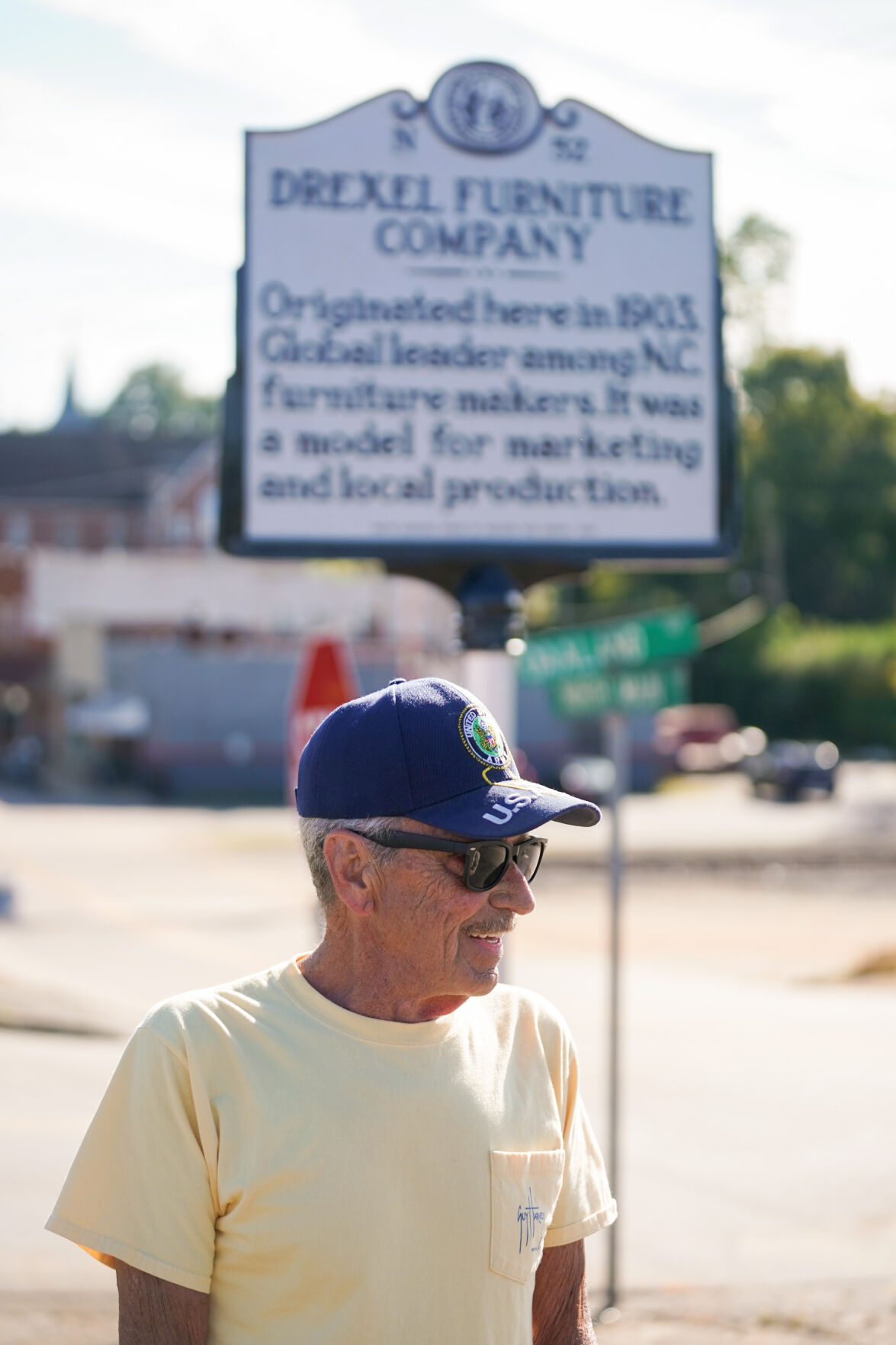
Drexel Furniture Company’s last employee at the plant in downtown Drexel, T.A. Hutchins, was a machine room supervisor and worked for the company for over 36 years.
Just across the street from the site that was home to a global leader in the furniture industry, dozens of lifelong Drexel residents and those connected to the company in one way or another, gathered to witness an unveiling that will mark the legacy of Drexel Furniture Company for generations to come.
The company was established on Nov. 10, 1903, in downtown Drexel, just north of the train tracks where Southern Railway freight engines chugged through the town. Started by Samuel Huffman and five other men, the company was founded with a $14,000-investment.
When Samuel Huffman died, his son Robert O. Huffman became the president, making several changes in operations. From manufacturing medium-priced furniture to spending more on advertising, the company had grown from 50 workers to 2,300 by 1957.
The company retained global status for decades, maintaining partnerships with various hotels, and government agencies across the globe. In 1994, there were 11 Drexel factories in North Carolina and South Carolina.
Although Drexel Furniture’s significance stretched far beyond the boundaries of the state, Laurie Johnston, N.C. Room Curator for Burke County Public Library, and Phyllis Garrison, member of Grow With Drexel, had to prove in a lengthy paper that the company had statewide significance.
With both primary and secondary sources, the two churned out a thick book to bring before a board of American History professors from universities across the state in order to judge whether the Drexel Furniture Company was worthy of receiving a N.C. Highway Historical Marker.
Madeleine Murr and Phyllis Garrison of Grow With Drexel share a presentation with community members about the lengthy process of securing a North Carolina Highway Historic Marker.
LISA PRICE / THE PAPER
It was. Leslie Leonard, from the N.C. Highway Historical Marker Program, said the program has been jointly operating with the N.C. Department of Transportation since 1935 and there are currently 1,661 markers across the state, with each county having at least one.
“The state invests in these markers to put up in communities across the state so that everybody can have a deeper understanding of the history in their community,” Leonard said. “If you don’t really understand the history of where you’re from, how do you really love and care about a place?”
Madeleine Murr, a member of the marker committee and Grow With Drexel, shared how she got the idea to pursue a marker for Drexel.
In 2017, she and her husband bought a motorhome to travel all over the country, and she became captivated by the markers and the history they share. The passion behind remembering Drexel Furniture Company and pushing the town forward also inspired the start of Grow With Drexel.
“When I traveled from the East Coast to the West Coast, everywhere I went, when I told people that I was from North Carolina, I was an instant success, because they knew all about the great textiles and furniture that came out of North Carolina,” Murr said, recounting her days working in interior design.
Drexel Furniture Company’s last employee at the plant in downtown Drexel, T.A. Hutchins, was a machine room supervisor and worked for the company for over 36 years.
LISA PRICE / THE PAPER
Many former employees of Drexel Furniture Company were in attendance and shared stories about their time there. One of Drexel’s last employees, T.A. Hutchins, who worked as a machine room supervisor, and served the company for 36 and a half years, was in attendance and shared with others what it was like to work at the company in its “glory days.”
When the plant and corporate office closed its doors in 2001, Hutchins said he and another employee were ordered to shut down the plant. After, he went on working in the furniture industry. He is just one of the many former Drexel employees that look back on their days with the company with a sense of fondness.
Now, the site of the former plant is readying for a new industry. It’s the site of the future Drexel Business Park, which boasts 100 acres for sale. When the site is developed, it has the potential to increase the town’s electric revenue ninefold and double the town’s general fund tax base, according to Town Manager Bill Carroll.
The site is undergoing utility work and the town is in talks with potential buyers that are interested in bringing their operations to the Town of Drexel.
Madison Lipe is the municipal reporter for The Paper. She can be reached at 828-445-8595 or madison@thepaper.media.
Keep it Clean. Please avoid obscene, vulgar, lewd,
racist or sexually-oriented language. PLEASE TURN OFF YOUR CAPS LOCK. Don't Threaten. Threats of harming another
person will not be tolerated. Be Truthful. Don't knowingly lie about anyone
or anything. Be Nice. No racism, sexism or any sort of -ism
that is degrading to another person. Be Proactive. Use the 'Report' link on
each comment to let us know of abusive posts. Share with Us. We'd love to hear eyewitness
accounts, the history behind an article.































(0) comments
Welcome to the discussion.
Log In
Keep it Clean. Please avoid obscene, vulgar, lewd, racist or sexually-oriented language.
PLEASE TURN OFF YOUR CAPS LOCK.
Don't Threaten. Threats of harming another person will not be tolerated.
Be Truthful. Don't knowingly lie about anyone or anything.
Be Nice. No racism, sexism or any sort of -ism that is degrading to another person.
Be Proactive. Use the 'Report' link on each comment to let us know of abusive posts.
Share with Us. We'd love to hear eyewitness accounts, the history behind an article.