

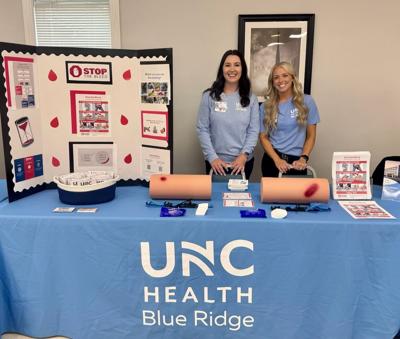

Sabrina Patterson, RN, and Kaylee Pittman, RN, are not Boy Scouts, but their message is spot on with the Scout motto: “Be Prepared.”
In fact, Patterson is the injury prevention specialist with UNC Health Blue Ridge while Pittman is the hospital’s trauma program manager.
The two head up the hospital’s efforts to keep the community safe by taking their courses to schools, manufacturing and office facilities, and churches across Burke County.
“Most cardiac arrests and severe injuries do not happen in the emergency room parking lot,” Patterson said. “They happen in churches, schools, workplaces, ball fields, and grocery stores.
“The community is often the first responder (to an injury or emergency),” she continued, “before the EMS arrives.”
Just three weeks ago The Paper ran a story about how a member of Pleasant Ridge Baptist Church, Roger Duckworth, suffered a potentially fatal heart attack and might have died had not church members started CPR immediately and used the church’s automated external defibrillator (AED).
“Just one week before,” Pittman said, “we had taught a ‘Stop the Bleed’ class at Pleasant Ridge and also given them a refresher course on hands-only CPR.”
As to what Stop the Bleed entails: It is a national public health campaign, launched in 2015 by the Obama administration, designed to teach bystanders how to recognize and stop life-threatening bleeding.
The program is led by the American College of Surgeons in collaboration with the Department of Defense.
The training, Patterson and Pittman explained, focuses on three primary techniques to control bleeding before professional help arrives:
Direct pressure: Using your hands and a clean cloth to apply firm, steady pressure directly into the wound.
Wound packing: Filling a deep wound with gauze or cloth and then applying pressure.
Tourniquet application: Correctly using a commercial tourniquet on an injured limb to stop arterial blood flow.
Practicing CPR or Stop the Bleed may seem a daunting task to someone who has never responded to an emergency before, but Pittman said, “People are often hesitant, maybe afraid they will do something wrong, but doing something is always better than doing nothing. AEDs talk you through each step and hands-only CPR is simple and effective.”
Patterson noted, however, that hands-only CPR is often not enough to save a heart attack victim.
“When someone goes into cardiac arrest, their heart often has a dangerous rhythm that can only be corrected by an AED,” she said. “CPR keeps blood flowing, but an AED is what can restart the heart back into a normal rhythm.”
And about that preparedness?
“We encourage organizations, churches, and businesses to make sure they have an AED,” Pittman responded. “They need to know where it is, and they need to make CPR and Stop the Bleed training part of their culture. Prepared communities save lives.”














(0) comments
Welcome to the discussion.
Log In
Keep it Clean. Please avoid obscene, vulgar, lewd, racist or sexually-oriented language.
PLEASE TURN OFF YOUR CAPS LOCK.
Don't Threaten. Threats of harming another person will not be tolerated.
Be Truthful. Don't knowingly lie about anyone or anything.
Be Nice. No racism, sexism or any sort of -ism that is degrading to another person.
Be Proactive. Use the 'Report' link on each comment to let us know of abusive posts.
Share with Us. We'd love to hear eyewitness accounts, the history behind an article.