

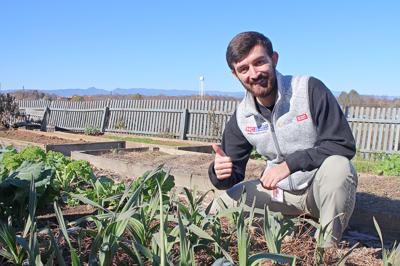

In his first year leading the Burke Master Gardener class, N.C. Cooperative Extension newcomer Tanner Collier hopes to foster the sense of community he says comes with gardening.
The next Master Gardener program, which begins Jan. 19, 2027, is a “crash course” in horticulture, and those who finish the 14-week program earn an elite status as community gardeners.
On a deeper level, the program gives people an opportunity to serve their community in a unique way: After completing 50 hours of class instruction, participants complete 40 hours of volunteer work at the Extension office helping others learn about gardening. Beyond that, master gardeners often continue to volunteer on their own time.
“I always get calls from people saying, ‘I want to volunteer, where can I volunteer,’” said Collier. “This class is the first step in doing that. … If they love horticulture and want to give back to the community, this class is perfect.”
Collier, who took on the horticulture agent role at the Extension office in April, said he is thrilled to be leading the program this year.
“This is my dream job,” he said.
As he came of age in Lenoir, Collier worked at Town and Country Greenhouse and Nursery before and during college. Collier graduated from N.C. State University with a degree in agricultural science and minors in horticulture, crop science, and Extension education.
“I’ve always loved growing plants … I love being outside,” he said. “That’s been my jam.”
Collier said he hopes to provide a hands-on experience for potential master gardeners that will echo his time at the nursery.
“I didn’t want to do a formal, sit-down-in-a-classroom type education; I want to get out in the community and help people,” he said.
Meanwhile, Collier said, master gardener students will learn from the same coursework as horticulture students at N.C. State. In fact, the master gardener course roughly translates to nine classes at the college, he said.
Students will learn about botany, plant classification, soil science, wildlife, tree fruits, propagation, and a litany of other subjects, all while building a connection with each other rooted in their love of gardening.
“It’s a great community,” he said. “You get to meet tons of people from different backgrounds; you get to learn every single day.”
Between high produce prices and contaminated crops, Collier said it’s more critical than ever for communities to have home gardening knowledge.
“Toward the beginning of the year, when prices of groceries were high, it was getting to a point where people were saying it was outrageous,” he said. “If something does happen where either prices get too high, or with the lettuce outbreak where the lettuce was contaminated, if you grow your own, you can still have lettuce to eat.”
Collier added that beyond the practicality of gardeners sustaining themselves and their families with their own crops, giving excess harvest to others is rewarding.
“To grow things to give to others, to people who are less fortunate, it grows our community,” he said.
Collier said he looks forward to seeing relationships — and plants — continue to grow as a result of the class.
“The relationships they get to make and continually learning and growing themselves, it’s one of the best things about the program,” he said.





















(0) comments
Welcome to the discussion.
Log In
Keep it Clean. Please avoid obscene, vulgar, lewd, racist or sexually-oriented language.
PLEASE TURN OFF YOUR CAPS LOCK.
Don't Threaten. Threats of harming another person will not be tolerated.
Be Truthful. Don't knowingly lie about anyone or anything.
Be Nice. No racism, sexism or any sort of -ism that is degrading to another person.
Be Proactive. Use the 'Report' link on each comment to let us know of abusive posts.
Share with Us. We'd love to hear eyewitness accounts, the history behind an article.