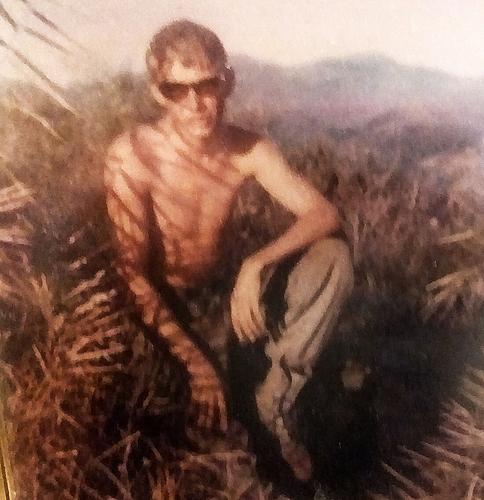
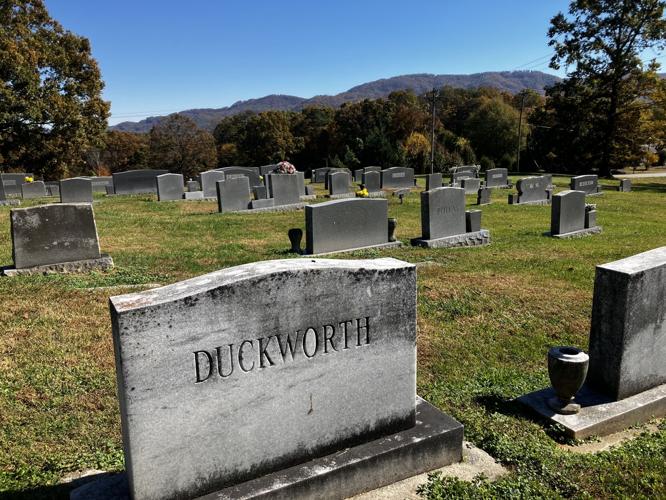
ABOVE: Robert Lee Duckworth’s final resting place at the Pleasant Ridge Baptist Church cemetery. The South Mountain range towers in the distance. TOP: A photo of Robert Lee Duckworth during his time in Vietnam.
Undoubtedly, it would be a gripping one if he could.
His would be the story of a young boy from a small town drafted into the Army at the height of the Vietnam War.
His would be the story of a boy who was always small for his age, but who under enemy fire grew to heroic stature, surviving five woundings and being honored for battlefield gallantry.
His would be a story that was in some ways so painful that it grieved him to even think about it, much less talk about it with others.
A photo of Robert Lee Duckworth during his time in Vietnam.
Duckworth One
FOR THE PAPER
And his would be a story shared by hundreds of thousands of other young boys who went to fight a war in Southeast Asia who were never clearly told what their objectives were or just why they were facing death in a jungle half a world away from their homes.
A Cemetery Visit
The earthly remains of Staff Sgt. Duckworth are buried in the cemetery of Pleasant Ridge Baptist Church, just a short distance from where he grew up after being born at Grace Hospital on Sept. 11, 1948.
On an early November afternoon when a visitor approaches his grave, Veterans Day is just a week away, but the day feels more like mid-September. The temperature is pushing 70 degrees, the sky is crystal blue, and bright splotches of color dot the sides of the South Mountains ridge which towers in the distance.
Duckworth’s resting place faces those mountains, looking out across a wide and peaceful valley before the hills begin their climb toward the summits of Burkemont and of Buzzard Roost.
The visitor is reminded of the words of President John Kennedy, spoken when he visited Arlington National Cemetery just a couple of weeks before his death.
Looking out over the broad expanse of Washington, D.C., splashed with November sunlight, the President remarked to an aide, “I could stay up here forever.”
ABOVE: Robert Lee Duckworth’s final resting place at the Pleasant Ridge Baptist Church cemetery. The South Mountain range towers in the distance. TOP: A photo of Robert Lee Duckworth during his time in Vietnam.
BILL POTEAT / THE PAPER
Duckworth’s headstone tells a visitor almost nothing, just the dates of his birth and death. No American flag is engraved into the stone, no Army helmet, no reminder of his service at all.
After more than 50 years, even those dates are starting to fade, just like the nation’s memory of the sacrifices of those who fought in Vietnam.
The footstone, provided by the Army, is more informative. Beneath a small cross are the words:
Robert L. Duckworth
North Carolina
33G CO C 2BN 1 INFANTRY
Vietnam
Sept 11 1948 March 27 1972
Again, those may be the dates, but they are certainly not the facts, and for those we must turn to two of Duckworth’s surviving relatives, his sister, Susan Whisenant, and his former brother-in-law, Dwight Stillwell.
Family Memories
Susan was born 23 months after Rob in December of 1950. Dwight is the same age as Rob, and the pair began first grade together at Glen Alpine Elementary School. Both remark on how small Duckworth was.
“Rob was small for his age and I was just the opposite, and we both were picked on,” Dwight remembered.
“He was always small for his age,” Susan commented. “Not the type that you would expect to be a hero.”
Hero or not, Susan looked up to her brother, seeing him as someone who always looked after her, always protected her.
“He may have been small,” said Susan of the brother she lost more than 53 years ago, “but he always had a very big heart. He was kind to everyone, and would do anything for anybody who needed him.”
When it was time for Dwight and Duckworth to advance to second grade, the friends were separated. Duckworth was deemed “too immature” to move forward and was “held back” in first grade.
The boys did find themselves together in high school when they were in the same car in Drivers Education under the legendary coach Jug Wilson.
They also later worked together at the Winn-Dixie in downtown Morganton. At the time he was drafted into the Army in 1968, Duckworth was working at Wamsutta Textiles and by then Dwight was dating his sister Susan.
“He didn’t volunteer for the Army and he certainly didn’t volunteer to go to Vietnam,” said Dwight of his friend and soon to be brother-in-law. “But he did his duty to his country.”
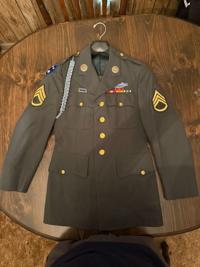
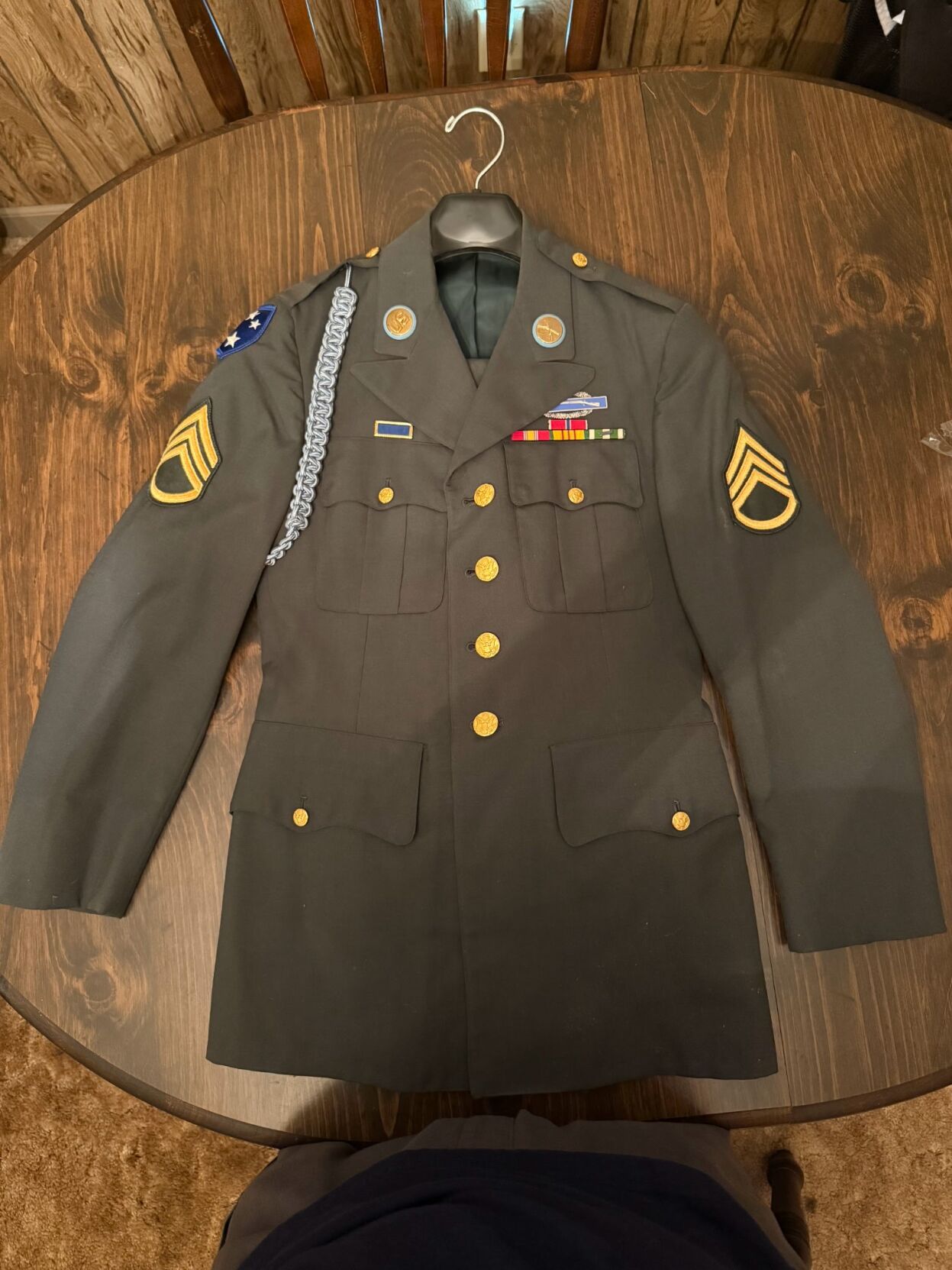
Robert Lee Duckworth’s dress uniform from his days in the Army.
FOR THE PAPER
“He was a good person, such a good person,” said Dwight of his friend. “He was good to his sister. He loved his mother. He was a hard worker. He simply wanted to do the right thing.”
And for Robert Duckworth, doing the right thing meant going where his country wanted him to go.
Years of Valor and of Mystery
Although he was drafted for two years of service, tours of Vietnam lasted for exactly one year — one year and then back to the States.
Duckworth arrived in Vietnam in 1969, the year President Richard Nixon said he had a “secret plan” to end the war. Despite the plan, which was basically turning more combat operations over to the South Vietnamese Army, more than 20,000 young Americans died during Nixon’s first term of office.
Duckworth was not one of them.
Instead, during that year’s tour of duty he was in constant combat.
He earned a Bronze Star, awarded to soldiers who have distinguished themselves through heroic or meritorious achievement or service in a combat zone.
He also was awarded the Combat Infantry Badge, recognizing his service in combat, under enemy fire.
He was wounded five times, receiving a Purple Heart for the first wound and four Oak Leaves, one for each of the subsequent woundings — meaning he earned a Purple Heart five times.
And, when his tour of duty was completed, he came home. Got married. Went back to work in the textile industry. Said next to nothing about his time in Vietnam.
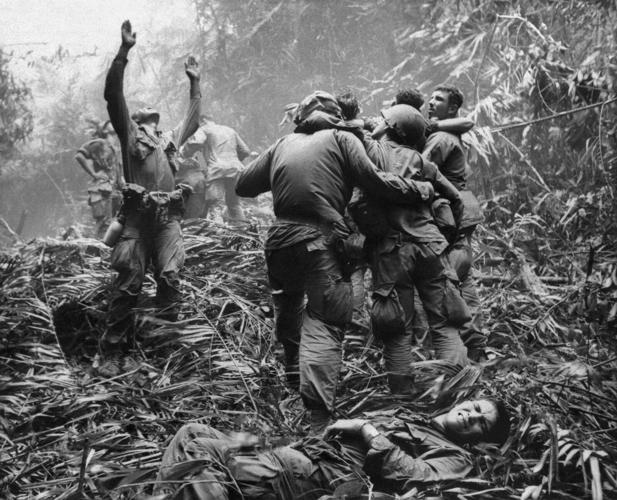
A picture from his time in Vietnam shows a shirtless Duckworth posed before a jungle backdrop, his upper body unmuscular, the expression in his eyes indiscernible behind sunglasses. The photo seems to cry out, “So young … so young.”
“He never really talked about what he did or the action he saw,” said Susan of the brother who returned home. “I know some of our cousins would press him about it and he would say, ‘You really don’t want to know.’”
Dwight says Duckworth probably had to follow orders that he did not agree with, noting that civilian casualties were rampant during the Vietnam conflict.
Dwight does know that his friend came home a changed man. He was given to nightmares, mood swings, and flashbacks.
One evening at a South Carolina beach Duckworth was near the water with a group of his cousins. One of the cousins set off some fireworks, and Duckworth immediately sank to the sand in a protective crouch.
“In today’s language, I think he certainly suffered from PTSD,” Dwight said. “But 50-plus years ago, no one knew what PTSD was.”
An Untimely End
Had he been given the gift of a long life, Duckworth might have taken steps to recover from the psychological and emotional wounds of vicious combat in Vietnam.
Had he been given the gift of a long life, he might also have opened up about those experiences, sharing his pain with his sister and his faithful childhood friend.
But it was not to be.
On the evening of March 27, 1972, Duckworth was driving with his wife and three friends to the old Charlotte Coliseum, now Bojangles Arena, to see Sonny and Cher in concert.
A driver coming from the opposite direction made the deadly decision to try to pass several vehicles. His car collided with Duckworth’s vehicle. And just like that, the young hero was gone.
“I mourn him as a man who did the best he could for his country,” said Dwight. “Had he lived, we would still be friends. But I know that he was a hero, a real hero, a hero that people should remember.”
“I want people to know how courageous he was,” said Susan. “I would like for him to be recognized. He was just an outstanding person, and a large part of my heart died the day he died.”
A Place of Honor
Dwight and Susan are currently working with the Burke County Museum of History to set up a display in Duckworth’s honor there.
Included in the display will be Robert’s uniform, his Bronze Star, his Purple Heart and the accompanying Oak Leaves, as well as photographs and papers related to his time in service.
“Robert died a senseless death,” Dwight concluded. “He deserved more for his courage and what he went through for his country. To our family, he will always be Rob, but to this country, he should be a hero.”
Bill Poteat is editor emeritus. He may be reached at 828-445-8595 orbill@thepaper.media.
Keep it Clean. Please avoid obscene, vulgar, lewd,
racist or sexually-oriented language. PLEASE TURN OFF YOUR CAPS LOCK. Don't Threaten. Threats of harming another
person will not be tolerated. Be Truthful. Don't knowingly lie about anyone
or anything. Be Nice. No racism, sexism or any sort of -ism
that is degrading to another person. Be Proactive. Use the 'Report' link on
each comment to let us know of abusive posts. Share with Us. We'd love to hear eyewitness
accounts, the history behind an article.

























(0) comments
Welcome to the discussion.
Log In
Keep it Clean. Please avoid obscene, vulgar, lewd, racist or sexually-oriented language.
PLEASE TURN OFF YOUR CAPS LOCK.
Don't Threaten. Threats of harming another person will not be tolerated.
Be Truthful. Don't knowingly lie about anyone or anything.
Be Nice. No racism, sexism or any sort of -ism that is degrading to another person.
Be Proactive. Use the 'Report' link on each comment to let us know of abusive posts.
Share with Us. We'd love to hear eyewitness accounts, the history behind an article.