





Lenoir is breaking out the crystal ball, planning decades into the future to form a comprehensive assessment detailing water and wastewater priorities — a plan that could cost the city nearly $359.3 million over the next several decades, should it tackle all the projects.
The City of Lenoir partnered with McGill Associates to develop an Asset Management Plan (AMP) and Asset Inventory and Assessment (AIA) for water and wastewater systems, a North Carolina Department of Environmental Quality-funded project.
The AMP consists of four main components: asset inventory, asset assessment, a capital improvements plan, and an operation and maintenance plan.
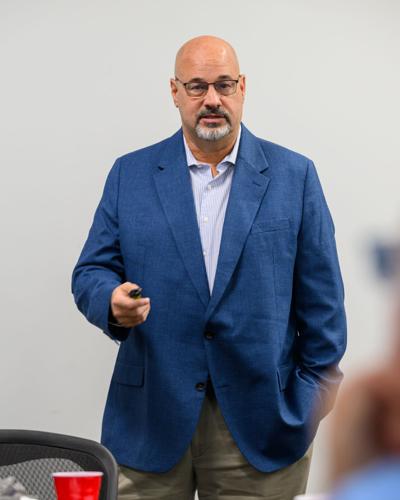
Joel Whitford, the senior project manager from McGill, explained that the AIA would serve as a guide for the next 20-40 years, detailing where projects are, how they should be handled, and identifying which points should be pivotal in future Capital Improvements Planning (CIP).
“CIP is very important in programming, because it addresses, probably most importantly, viability needs,” Whitford told the committee. “Water and sewer is not something you can just put in the ground and forget about it. It has a lot of wear and tear to keep it operating so that your customers really have continued water and sewer service without realizing it.”
Many times, the problem with the infrastructure, according to Whitford and Project Consultant Greg Padgett, is its age. In Lenoir, 65% of the water pipes are older than 50 years old and 12.3% are between 41 and 50 years old.
As for wastewater pipes, about 44% are over 50 and 34% are between 41 and 50 years old. To compound the age, 65% of the wastewater pipes are made of clay — a material Whitford said is susceptible to cracking and root infiltration.
“You’re reaching what the American Water Works Association (AWWA) says is that life expectancy — you’re getting near end of life expectancy,” said Padgett. “That’s what we looked at (to) start making a plan. That doesn’t mean it’s going to fail tomorrow. … We identify those lines and say, ‘These have the highest potential for failure, the likelihood, and what’s that consequence of failure.’”
According to “Buried No Longer,” a 2012 report from the AWWA, asbestos-cement pipes, which comprise about a third of the water pipes in Lenoir, have an average estimated life expectancy of 80-100 years, and PVC pipes, which account for another 29% of the City’s water pipes, have a life expectancy of about 55 years.
Whitford explained that having a 10-year plan already in place puts Lenoir ahead of the curve, as many municipalities that start looking at infrastructure have to build a CIP as they’re also developing the long-term plan.
To illustrate what the plan could cost, Whitford showed a chart that contained Lenoir’s current CIP, which covers fiscal year 2027 through 2036. In 2026 dollar costs, the city has already planned for almost $76 million in infrastructure distribution, collection, and treatment between the water and sewer system combined.
For projects expected to come along at or after year 11, beyond the current CIP, another $140,755,478 in costs are projected, with an additional $142,572,704 in infrastructure planning falling outside of that.
The projects total more than $359.3 million over the next several decades, although most of these costs aren’t projects the city has taken on, as much as future potential projects.
Those numbers are all calculated in 2026 dollars, not taking into account inflation and other fluctuations. According to McGill’s presentation, AIA-generated projects can be integrated in the next 10-year plan based on priority levels.
Alongside the report, McGill included a breakdown of potential funding sources, grants, and low-interest or zero-interest loans — which Whitford explained are easier to acquire with an AMP in place.
“This is another tool in your toolbox,” Whitford said. “We have a very comprehensive list of needs within the system, and again it’s long-range, long-term future planning. Every year, that’s why council does a great job to consider these projects meetings and really guide the city and its citizens on what’s most important — spending your money on the right things, not just for the sake of doing it.”
The council received an in-depth booklet which it will consider for adoption at the Nov. 3 city council meeting.


























(0) comments
Welcome to the discussion.
Log In
Keep it Clean. Please avoid obscene, vulgar, lewd, racist or sexually-oriented language.
PLEASE TURN OFF YOUR CAPS LOCK.
Don't Threaten. Threats of harming another person will not be tolerated.
Be Truthful. Don't knowingly lie about anyone or anything.
Be Nice. No racism, sexism or any sort of -ism that is degrading to another person.
Be Proactive. Use the 'Report' link on each comment to let us know of abusive posts.
Share with Us. We'd love to hear eyewitness accounts, the history behind an article.