North Carolina Speaker of the House Destin Hall delivered a keynote address supporting the creation of a passenger rail corridor between Salisbury and Asheville at the Railroads and Regional Economic Development Conference on Wednesday.
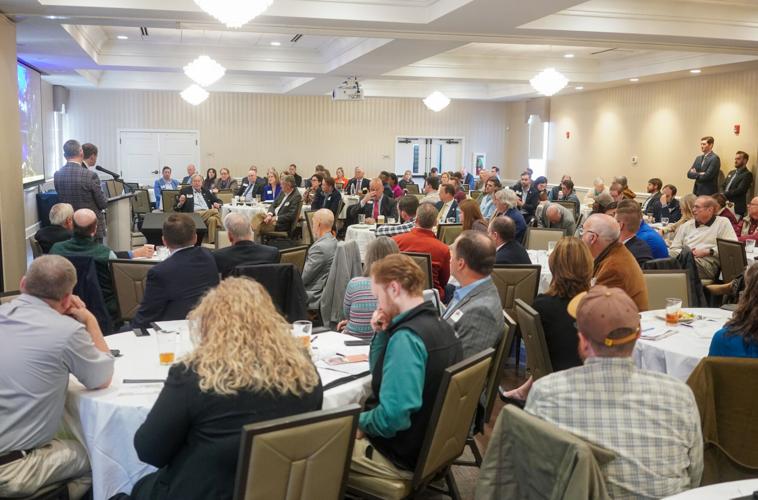
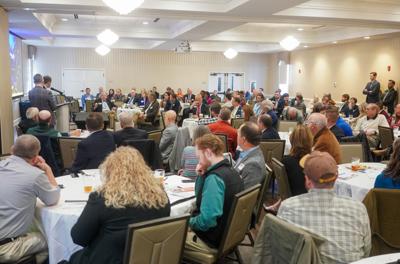
A packed Morganton Community House attended the all-day Railroads and Regional Economic Development Conference, which featured about a dozen speakers on Wednesday, March 18.
A packed Morganton Community House attended the all-day Railroads and Regional Economic Development Conference, which featured about a dozen speakers on Wednesday, March 18.
North Carolina Speaker of the House Destin Hall delivered a keynote address supporting the creation of a passenger rail corridor between Salisbury and Asheville at the Railroads and Regional Economic Development Conference on Wednesday.
LISA PRICE photos / THE PAPER
More than 100 local, state, and federal leaders gathered in Morganton last week to discuss a decades-long push to restore passenger rail service through Western North Carolina.
The idea is to establish a corridor from Salisbury to Asheville. The project could bring new commuting options to Burke County residents, attract tourism, and inject millions into the regional economy.
At the Railroads and Regional Economic Development Conference held Wednesday in the Morganton Community House, officials and industry leaders from Asheville, Salisbury, Morganton, Valdese, Marion and other municipalities outlined how a proposed rail line could expand access to jobs, strengthen business growth, and reshape transportation across the foothills and mountains.
The corridor is projected to cost $665 million. Speakers told attendees that federal funding would cover 80% of the cost as long as local and state governments provide a 20% match.
If the project is funded, implementing the corridor would create 5,280 jobs from Asheville to Salisbury during construction, said N.C. Department of Transportation Rail Division Director Jason Orthner.
Implementing the corridor would entail construction of crossings, stations, and stops along the route.
Orthner said that, over the course of its construction, the project would generate $360.5 million in employee wages, $1.05 billion in economic output, and $33.6 million in local and state tax revenue over the course of its implementation.
After it is complete, Orthner said the corridor would support 305 jobs and generate $19.9 million in wages, $59.8 million in economic output, and $1.8 million in local and state tax revenue annually.
The 139-mile track from Salisbury to Asheville would connect to the S-Line Corridor that links Raleigh and Richmond, Va. This would draw people from other parts of the state, Orthner said, which means the Salisbury to Asheville line could have between 225,000 and 450,000 passengers annually by 2045.
The proposed route would offer three daily round trips, serving communities including Morganton, Marion, Old Fort, Black Mountain, Valdese, Hickory, and Asheville, according to the Western North Carolina Rail Committee’s website.
Orthner said that, while this project could cost $665 million, road projects can also cost “hundreds of millions of dollars.”
“When you’re including the equipment, the terminals, and the infrastructure improvements, (this project) is actually a substantially great value, or at least a very feasible value,” Orthner said.
Although there are still millions of dollars and years of work to go, leaders are confident that the benefits would be worth it. North Carolina Speaker of the House and Burke Board of Commissioners Attorney Destin Hall put the project in perspective when it comes to the state’s growth and economic development.
Since 2010, the state went from being one of the worst for business climate to one of the best, he said, adding that North Carolina has seen tremendous population growth and continues to be one of the fastest growing states in the country.
“Of course, with growth comes issues that you’ve got to deal with, but ultimately it’s a positive thing,” Hall said. “One of the main reasons folks are coming here is because of the business climate that we have in this state that’s caused us to thrive.”
Rail is a key component of the infrastructure that brings companies to the Tar Heel State year after year, Hall said, especially in Western North Carolina, where rail came to the region in tandem with the region’s economic driver: the furniture industry.
After furniture left the region, there was a lull in the local economy, but over the past decade more and more companies are returning.
“I’m a little bit biased, but the truth is, I don’t think there’s a better place to be in this state, in my opinion, than on this (U.S.) 321 corridor,” Hall said. “I think that’s the best place to be for the next generation, and the reason for that is we’ve got the infrastructure necessary for businesses to come in here. In many ways, it’s sort of a relic of our industrial manufacturing past.”
Passenger rail is expected to be a key component in the workforce by connecting employees to work throughout the region, according to Tristan Winkler, transportation planner with Land of Sky Regional Council, a multi-county local government planning and development organization.
“One thing we’ve noticed, especially with Buncombe County, is people are coming from further and further away. Our work shed is expanding, and we’re seeing those economic connections really get strengthened,” Winkler said, adding that the number of people who work in Buncombe County, but live in McDowell County, has nearly tripled over the last 20 years.
“We see those economic connections growing, and having a commuter choice that strengthens that connection for Western North Carolina is something that’s really key,” Winkler said. “I think that shows that this is a project that would absolutely have benefits to tourism, but also connect our communities and provide those connections for employers and employees through our region.”
“I think the average citizen kind of thinks about railroads as something from the distant past. In this part of the world, sometimes they think about Tweetsie, but they don’t necessarily know about the economic impact that rail has on North Carolina and more so what it can have in the future with the right investments.”
Orthner said railroads operate in 86 of the state’s counties and generate more than $20 billion in statewide economic output each year. Railroads also support 88,000 jobs and generate $990 million in state and local tax revenues annually.
Keep it Clean. Please avoid obscene, vulgar, lewd,
racist or sexually-oriented language. PLEASE TURN OFF YOUR CAPS LOCK. Don't Threaten. Threats of harming another
person will not be tolerated. Be Truthful. Don't knowingly lie about anyone
or anything. Be Nice. No racism, sexism or any sort of -ism
that is degrading to another person. Be Proactive. Use the 'Report' link on
each comment to let us know of abusive posts. Share with Us. We'd love to hear eyewitness
accounts, the history behind an article.






























(0) comments
Welcome to the discussion.
Log In
Keep it Clean. Please avoid obscene, vulgar, lewd, racist or sexually-oriented language.
PLEASE TURN OFF YOUR CAPS LOCK.
Don't Threaten. Threats of harming another person will not be tolerated.
Be Truthful. Don't knowingly lie about anyone or anything.
Be Nice. No racism, sexism or any sort of -ism that is degrading to another person.
Be Proactive. Use the 'Report' link on each comment to let us know of abusive posts.
Share with Us. We'd love to hear eyewitness accounts, the history behind an article.