

Conditional zoning in Burke County is a ‘go’ after all.
The Burke Board of Commissioners approved a staff-initiated request to return conditional zoning to the county for the first time since 2021 during a marathon regular monthly meeting Tuesday.
The vote was 4-1. Board Chair Jeff Brittain, Vice-Chair Scott Mulwee, Randy Burns, and Johnnie Carswell voted in favor of the zoning text amendment.
Commissioner Phil Smith opposed the measure, which could have a significant impact on the development of the controversial Great Meadows Megasite in western Burke County.
Conditional zoning allows local governments to place increased restrictions on land developers and is used primarily to protect private property owners from encroachment by industry. It also allows for fewer restrictions than traditional zoning in certain circumstances.
The matter came before the county’s planning and zoning board last month, and that board voted 4-2 against recommending the item to the commissioners. But planning and zoning is strictly an advisory board, and the final decision was entirely in the hands of the commissioners.
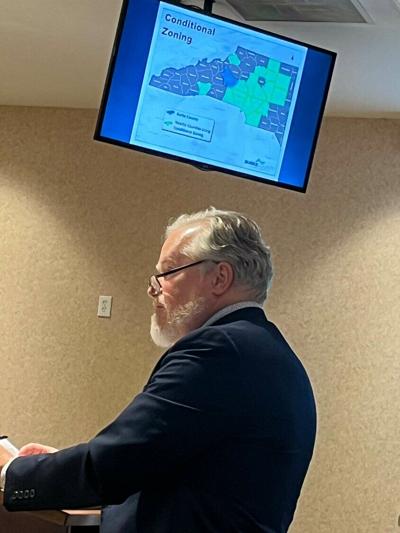
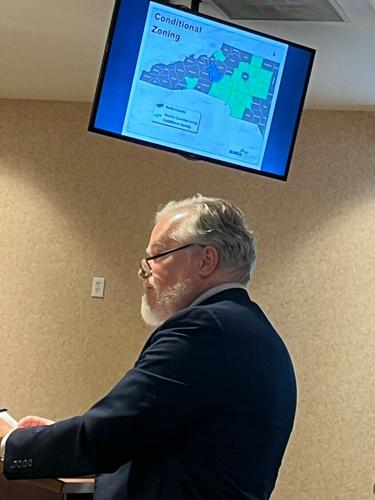
Tuesday, Deputy County Manager and Community Development Director Alan Glines outlined the text amendment, and then several speakers addressed the board during the ensuing public hearing.
As was the case with some members of the planning board, the idea that conditional zoning could be used to lessen restrictions on developers gave some residents pause.
“Face-value, this sounds like something that gives us more control,” said Tim Roush. “I’m a little concerned when I see the paragraph that says you can have more or less restrictions.”
Seeking clarification on the spirit of the amendment, Smith asked Glines if conditional zoning would help protect the public interest. “So what you’re saying is, conditional zoning answers the concerns of citizens that live close to that,” said Smith. “Is that what you’re saying?”
Gline said it was.
“All the applications could vary; obviously, they’re going to be one-of-a-kind applications, each one, but those kinds of conditions are standard in a conditional zoning application.” Glines responded. “They’re often used in that way across the state – to get extra buffers, to modify a structure or a building and make sure it looks a certain way. There’s a lot of conditions that can be placed on a conditional zoning application.”
Smith still had reservations about the ordinance.
“I think one of the problems that the community has is that less-restrictive clause in there,” he said. “What do we mean by that? I’ve got a big problem with that, too.”
Glines explained there are situations where less restrictive zoning would be preferable, using housing lot sizes as an example.
“Instead of our acre minimum lot size, if we can satisfy public safety, and access for fire and emergency, and we can satisfy water and sewer and septic needs, maybe there is an occasion where you would approve a smaller lot size – less restrictive than the standard ordinance – because it’s going to meet another goal the community has,” Gline said.
Glines added all conditional zoning requests would require the commissioners’ approval.
“There are some times when ‘less’ might be in the best interest of everybody, and if we take it out, then we don’t have any option to work with from that perspective,” said Brittain.
Smith asked if the proposal could be further amended to state the ‘less-restrictive’ wording would apply to housing developments and not industrial ones.
Brittain said such a change was unnecessary.
“It would come through the planning board and then come to the commission, and if we didn’t like it, we wouldn’t approve it,” said Brittain.
Commissioner Randy Burns, citing the county’s zoning restrictions as a roadblock to housing expansion, moved to adopt the ordinance.
The proposed megasite has been a topic of contention locally since last October, when the General Assembly handed Burke Development Inc. nearly $36 million to purchase the 1,353-acre tract and begin constructing infrastructure. No future tenants of the site have been named, but some residents are worried the county is targeting a lithium battery manufacturer, which they say could negatively impact property values and watersheds.
Marty Queen is the senior reporter for The Paper. He may be reached at 828-445-8595 or at marty@thepaper.media.


















(0) comments
Welcome to the discussion.
Log In
Keep it Clean. Please avoid obscene, vulgar, lewd, racist or sexually-oriented language.
PLEASE TURN OFF YOUR CAPS LOCK.
Don't Threaten. Threats of harming another person will not be tolerated.
Be Truthful. Don't knowingly lie about anyone or anything.
Be Nice. No racism, sexism or any sort of -ism that is degrading to another person.
Be Proactive. Use the 'Report' link on each comment to let us know of abusive posts.
Share with Us. We'd love to hear eyewitness accounts, the history behind an article.