

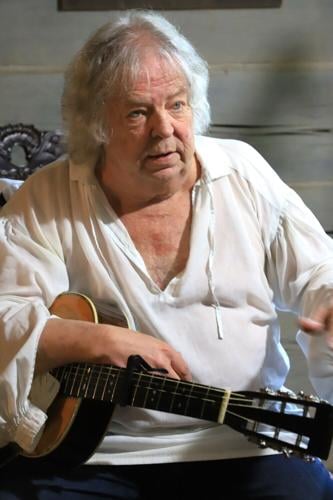
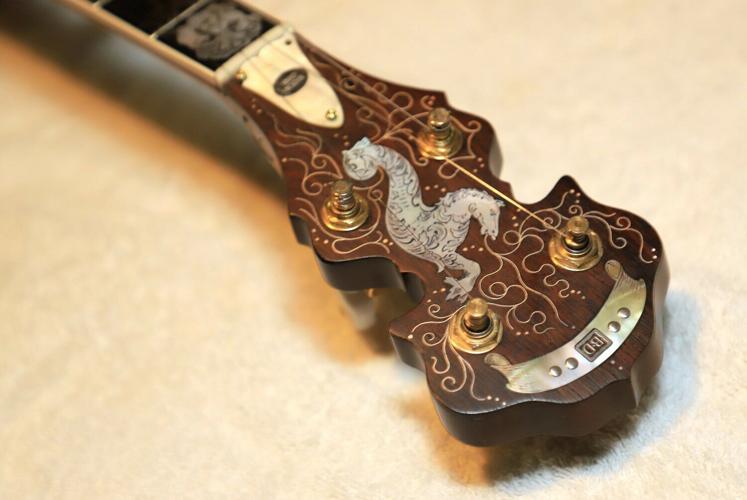
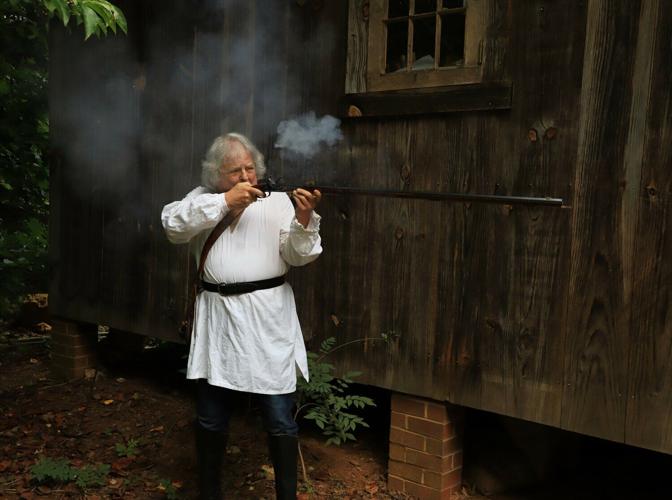
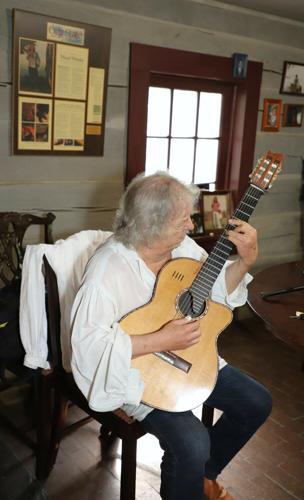
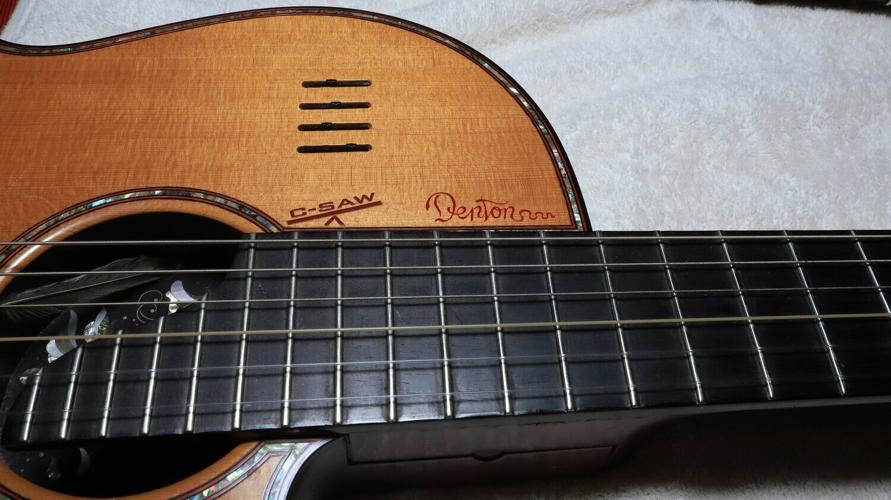
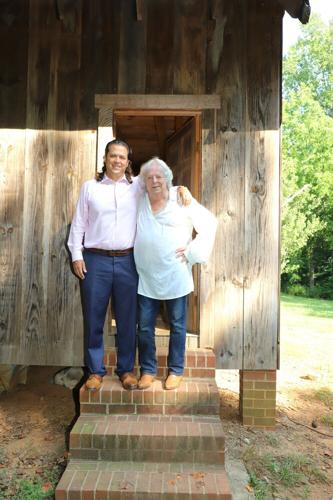
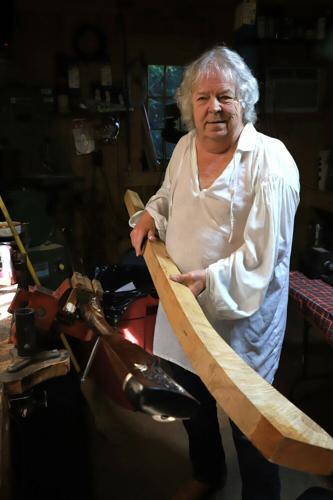
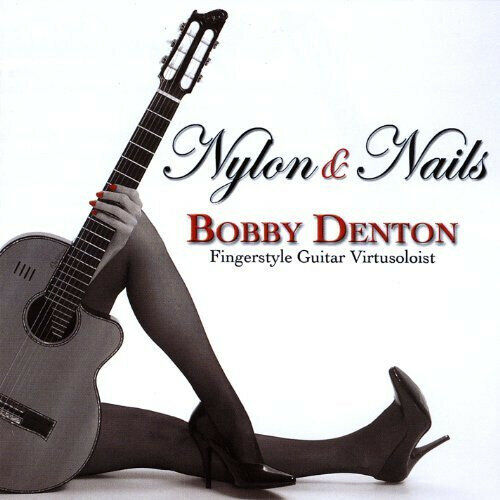
When you want something done right, do it yourself. That’s a proverb Bobby Denton appears to live by. The guitars he plays? He made them. The banjo? Built by his hands. His rifle? His creation. Even his shirt is his handiwork.
He has the heart of an artist, and creating is as much a part of him as drawing a breath.
“I always liked custom-made things, even when I was a kid,” Denton said, adding that his two passions — music and rifles — date back to a childhood spent not a thousand yards from his home near Burkemont Mountain.
He reflected on how his dad moonlighted by repairing TVs once he was off the clock from his day job at Henredon furniture. A young Bobby often tagged along on the service calls.
“I’d occasionally see a gun on the wall and I’d ask the owner to take it down so I could see it close up. Drove my dad crazy,” he said.
He also credits the “Daniel Boone” TV show with stoking his interest in rifles: “I thought he was cool.”
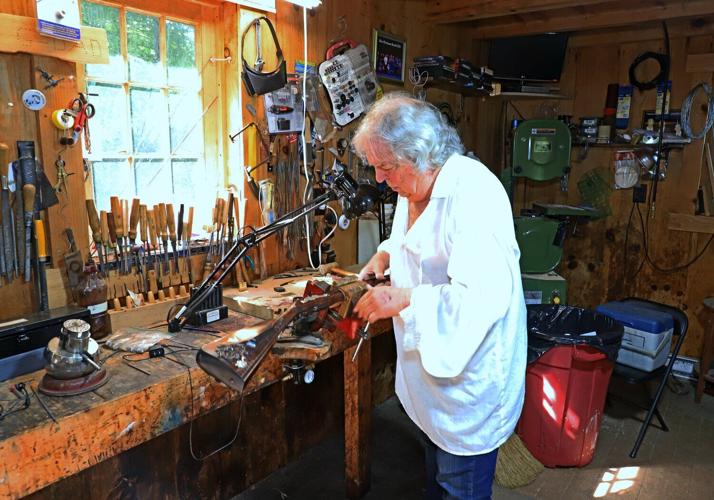
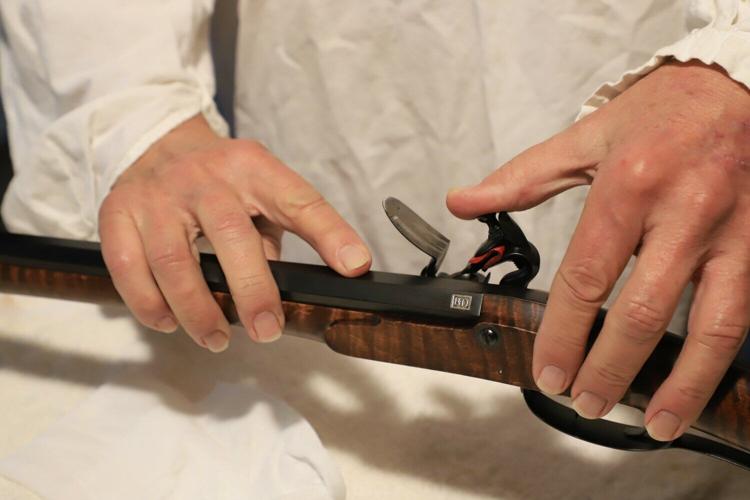
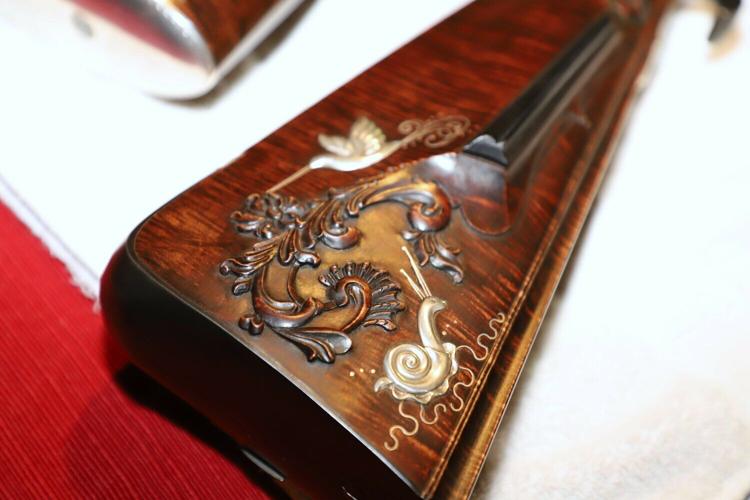
Many decades later, his interest in creating a beautiful rifle is as strong as ever. Laid out on a table were several flintlock rifles, each one intricate and unique with carvings and metalwork. He picked up one of the guns and began to explain.
“The barrels are what we call swamped. The barrel is a quarter-inch smaller in the waist (the parts of the barrel include muzzle, waist, and bridge.) You can see this is tapered,” he said as he pointed to the slimmer portion of the barrel. “That takes weight out and adds elegance. All my barrels are swamped.”
What begins as a hunk of wood is transformed into an art under his skilled hands. He’s a fan of working with curly maple.
“It’s a nice wood because the hardness gives you a crisp sharp line - if you know how to do it. Soft maple wants to sand away or the sharp edges have a tendency to roll over,” he said.
Even the smallest detail - like the hinges on the rifle’s patch box - is made by Denton. His guns are usually iron-mounted but he has constructed brass-mounted guns on request. Some rifles take as long as three years to complete, but most are completed within a year. The Southern Mountain Rifle, the simplest in design, takes the least amount of time.
He has no guess on how many he’s made, he said, but he’s been making them for more than 50 years, since he was about 20. He first made guns for himself, but soon began being commissioned to create rifles for others.
Every rifle is fully functional, but the commissioned guns often have more in common with a Picasso than a weapon. Most customers aren’t professional riflemen and choose to hang the gun in a place of honor and high visibility in their homes.
“(In the design process) you’ll change it a thousand times. That’s what makes it fun. It doesn’t necessarily get better and better, it just gets different until you like it,” he said.
Each project begins with a pencil sketch. He’s not terribly interested in the customer’s feedback and he doesn’t look back at previous designs for fear of accidentally copying himself.
Most customers understand his approach to design.
“They’ll say, ‘Just make it like you are doing it for yourself.’ And I said, ‘You took the words right out of my mouth.’ … That’s the easiest way to do it. The guys who know what I do don’t ask me to do anything ridiculous.”
He then laughed as he recalled a special request.
“I did have one guy ask me if I could put a beaver on the gun. I said, ‘Yeah, but I’m not going to.’”
He incorporates his gun-making philosophy into how he creates guitars and banjos. He knows what he wants. And he focuses more on the feel of the instrument than on the sound.
“The sound is the last thing I think about,” he said. “I could put strings on that table (gesturing to his dining table) and make it sound good. I just need an amp I like the sound of. And the pickup will do 90% for you.” A pickup converts the vibrations of the strings into electrical signals.
And making an instrument sound good is something he knows how to do. Denton began playing music when he was about 10. Even as a young boy, he would play eight to 10 hours a day.
He was a big fan of Earl Scruggs. He taught himself to play like the famous musician by watching him on television and slowing down his records on the turntable.
“I could pick up the sequence and that’s the way I learned it. No one around here taught it,” he said.
He did have the opportunity to meet his musical hero. When he was about 12 or 13, Denton went backstage after a concert Scruggs played in Asheville.
“I played Cannonball Blues for him. I didn’t play it well, but I played it for him anyway,” he said.
He did receive some great advice from the musician. Scruggs showed him how he could cut the thumb pick so it would better stay on his young hands.
His banjo-playing ability took him to the Grand Ole Opry stage at the young age of 18. Those were in the days of Minnie Pearl, Jimmie Dickens, Tom T. Hall, Marty Robbins, and Stringbean. He went up to Nashville, auditioned, and that same night was on stage at the Ryman Auditorium with Jim and Jesse and the Virginia Boys. He had been listening to their albums so he knew their songs well.
When asked how he felt about playing at such an important venue, he said, “I didn’t think much about it. I was too stupid.”
After that first night, he joined the band on the road - coincidentally in the old bus that had been used by Lester Flat and Scruggs.
He also had stints on two popular music shows. For about two years, Denton played on the “Country Boy Eddie Show” on WBRC in Birmingham, a variety show where the singer Tammy Wynette got her first big break.
“Eddie was the Arthur Smith of Birmingham,” he said then went on to explain that Arthur Smith hosted a popular TV show out of Charlotte and wrote “Dueling Banjos” (originally titled Feudin’ Banjos). “People call that writing. I hate that song.”
“The Tommy Faile Show” in Charlotte was also a musical home for Denton.
“Arthur and Channel 3 (WBTV in Charlotte) had a falling out so he went to Channel 9 (WSOC in Charlotte) and Channel 3 gave Tommy Arthur’s show,” he said. “Mom found out about it, had some kind of tape that she sent to Tommy. He called me and said next time you are home, come up and do the show. I did that a couple of times and then he hired me. And I stayed with Tommy for seven years.”
Perhaps the biggest bluegrass compliment Denton received came from Josh Graves, the longest-serving member of the Foggy Mountain Boys (backing band of Flatt and Scruggs).
“I first met him and played with him in Lenoir,” he recalled. “He said I played like Earl. Josh and I never had to rehearse. For two years, we never rehearsed. Anything he named I knew how to play because I had studied it for five years.”
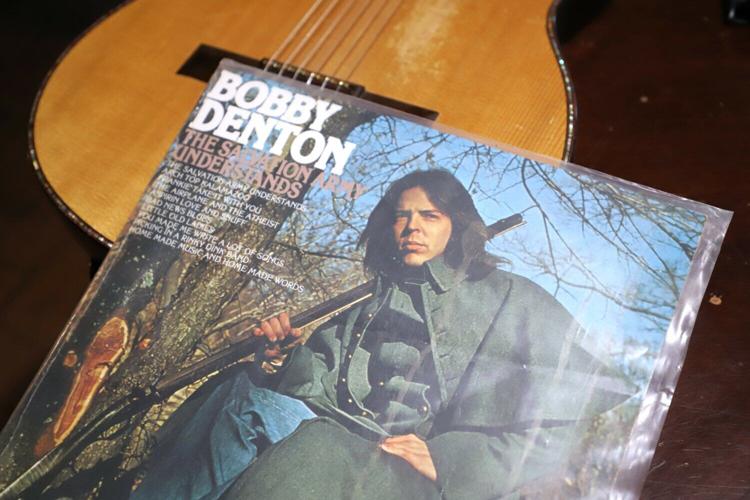
Denton did not only play for other artists. In 1982, he put out an album “The Salvation Army Understands.” Fittingly, the album jacket features a photograph of Denton with a rifle. He wrote the lyrics and music for all but one song.
“I’m no Glen Campbell but I can sing on key,” he said. “I recorded this album when I worked in Birmingham. I believe it was paid for by Pepsi-Cola and produced in RCA Studio B in Nashville by Henry Strzelecki (Chet Atkins’ bass player).”
RCA Studio B is often credited as the birthplace of the “Nashville Sound” and was the recording home of such musical legends as The Everly Brothers, Chet Atkins, Dolly Parton, and Elvis Presley.
“I initially wanted to be a working musician and go out and play the banjo for a good band and that’s what I did. It worked. But then I thought, I sure wish I could write songs and then I did. There’s an art to writing songs. It’s not just luck. And it’s not genius necessarily. It’s craft. You learn what is going to be a song and what isn’t,” he said.
Now in his 70s, he still has the hope of writing a song that is recorded by a major artist.
“But that’s a very hard thing to do. I never give up. I’m always writing but it’s not something I dwell on.”
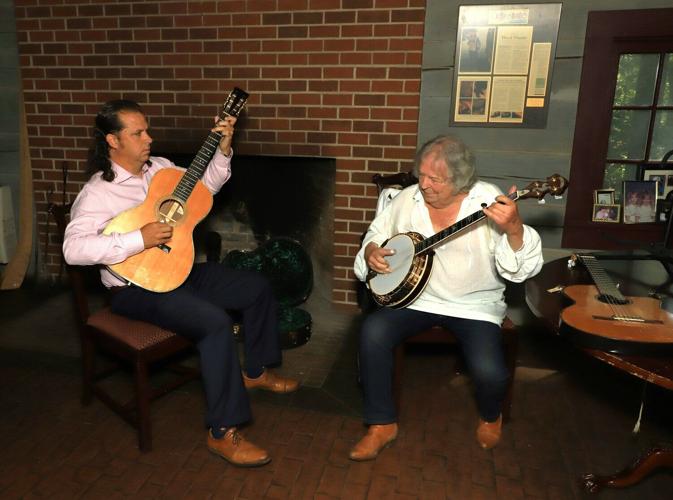
Throughout this conversation with Denton about music and rifles, he is joined by friends and family. Rob, his son and a local attorney, was quick to point out distinctive elements in the rifles produced by his dad and highlight many of the famous musicians who crossed his path.
“Oh, he gives me credit for everything,” Denton said. “I say, ‘Robert, you shouldn’t do that.’”
Rob continued anyway. Sheryl Crow’s bass player points to lessons he took as a 12-year-old from Denton as instrumental to his success. Reggie Harris of The Harris Brothers also throws due credit Denton’s way.
“With a banjo, Dad can jam,” Rob said. “I’ve seen him sit in with rock bands. Seriously, Southern rock, and Dad takes a break on a song he’s probably never heard. Some old Southern rock song that they’re playing and Dad’s playing and all of a sudden he takes off on a break in a rock song with a banjo that blows their minds.
“From a 10-, 11-, 12-year-old boy learning from a radio or a record or a TV, by himself, playing 8, 10, 12 hours a day. And that spark has led us to know people like Artimus Pyle, Doc Watson, Chet Atkins, Sheryl Crow … all because of his drive to become a great banjo player.”
Denton is a perfectionist. He’s not satisfied with playing well enough. With Denton on banjo and Rob on guitar, the duo played “John Hardy.” Denton also played “Cannonball Blues” on guitar followed by “You Are My Flower.”
He apologized for what he said was less than his best.
“Right now I’m not at the top of my game,” he said, although everyone else in the room remained amazed by his obvious talents.
He prefers playing later in the day.
“An hour or two from now … then I feel like I can’t miss. When you get in the groove you have to try to mess up,” he said.
“You’re just a second-, third-shift guy, that’s what it is,” joked his son.
Ed Phifer, who has known Denton for decades, recalled a time when he was practicing fingerstyle guitar with the song “Windy and Warm.” Once he thought he had it, he played the song for Denton who was not impressed.
“When I asked what I did wrong, he told me ‘Everything,’” Phifer remembered.
When he pushed his friend for more information, Phifer said Denton elaborated, “Your right hand is wrong and your left hand is wrong. I asked if he at least could tell what song I was playing and he said, ‘It’s supposed to be “Windy and Warm” but it’s not.”
Denton said he didn’t remember this ever happening, but the glint in his eye showed that the story could be true.
Creating music and rifles are clearly passions of Denton’s but a new interest is taking his time now: making his own quill pens from turkey and goose feathers.
“I’m working on my handwriting now and my pens. I’m not interested in calligraphy. I just want to do a really nice handwriting. Calligraphy would be a full-time job and I won’t live long enough to be a good calligrapher.”
Don’t bet against that.
Angela Kuper Copeland is the arts & entertainment editor at The Paper. She may be reached at angela@thepaper.media or 828-445-8595, ext. 2003.




















(0) comments
Welcome to the discussion.
Log In
Keep it Clean. Please avoid obscene, vulgar, lewd, racist or sexually-oriented language.
PLEASE TURN OFF YOUR CAPS LOCK.
Don't Threaten. Threats of harming another person will not be tolerated.
Be Truthful. Don't knowingly lie about anyone or anything.
Be Nice. No racism, sexism or any sort of -ism that is degrading to another person.
Be Proactive. Use the 'Report' link on each comment to let us know of abusive posts.
Share with Us. We'd love to hear eyewitness accounts, the history behind an article.