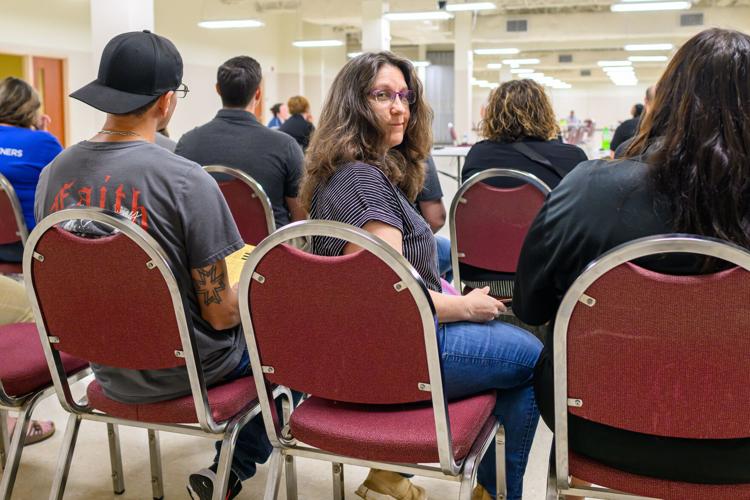
Terry Doyle, a sociology professor at Western Piedmont Community College, sat in jail after one of the rounds. She brought students from her social problems class to learn first-hand from the simulation.
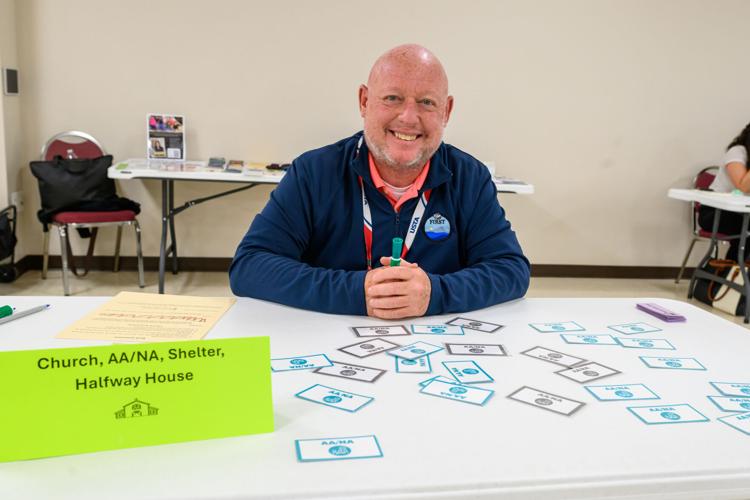
Participants flipped cards at the AA/NA station before Allen Foiles marked their play cards, indicating if they ‘attended’ and didn’t cause problems during the meeting.
The 12-minute timer ended. The host announced, “Time’s up!” and most of the Reentry Simulation participants dejectedly returned to the area of the room partitioned as the “jail.” For many, it wasn’t the first time sitting in the section and definitely wouldn’t be the last before the event finished.
On April 16, the Burke County Opioid Response team, in conjunction with the North Carolina Department of Adult Corrections, hosted a reentry simulation at the Foothills Higher Education Center.
The reentry simulation gave people a quick, two-hour sample of what being released from incarceration is like, accentuating the various, time-consuming requirements and hurdles that often land people back in jail, even when they’re taking every measure to avoid that outcome.
The event invited participants to pretend they’d recently been released from prison, each receiving a profile card and a “Life Card,” indicating their character’s backstory and weekly checklist.
Terry Doyle, a sociology professor at Western Piedmont Community College, sat in jail after one of the rounds. She brought students from her social problems class to learn first-hand from the simulation.
JACOB CHRISTOPHER / THE PAPER
With reentry awareness becoming a more prominent topic across the state — due to increased political discussion and initiatives introduced to reduce recidivism — simulations like the one held last Thursday are becoming more common, giving the general public a taste of life as a person leaving imprisonment.
Of all 34,718 offenders in the state, both on probation and coming from prison combined, about 30% were arrested again within two years of release, with 23% ending up incarcerated again, according to a 2026 correctional program evaluation of FY 2023 from the North Carolina Sentencing and Policy Advisory Commission.
“There are just so many barriers that the system has in place, and it’s hard to navigate those things,” said Brandi Greer, deputy director of Burke County Opioid Response. “This is really a good example of how hard it is to get reintegrated back into society and conquer those systems.”
HOW THE GAME WORKS
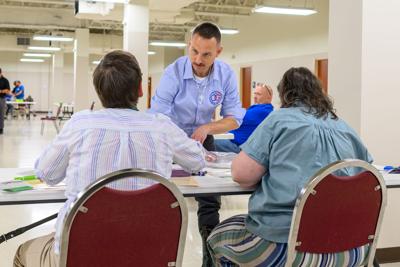
Every 12 minutes played out as a week, and participants raced between tables labeled as employment, the bank, treatment, and Alcoholics Anonymous/Narcotics Anonymous (AA/NA), attempting to finish all of their tasks before each of the four rounds ended.
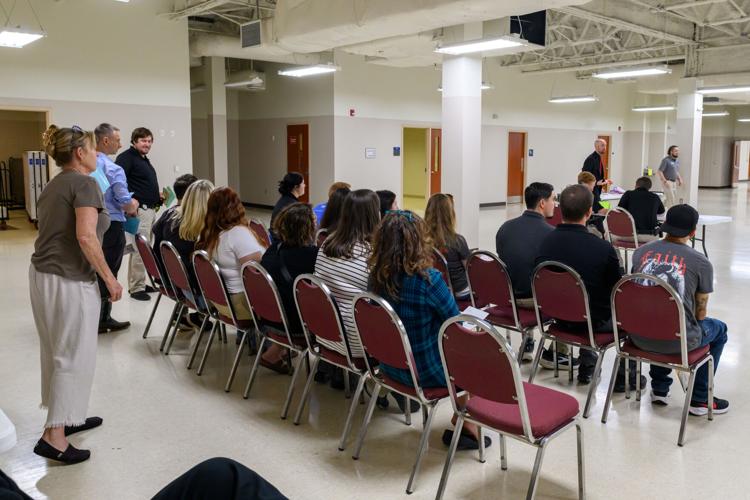
The view from the ‘jail’ after the first round of the reentry simulation. Several people stood because there weren’t enough seats.
JACOB CHRISTOPHER / THE PAPER
If they failed, they were sent to jail. If they wound up in jail, they had to pay $50 in bail to get out, and past the second round, they had to stay if they couldn’t pay.
Different profiles came with different possessions, ranging from three forms of identification, which were needed at all tables to participate aside from the “ID/DMV” table, to items that could be pawned or sold for extra cash.
Depending on a participant’s character card, they could spend the first portion of their “week” at work, which took seven of the 12 minutes if they were full-time employees.
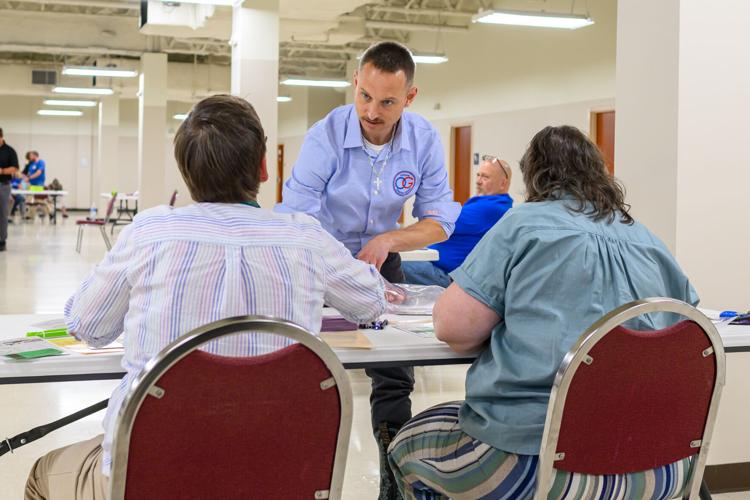
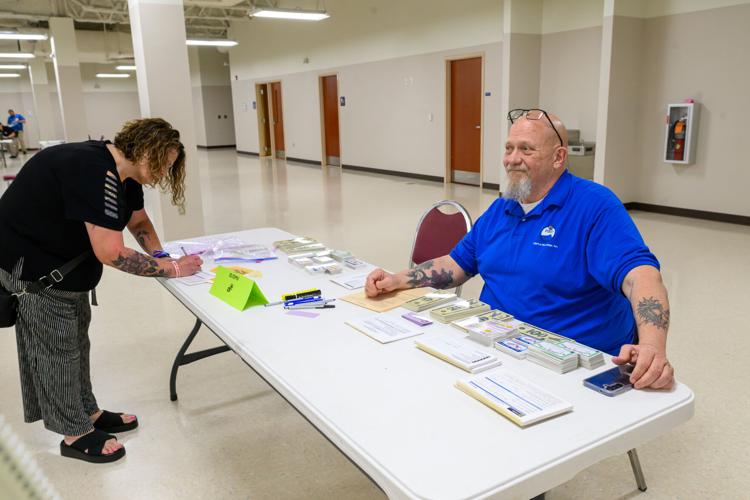
Thomas Wilkinson waits on a participant to fill out mock forms for identification at the ID/DMV table.
JACOB CHRISTOPHER / THE PAPER
Participants sat in a designated section and filled out a crossword puzzle while their time slipped away.
“It’s really eye-opening,” said Jennifer Gold, director of the Burke County Children’s Advocacy Center, as she sat in the work zone. “(It’s) totally raising my awareness. Things that — for me, in my day-to-day, are so easy — are so difficult during that reentry.”
Those lucky enough to have a job then had to visit the bank to cash their checks, before going to pay rent, pay for food, do a “urine analysis” — which comprised of randomly flipping a card to see if they were positive or negative for drug use — and going to AA/NA, where individuals also flipped a card to see if they got through the meeting without incident.
Participants flipped cards at the AA/NA station before Allen Foiles marked their play cards, indicating if they ‘attended’ and didn’t cause problems during the meeting.
JACOB CHRISTOPHER / THE PAPER
As participants visited each table, they used a limited number of transportation tickets, which they started the game with. For example, one round at work cost five transportation tickets, mimicking five days of employment.
If participants didn’t use their last transportation ticket to get to the transportation table, they had to borrow or buy tickets off other players, or risk landing in jail for not finishing their tasks.
It seemed like no matter how much a participant rushed, saved money, and tried to be strategic, jail was highly probable at the end of every round.
Keep it Clean. Please avoid obscene, vulgar, lewd,
racist or sexually-oriented language. PLEASE TURN OFF YOUR CAPS LOCK. Don't Threaten. Threats of harming another
person will not be tolerated. Be Truthful. Don't knowingly lie about anyone
or anything. Be Nice. No racism, sexism or any sort of -ism
that is degrading to another person. Be Proactive. Use the 'Report' link on
each comment to let us know of abusive posts. Share with Us. We'd love to hear eyewitness
accounts, the history behind an article.
























(0) comments
Welcome to the discussion.
Log In
Keep it Clean. Please avoid obscene, vulgar, lewd, racist or sexually-oriented language.
PLEASE TURN OFF YOUR CAPS LOCK.
Don't Threaten. Threats of harming another person will not be tolerated.
Be Truthful. Don't knowingly lie about anyone or anything.
Be Nice. No racism, sexism or any sort of -ism that is degrading to another person.
Be Proactive. Use the 'Report' link on each comment to let us know of abusive posts.
Share with Us. We'd love to hear eyewitness accounts, the history behind an article.