



“Bloody Burke,” a phrase that seems old as time in this Western North Carolina county.
Ask local historians, who are community archivists for Burke County, and you’ll hear various ideas on where the term originated. Ideas, but not a specific pinpoint in history.
Far back in Burke’s history in 1777, the county was formed from Rowan County and was named for Thomas Burke, who was a delegate and later governor of North Carolina. The county was founded after the Revolutionary War, a frontier and rigorous period for the area.
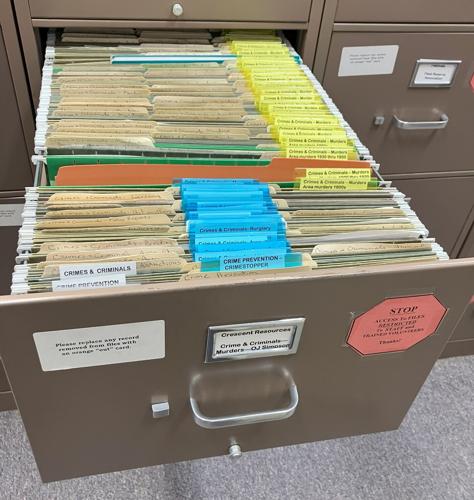
Through newspaper clippings, N.C. Curator Laurie Johnson found different accounts of “Bloody Burke.”
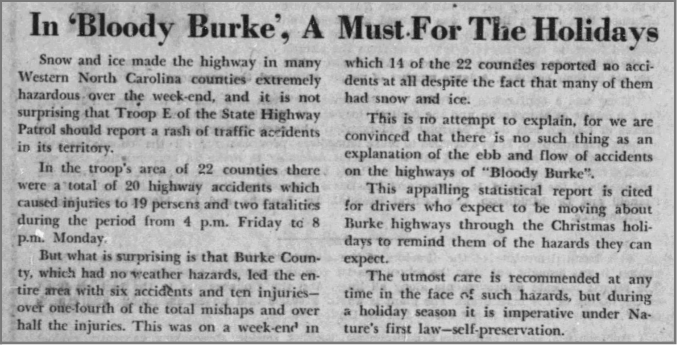
One clipping was from Dec. 23, 1954, called “In ‘Bloody Burke,’ A Must for the Holidays.” It details statistics of accidents in the area due to weather, but points to the six accidents and 10 injuries that took place in Burke (one-fourth of total accidents in 22 counties and over half of reported injuries).
“This is no attempt to explain, for we are convinced that there is no such thing as an explanation of the ebb and flow of accidents on the highways of ‘Bloody Burke,’” the article states.
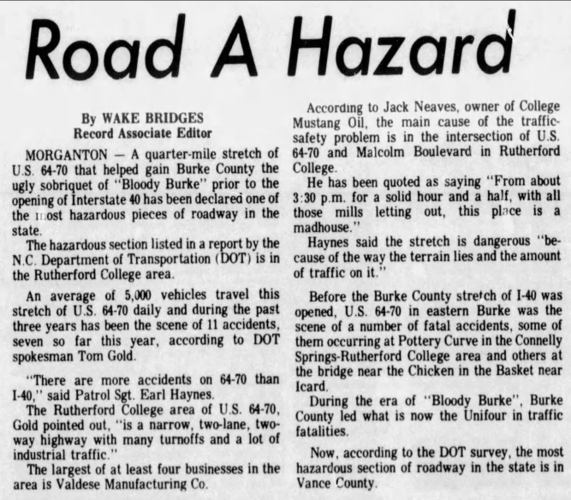
Another article (Dec. 2, 1980) called “Road A Hazard,” points to a “quarter-mile stretch of U.S. 64-70 that helped gain Burke County the ugly sobriquet of ‘Bloody Burke’” was deemed to be “the most hazardous pieces of roadway in the state.”
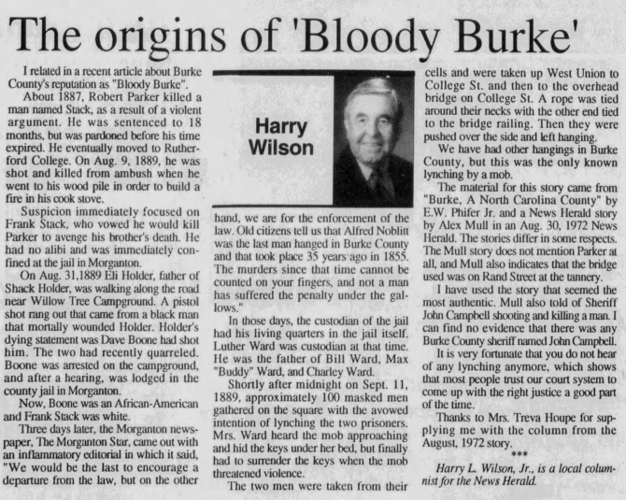
“The origins of ‘Bloody Burke’” (column by Harry Wilson) refers to the 1889 lynching of two jailed men over a railroad bridge in Burke: a white man named Frank Stack, and a black man named Dave Boone. Stack had allegedly killed Robert Parker, who had previously vowed to kill Parker to “avenge his brother’s death.” Boone had allegedly killed Eli Holder, the father of Shack Holder.
A mob of 100 masked men went to the jail and took the two prisoners after threatening the custodian of the jail. They were taken to the bridge over College Street and were pushed over the edge with ropes around their necks.
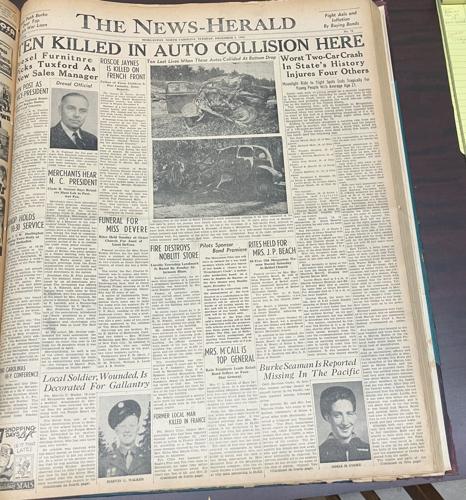
The last column she shared was by Glen Beaver in November 2017, who detailed a December 1944 car accident with 10 men dead and four injured. Two cars of “partygoers” were bar hopping and later in the night, crashed head-on into one another.
For another perspective, visit the N.C. Room at the Morganton Public Library, and volunteer Dottie Ervin can walk you through examples in history.
As she hums the song, Ervin suggested the tale of Tom Dooley (Tom Dula), who was hanged in Statesville for the murder of Laura Foster in 1968.
Or Frances “Frankie” Silver, who was executed in 1833 for the murder of her husband, Charlie Silver, and was the only woman hanged in Burke County.
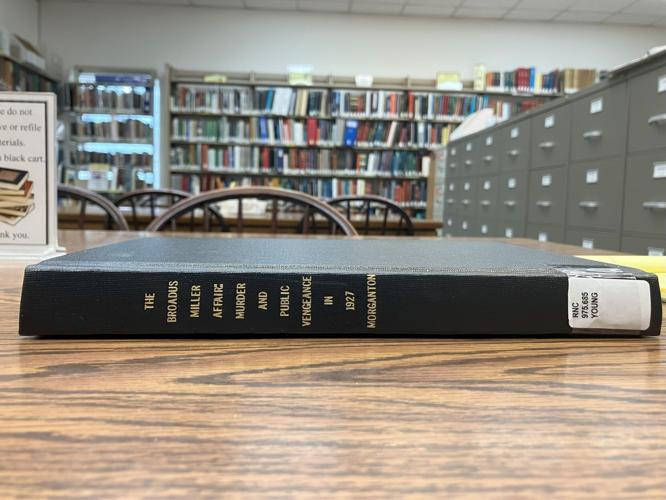
Another piece of history that Ervin thought to be a possible starting point of Bloody Burke occurred in the summer of 1927. Broadus Miller, a 27-year-old black man, was accused of murdering 15-year-old Gladys Kincaid, a white girl.
On the evening of Tuesday, June 21, Kincaid was heading home after a shift at Garrou Knitting Mill, but did not make it home. Eventually, her brother found her in a clump of bushes with a massive head wound, with a short iron pipe beside her on the ground.
Kincaid was still alive when found, but she died later that evening at Grace Hospital, then located where CoMMA now stands.
A massive, nearly two-week manhunt ensued with law enforcement from Burke, Catawba, and Caldwell counties. Once Miller was found in the mountains and shot to death, he was taken back to Morganton on July 3 and was dragged and publicly displayed on the courthouse square.
Surrounding each of these events, other articles detailed murders, crashes, and other violent crimes.
To locals, Bloody Burke derives from something different, but it all comes down to tragic stories that are part of our history.





















(0) comments
Welcome to the discussion.
Log In
Keep it Clean. Please avoid obscene, vulgar, lewd, racist or sexually-oriented language.
PLEASE TURN OFF YOUR CAPS LOCK.
Don't Threaten. Threats of harming another person will not be tolerated.
Be Truthful. Don't knowingly lie about anyone or anything.
Be Nice. No racism, sexism or any sort of -ism that is degrading to another person.
Be Proactive. Use the 'Report' link on each comment to let us know of abusive posts.
Share with Us. We'd love to hear eyewitness accounts, the history behind an article.