


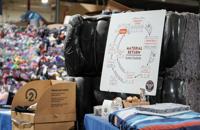


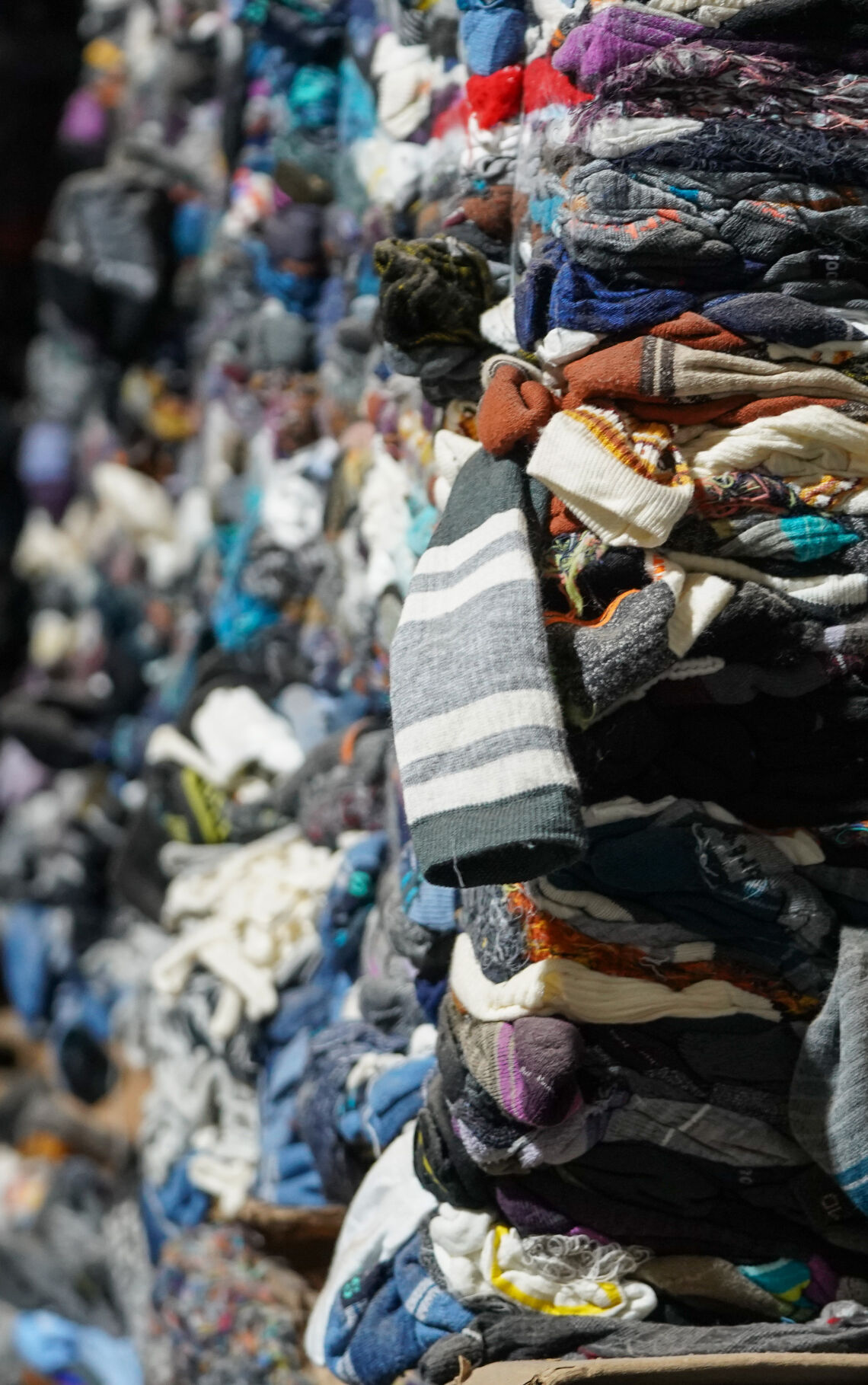


Material Return is transforming the textile industry by keeping industrial waste out of landfills and championing environmental sustainability.
And, in recent days, the company has worked to turn old T-shirts into blankets to be given to the victims of Hurricane Helene.
Powered by The Industrial Commons, Material Return was founded in 2017 with a mission to create a greener future, making effective use of millions of tons of textile waste in the country every year.
Material Return pioneers a circular supply chain, recycling textile waste into custom solutions for local manufacturers and national brands.
The circularity is directly in line with the company’s mission to keep industrial textile waste out of landfills.
“All of the textile mills we talked to said they didn’t have a way of recycling … Most of them were putting (their waste) in the landfill,” Bob Carswell, research and development director at Material Return, said. “Now that we’ve gotten the equipment we need, the business actually works and makes sense.”
According to Carswell, research and development for the process and for the necessary machinery took nearly three years to perfect.
Carswell credits Molly Hemstreet and Sara Chester, co-founders and co-executive directors of The Industrial Commons, for the company’s ability to help new businesses get incubated.
The Industrial Commons assisted with grant funding opportunities that account for $2 million worth of production equipment for Material Return.
“They helped us get the grant funding to help purchase this equipment and do all the research and development we’ve been doing for the past five years,” Carswell said. “We had to build it out. It took a good two to three years to figure out what equipment would work best.”
In 2021, the company expanded its operations and acquired additional machinery, enabling production to begin that same year.
“They were instrumental in helping us get that early investment to build out infrastructure to make this business long term scale what it needs to be,” Carswell said.
Material Return recently partnered with Opportunity Threads, a cut-and-sew manufacturer, and Project Repat to recycle textile waste from a project in which Project Repat turned T-shirts into blankets for families in western North Carolina affected by Hurricane Helene.
“They make really nice memory quilts. These are technically recycled textiles because they’re used T-shirts that would have gone to landfills,” Carswell said. “We actually recycle all the waste from this process.”
According to Carswell, the Project Repat took the chest and logo out of the shirts to make the memory quilts. Material Return processed waste from that process to create yarn.
“They get a T-shirt to manufacture a blanket, they stamp the chest out and we get the sleeves, the belly and the back, and all that stuff,” Carswell added.
CIRCULAR SUPPLY CHAIN: The Process
According to Carswell, Material Return is one of the first businesses in circular production. Material Return’s focus is manufacturing recycled textile waste from apparel goods including anything knit or woven.
The material goes through processing stages and machinery to create yarn that is sold back to weaving, knitting, or hosiery mills to create more products.
The material first goes through a grind or garnetting machine, which Material Return contracts out to two third-party companies based in South Carolina.
When the material reaches Material Return, it goes through a carding machine that cleans and makes the fibers parallel — the first step in the yarn making process.
After, it goes to the spinning machine where it’s spun into a yarn and ready to be sent to mills.
Bolek Strzelecki, director of operations, offered more insight.
“The whole idea is to reduce barriers of entry for brands to get into circularity programs,” Strzelecki said. “We’re that one-stop shop, all domestic. Having that opportunity for a brand helps them segue into that kind of future in circularity for a brand.”
In the United States, 92 million tons of textiles waste are produced each year with only 12% of it being recycled.
Marty Anderson, senior director of business development, is the liaison between Material Return and weaving companies, knitting mills, and hosiery mills, who purchase the company’s yarn to make products.
“We kind of have to educate them about it so they choose the right blend of yarn they need to use to make the product they’re wanting,” Anderson said.
Material Return works with local manufacturing companies, including Opportunity Threads, Project Repat, Smartwool, Basset Furniture, Valdese Weavers, Sew Co, TS Designs, and more.
Into The Future
Carswell spoke about Material Return’s contribution to a greener environmentally friendly future and its positive impact on the economy.
“It’ll lower the carbon emission rate because you’re using local textile waste that’s collected locally. You’re not shipping it all the way overseas to get it processed and shipped back to us and build out to retail,” Carswell said.
In addition, Carswell said the process will reduce dependency on petroleum, plastics, cotton, and material influx.
“Circularity framework is all about reducing the need for new material influx,” Strzelecki said.
Carswell predicts the push for the country’s move to a more environmentally friendly country will soon require Extended Producer Responsibility, requiring manufacturers to have an end-of-life solution for their items.
“It’s a European Union policy right now that’ll soon come to the United States,” Carswell said. According to Carswell, circularity is a great solution for those companies.
According to Carswell, the company will likely spend about $2 million next year on new equipment to expand the business.
Strzelecki is currently working on life cycle analysis, which will give the company more information about the fibers that textiles are made from.
“The goal is to mature the operation,” Strzelecki said.
Material Return collects over 750,000 pounds of textile waste per year. Carswell said the company has produced nearly 100,000 pounds of yarn from the waste collected this year.
“That number goes up every day. I want to double or triple that next year. I want everything we’ve collected to be sold back out … 100%,” Carswell said.

























(0) comments
Welcome to the discussion.
Log In
Keep it Clean. Please avoid obscene, vulgar, lewd, racist or sexually-oriented language.
PLEASE TURN OFF YOUR CAPS LOCK.
Don't Threaten. Threats of harming another person will not be tolerated.
Be Truthful. Don't knowingly lie about anyone or anything.
Be Nice. No racism, sexism or any sort of -ism that is degrading to another person.
Be Proactive. Use the 'Report' link on each comment to let us know of abusive posts.
Share with Us. We'd love to hear eyewitness accounts, the history behind an article.