



Tariffs are not a one-way, one-time transaction.
An item, a component, a part can make multiple trips across borders, accumulating tariff taxes along each step in the process of becoming a final product ready for consumer purchase.
Take furniture as an example. The final piece of furniture ready for retail may be made in China, and therefore is subject to inbound tariffs. But the offshore furniture manufacturer may buy the lumber, it could be Pennsylvania Black Cherry, from the U.S.A. And that foreign manufacturer may charge a tariff on the inbound Black Cherry lumber. And the U.S.A. may charge its tariff on the imported finished piece of furniture.
Automobiles are other examples. The supply chain for car parts spans the globe and materials move all over the world all the time in the process of becoming the new car sold by dealerships right here in our backyard. Each step could be subject to individual tariffs, adding to the retail cost.
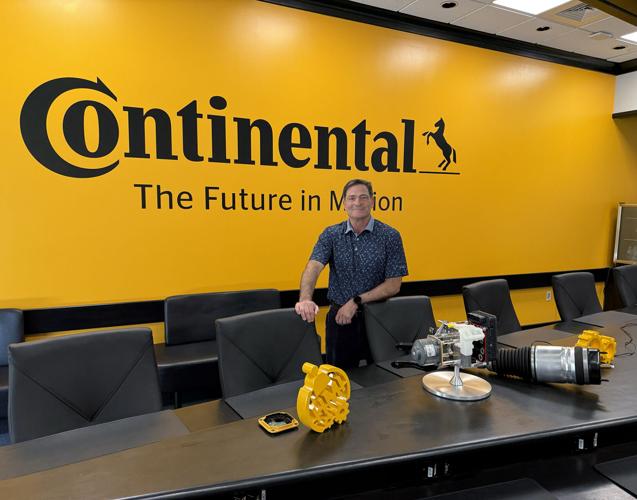
Morganton is home to two Continental-Automotive plants that build sophisticated braking and suspension systems for about 25% of the car market. The modern, high-tech, clean-room operations are Continental’s primary brake and suspension divisions in North America.
Continental-Automotive is based in Frankfurt, Germany, with 2024 sales of about $21 billion and 92,000 workers, according to corporate profiles. (See related story Page ##)
The Morganton operation employs about 400 people in its two plants on Jamestown Road on either side of Interstate 40. Plant 1, the larger facility, is a 278,000 plant on 40 acres adjacent to the east-bound lanes of I-40. It manufactures sophisticated braking systems. Plant 2, on the north side of I-40 builds, is a 62,000 square-foot plant on five acres and builds suspension units.
Nearly one out of every four cars you see on the street are build using these Morganton-made systems.
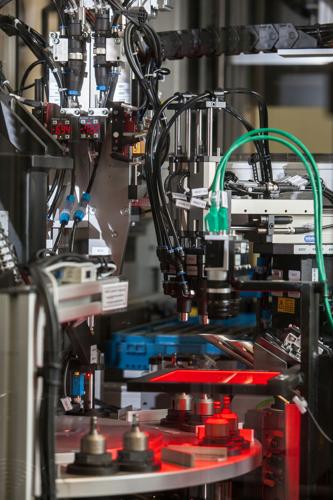
These Morganton plants receive components from around the globe and, in a tightly choreographed process, assemble them into advanced, computerized braking and suspension safety systems for BMW, Volkswagen, and all of the Big Three (Ford, GM, and Stellantis). Sales from Morganton’s plants are not publicly available.
With the rapid emergence of computerized, driver-assist, safety systems, it is a competitive, cost-conscience, high-tech industry. Any slippage in the just-in-time process has cost consequences felt up and down the supply chain, from workforce count to retail price. Profit margins are thin and carefully managed.
The Morganton operations are overseen by David Jones, 64, an 18-year veteran with Continental who serves as general manager. Seated in his office in Plant 1, Jones described in nontechnical terms the potential effects of tariffs in the firm’s global supply chain logistics. The conversation occurred during the heat of the tariff battle and two days before President Donald Trump announced a 90-day pause on tariff hikes, except for China.
“For example, our valve block, which is that shiny aluminum piece that makes up the bulk of the braking unit: This raw block comes from a facility in Texas. Today that would cross the border into Mexico to get machined. It would come back to us to have some more work done to it, to create a (sophisticated braking system), and then we would send it back to a plant in Mexico that makes the automobile,” Jones said. “And then the automobile would come back into the United States to be sold.”
“So just as an example, every time that thing goes back and forth, right now it would get tariffed by one country or the other. So that’s four or five tariff steps for a component that ends up in a vehicle that ends up here, that might end up with the Ford dealer,” he said. “Because some of our major Ford plants that we provide product to, the actual vehicles are made in Mexico. A good many of those on the lot right across the interstate, are made in Mexico.”
Compounding the issue for Jones and his internal financial strategists is the rapid evolution of the tariff imbroglio. (As this story was being prepared, President Donald Trump suddenly placed a 90-day pause on all tariffs except China. This move came just hours after the Administration’s nearly across-the-board escalation of tariff rates.)
“There are going to be a lot of finance people, a lot of accountants, a lot of auditors, tariff auditors, who have figure all this out,” he said. “Because it’s unchartered territory. It changes every day, changes every hour. None of us know exactly.”
“All the tariff talk has really created an enormous amount of confusion for us as a company,” he said. “We have many controllers and task forces working to try to understand what that would mean for us and how we would deploy it. So, an enormous amount of company energy and resources are being spent even trying to collect how we believe we would deploy it and execute it.”
“We all would like some clarity,” he said.
One thing is clear, he added. With the razor-thin margin of his operations he cannot absorb the strain of added tariff costs. “We can’t afford to carry all the burden of that, and we will not carry it all.”
On the bright side, Jones said that no local projects have been put on hold and for the time being it is business as usual.


























(0) comments
Welcome to the discussion.
Log In
Keep it Clean. Please avoid obscene, vulgar, lewd, racist or sexually-oriented language.
PLEASE TURN OFF YOUR CAPS LOCK.
Don't Threaten. Threats of harming another person will not be tolerated.
Be Truthful. Don't knowingly lie about anyone or anything.
Be Nice. No racism, sexism or any sort of -ism that is degrading to another person.
Be Proactive. Use the 'Report' link on each comment to let us know of abusive posts.
Share with Us. We'd love to hear eyewitness accounts, the history behind an article.