

A few weeks ago, I wrote about the serious drug problem impacting American and Burke teenagers. My conclusion was that the legalization of weed, and the use of more grounded educational approaches would do great things to counteract the rise in drug usage.
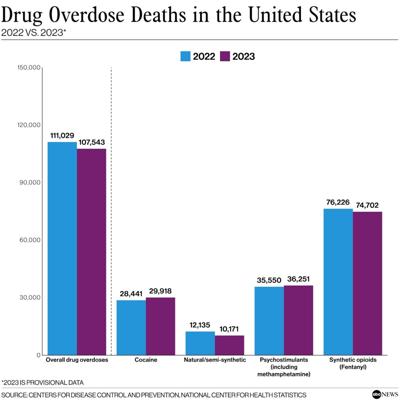
Now, I am returning to the topic of drug usage because the CDC announced last week that overdoses in the U.S. fell in 2023, by both reported and predicted measures. A reported drug death is when the government does a complete analysis of the body, including a toxicology report, and determines the death to be from an overdose.
“Predicted provisional counts represent estimates of the number of deaths adjusted for incomplete reporting” (CDC). From here on out, I will use predicted to measure drug overdoses, as reported often is ironically more inaccurate.
By both measures, however, drug overdoses decreased in America in 2023, and in North Carolina specifically, 2023 was a much better year in terms of drug overdoses. The country had 3.1% fewer drug overdoses in 2023 than in 2022, and in North Carolina, that number was 14.3%, which was the highest decrease in the Southeast, and fifth highest in America (Nebraska, Indiana, Kansas, and Maine were better).
And this is all great. For the first time in five years, overdoses have decreased. Really, this is a good sign, but there are a few issues that make this news a little less bright.
If March 2020 was the start of the Pandemic in America, we still have 1,293 more deaths per month than pre-pandemic levels in North Carolina. In America as a whole, 14 people die of an overdose for every European, even though we have half their population. And our deaths due to drug overdose per million is 17 times higher than the EU’s. Deaths are still very high: 108,000 Americans have died of a drug overdose in the past 12 months. In 2010, there were 21,000 deaths due to an overdose, so 13 years later, five times more people died due to an overdose.
The worst sign is that the DEA reported “no field office [in the U.S.] reported that fentanyl is less available or more expensive, either of which would point to a decrease in the supply," which is disappointing.
The sources of fentanyl in America (Mexican cartels fed by Chinese gangs) are not abating. In fact, the House Select Committee on the Chinese Communist Party found that the CCP “Directly subsidizes the manufacturing and export of illicit fentanyl materials and other synthetic narcotics through tax rebates.”
The Mexican cartels, the ones who export the finished fentanyl in fake pills, have little to fear from a Mexican government that attempts to coexist with the cartels in a “Don’t make me fight you by doing anything too stupid” sort of way, so the source of fentanyl has not lessened.
But the world isn’t all dark, despite all the gloom in this column; 4,000 fewer people died in 2023 than in 2022 from an overdose. That is a genuine gain, and momentum is momentum.
To have the drug crisis hit a ceiling, and even decrease is great news. What we can take from this slight reversal, is that some anti-fentanyl, anti-meth, anti-cocaine, and anti-street opioid programs are having some positive effects.
For example, the distribution of Narcan, a drug that reverses the effects of an overdose, if administered as quickly as possible, 93% of the time. And I encourage people to go buy Naloxone (Narcan), as the FDA approved its over-the-counter sale last year. You can buy Narcan in nasal spray form from Walgreens, CVS, Table Rock Pharmacy, etc.
We should also protect those who report drug overdoses. In states where those who report a drug overdose are protected from immediate arrest, there was a 14% reduction in overdoses. Those who use dangerous drugs in groups often wait to call law enforcement or never call law enforcement because they are often in a drug-induced haze, and they struggle to balance consequences in their mind as well as they could if they were lucid. By removing that fear from their minds, more will call the police/EMS who can help.
Besides improving access to Narcan and removing the fear of arrest, we should put more resources into rehabilitation. And no, I am not the first person to say that, probably not the ten millionth person to say that, but despite all of the talk about improving our rehab services and getting people off of dangerous drugs, we as a society, continue to not improve our drug-rehab services.
Only twice before has the number of drug overdoses decreased in a year: 1990 and 2018, so this is a genuine milestone. But each time after those declines, there was an increase. In 1990, only 8,400 overdoses across the entire country. Thirty-four years later, we have 107,000 deaths, so now is not the time to take a victory lap, but the time to redouble our efforts.
Henry Beall is a columnist for The Paper. He is a junior at Freedom High School.









(0) comments
Welcome to the discussion.
Log In
Keep it Clean. Please avoid obscene, vulgar, lewd, racist or sexually-oriented language.
PLEASE TURN OFF YOUR CAPS LOCK.
Don't Threaten. Threats of harming another person will not be tolerated.
Be Truthful. Don't knowingly lie about anyone or anything.
Be Nice. No racism, sexism or any sort of -ism that is degrading to another person.
Be Proactive. Use the 'Report' link on each comment to let us know of abusive posts.
Share with Us. We'd love to hear eyewitness accounts, the history behind an article.