












Car ownership isn’t what it used to be.
It’s become a financial sinkhole for many households and even obtaining a driver’s license has lost its sheen as a rite of passage among Gen Z (those born between 1997 to 2012).
This further clears the path for the passenger train revival we’re currently experiencing throughout the United States, and Gen Z is at the front of it — galvanizing local support to restore a proposed rail route between Asheville and Salisbury.
“Efficient passenger railways, especially in places like Morganton, would be incredibly beneficial,” says Noah Johnson, a recent UNC-Chapel Hill grad raised in Burke. “They would provide a vital transportation option for those unable to drive or fly, facilitate easier access to airports without the hassle of parking, and support college students by offering a reliable means of commuting without the need for a car.”
Gen Z Is Souring on Cars
as Costs Skyrocket
The high cost of cars is frequent fodder for young people eager to remain connected to other cities throughout the Tar Heel State.
But passenger trains' affordability advantage over cars is not always apparent. The costs of owning and driving a vehicle often get lost in the rattle and hum of our car-centric cities.
Let’s just compare some of these expenses.
The average payment of full coverage car insurance in North Carolina is $2,040 per year, or $170 per month, according to Bankrate, a personal finance company.
If you don’t own your vehicle outright in the United States, you can expect to pay an average of $735 a month for new cars and $523 for used ones in 2024, as reported by personal finance company Nerdwallet.
Throw in regular repairs, routine oil changes, licensing and registration fees, and gas (which is currently hovering near $3 a gallon) and you’ll find yourself staring at a rather hefty sum of money that is supposed to secure us the so-called “freedoms of car ownership.”
The sad reality is that few Gen Zers have many other transportation choices.
Our general lack of infrastructure for public transit — passenger trains in particular — means people with more modest means have to get creative.
Otherwise, they’re forced to shoulder the financial burden of car ownership (to say little of the guilt many also carry for further contributing to carbon emissions and worsening climate catastrophes).
This financial yoke and concerns over sustainability may help explain, in part, why so few Gen Zers are driving cars compared to older generations.
Many are either opting out of driver’s licenses completely or postponing this once-celebrated ritual that is fast becoming a cultural relic.
We may even call it passé.
In fact, the number of 16-year-olds with driver’s licenses has decreased by roughly 27% since 2000, USA Today reported in May 2024.
It’s no longer the rite of passage it used to be. And that’s not a bad thing. After all, younger generations are the ones who will have to live with the consequences of our fossil fuel society.
Train optimists, on the other hand, hope that skyrocketing car costs and consumers' increased environmental consciousness will spark youthful vigor for passenger rail.
“I appreciate trains for their cost efficiency,” explains Morganton native Jared Maksoud, when asked about the Asheville-Salisbury passenger rail route state officials believe could be restored within the next five years. “As a college student, I’ve used trains as great substitutes at a fraction of the cost I would’ve spent on Ubers or taxis since I don’t have a car.”
To him, cost-savings are obvious.
“My most recent train experience was on the Amtrak route from Baltimore to downtown D.C.,” he continues. “The entire hour-long trip cost eight dollars and the train was very modern. It saved me a hundred dollars for the whole trip and was super convenient.”
Many Catch the Passenger Rail
Bug While Traveling Abroad
Passenger rail is often only an option for people living in more densely populated metropolitan areas in the U.S., such as those in the Northeast Corridor that includes Boston, New York City, and the D.C. Beltway. This isn’t to say more small towns in America couldn’t support their own train stations.
Many more can.
It’s quite common, in fact, for villages or small towns in Japan, Germany, and Italy to maintain active train stops.
Bella Gialluca, a University of Florida student whose family has lived in Morganton for several years, was surprised by this while visiting Europe, a continent admired for its reliable train service and picturesque routes.
“The train made many stops before reaching the city, all at little Italian villages with no more than 15 houses each,” she recalls. “I imagine Morganton as being one of these little villages in the system of the Asheville-Salisbury line. I arrived in La Spezi relaxed and feeling rested even after about three hours of travel.”
This kind of regular service is largely a matter of choosing to invest in train infrastructure rather than continuing to subsidize oil companies and automakers. And until we build upon our pre-existing train routes, our young people will have to wait, frustratingly, until college or after high school, to experience the affordability passenger rail promises.
Similarly to her peers, Mary Margaret Collett didn’t experience the joys of passenger rail until she visited Europe.
“My interest in trains began when I traveled to France and Switzerland with my family a few years ago and had my first train experience,” recalls the Morganton native. “It was such a relaxing experience, and I felt a little sad coming back to the States because of our lack of infrastructure.”
For many young people who catch the passenger rail bug, it’s disappointing to return home to a region that lacks active train stations.
“While studying abroad in Italy, I took a number of memorable train rides that were not just notable for their beautiful views, but also for their convenience and efficiency,” explains Gialluca. “It felt ridiculous to me that we can’t have such extensive train travel across the U.S. Although we do to some degree, I have never lived in an area with train access.”
Young People Are Organizing
to Restore Passenger Rail
This may change in the near future, however. And Gen Z is active in making that happen.
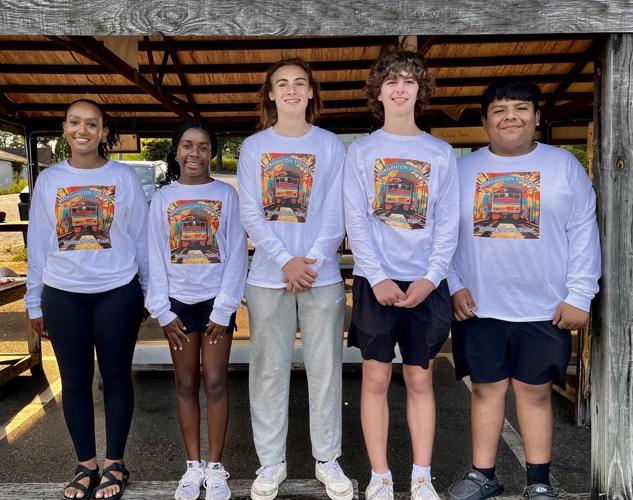
Just look at the efforts of Teens for the Train, a youth group started by Henry Beall, a senior at Freedom High School, to raise support for the proposed Asheville-Salisbury line.
If you’ve attended any of the local festivals or outdoor events this past year, you’ve likely spoken with some of these bright, energetic folks while tabling a booth with their parent group, Waiting for the Train, a nonprofit working to bring passenger rail back to western North Carolina.
The prospect of less expensive and more sustainable travel has Gen Z fired up. Maksoud believes that restoring the Asheville-Salisbury route would be transformative for communities throughout western North Carolina.
“Passenger rail is important for the entire country both for environmental health and cost-efficient travel,” he says. “As a Morgantonian, a cheap, safe alternative to flights or long car rides would revolutionize our town. I am most excited about the opportunity to travel to big cities at fractions of the costs that it would normally take.”
Establishing consistent train stations across the U.S. enables rural municipalities, such as Morganton, Valdese, and Drexel, to become more easily connected to larger cities, all while retaining their beloved “small-town lifestyles.”
Gialluca also sees passenger rail as a way to make higher education more affordable, as well.
“I believe passenger rail would provide our community with easier access to important North Carolina hubs like Raleigh and Charlotte without the hassle of mountain highway commutes,” she says. “Moreover, convenient travel within North Carolina and to other states might make it easier for people with few nearby options to pursue higher-level education.”
When asked why she believes passenger rail is so important for western North Carolina, Collett focuses on the added economic benefits it would bring to the Foothills.
“Passenger rail is important for our community because it provides efficient transportation for individuals who otherwise may not have access,” she says. “It can also help the local economy with potential tourism and create job opportunities.”
When that train finally comes rolling through Burke County, she already knows where she hopes to go: “I look forward to spending a day in Asheville without worrying about parking. It would be a great next step in having better public transportation throughout the entire state.”
Until then, the rest of us will have to resign ourselves to costly car ownership — and console ourselves with dreams of far more affordable train rides in the, hopefully, soon but not-too-distant future. That’s if Gen Z has its way.

























(0) comments
Welcome to the discussion.
Log In
Keep it Clean. Please avoid obscene, vulgar, lewd, racist or sexually-oriented language.
PLEASE TURN OFF YOUR CAPS LOCK.
Don't Threaten. Threats of harming another person will not be tolerated.
Be Truthful. Don't knowingly lie about anyone or anything.
Be Nice. No racism, sexism or any sort of -ism that is degrading to another person.
Be Proactive. Use the 'Report' link on each comment to let us know of abusive posts.
Share with Us. We'd love to hear eyewitness accounts, the history behind an article.