


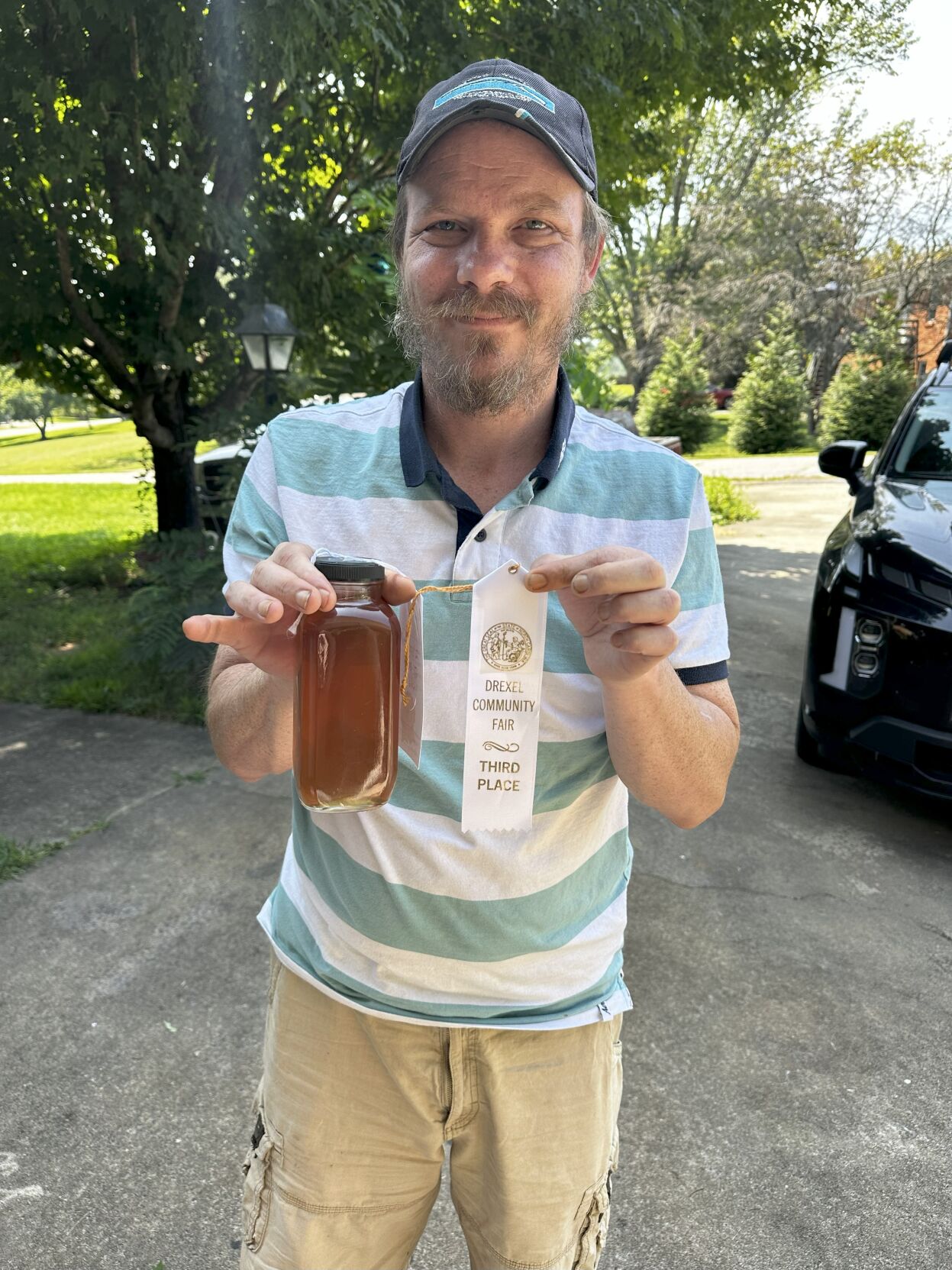
Climbing to the top of a 40-foot ladder while wearing sweats and a hoodie to capture a swarm of bees in a cardboard box was not 12-year-old Mark Shell’s idea of a good time.
For his father, a longtime beekeeper who did not believe in protective equipment, catching swarms was just one of the things his son needed to master.
During middle school, Shell took up the trumpet and then switched to the French horn in the 10th grade, determining that there was less competition in the French horn section, where he began winning all-county honors.
By the time he graduated from Central Davidson High School in 1998, Shell had his sights set on a music education degree at Appalachian State University.
Admitting that learning to play all the instruments in the band was more than he had bargained for, Shell’s grades at ASU suffered and he enrolled at WPCC in order to improve his grade point average.
While there, an Army recruiter suggested that he audition for the Army Band as a French horn player. After passing the audition, Shell signed up to attend the Army School of Music at Virginia Beach, Va., when the semester was over.
Not long after the 9/11 attacks, Shell called the recruiter, insisting that he would rather fight terrorists than pursue a career in the Army band.
To this day, he still tells everyone, “9/11 was my generation’s Pearl Harbor.”
In January 2002, Shell went to Fort Benning, Ga., for basic training followed by infantry school. As a machine gunner, he was assigned to the 2nd Infantry Division at Fort Lewis, Wash., the home of the first Stryker brigade.
A Stryker is an eight-wheeled armored vehicle, its purpose being to transport infantry squads while maintaining continuous, real-time communications and GPS data with other vehicles.
When Operation Iraqi Freedom, a large-scale invasion of Iraq, began in 2003, Shell was already at the Balad Air Base, a major airfield and logistical center, for six weeks when Saddam Hussein was captured.
From there, he went to Mosul, an area of heavy conflict and insurgency.
In an unexpected respite, Shell became a recruiter and by a long shot, was stationed in his hometown of Lexington, N.C., for 18 months.
He then transferred to Fort Hood, Texas as a sergeant in the Army’s distinguished 1st Battalion, 5th Cavalry Regiment.
The troop surge of 2007, an election strategy to address public discontent in the U.S. as well as widespread violence and instability in Iraq, resulted in Shell’s second deployment, where he was engaged in intense house-to-house urban warfare in Baghdad.
Back at Fort Hood in 2009, Shell received stop loss orders, involuntarily extending his military service which resulted in a third deployment in Iraq, this time in charge of logistics support to smaller bases surrounding Baghdad, as well as delivering humanitarian aid to the civilian population. He was discharged at Fort Hood in 2010.
For a time, Shell lived in the Lexington area, then moved to Morganton to help his mother take care of his grandfather, moving into the house with them.
He worked at the Western Youth Institution until it closed in 2013, then completed the Associate of Arts program at WPCC.
By the time his grandfather passed away, Shell was helping care for his father, who died in 2022. He noticed a few bees circulating around one of his father’s old hives on a warm January day.
Shell found the queen and a small nucleus of bees inside, no larger than a tennis ball, trying to stay warm.
Realizing that they would not survive on their own, he began feeding them a sugar solution and checked on them frequently. Since then, Shell has expanded the small colony to 12 hives.
Last year, the Orchard at Altapass, a nonprofit apple orchard on the Blue Ridge Parkway near Spruce Pine, N.C., needed a volunteer beekeeper.
Shell salvaged what was left of the hives after two black bear attacks in April. He brought everything to Morganton, rebuilt the hives and is nursing them back to health.
Next year, the bees will be returned to Altapass for the pollination season. All the while, Shell experienced a sense of peace and calm working with bees.
“Beekeeping has a lot of overlap for veterans,” he said. “You put on your gear, your adrenalin gets kicked up a little bit, you stay focused, follow the plan, and you’re ready for anything.”
With his background running LOGPACs (Logistics Packages) in Iraq, Shell, the junior vice commander of the VFW (Veterans of Foreign Wars) Post in Morganton, has helped obtain, store and distribute disaster relief supplies following Hurricane Helene in Burke and several other counties in western North Carolina.








(0) comments
Welcome to the discussion.
Log In
Keep it Clean. Please avoid obscene, vulgar, lewd, racist or sexually-oriented language.
PLEASE TURN OFF YOUR CAPS LOCK.
Don't Threaten. Threats of harming another person will not be tolerated.
Be Truthful. Don't knowingly lie about anyone or anything.
Be Nice. No racism, sexism or any sort of -ism that is degrading to another person.
Be Proactive. Use the 'Report' link on each comment to let us know of abusive posts.
Share with Us. We'd love to hear eyewitness accounts, the history behind an article.