

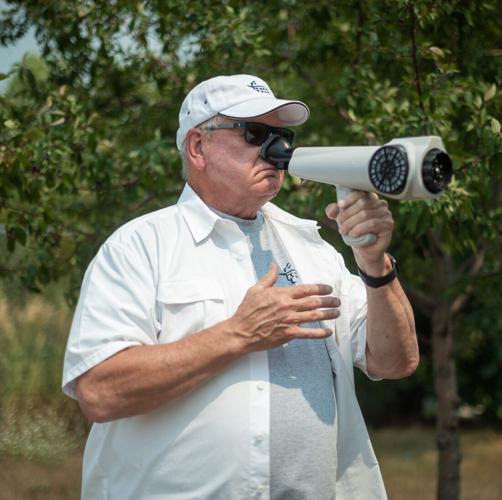


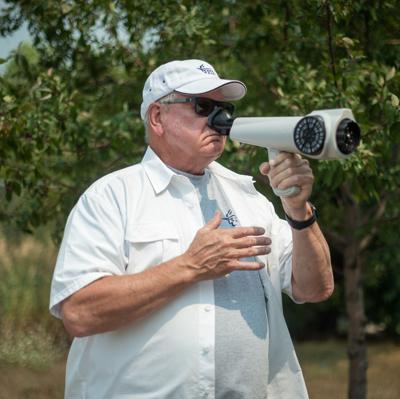
If you see a nerdy-looking guy walking down the street in Morganton with a bazooka strapped to his schnoz, fear not. He’s just checking the Bouquet de Poulet throughout town, a little “Hello There” from Case Farms’ chicken slaughterhouse.


VanNoppen
When the wind is just right, and the air temperature is just so, Morganton’s residents and visitors alike are seen scrunching up their faces and ever-so politely and gently asking, “WHAT IN THE HELL IS THAT SMELL?”
In Valdese, downtown can smell like fresh bread baking, thanks to the Waldensian Bakery (now under the unfortunate brand name Bimbo). Glen Alpine can smell like pancakes and bacon in the morning (during the United Methodist Church’s monthly Saturday morning breakfast).
You don’t see the nerdy guys in safety vests and Bazooka schnozes there. No need. They are not processing millions of chickens in those towns.
Case Farms corporately produces nearly a billion pounds of chickens annually for customers such as Kentucky Fried Chicken, Popeyes, and Taco Bell, according to ProPublica, an investigative nonprofit newsroom.
Burke County residents will consume an estimated 9.25 million pounds of chicken in 2026, according to the U.S. Department of Agriculture (USDA).
Of every 6-pound chicken that enters Case Farms, 25% to 30% is feathers, blood, and viscera. Do the math, and you get up to 2.7 million pounds of waste flushed into the local water (and often, air) systems in Burke alone.
No one disputes that Case Farms is a major employer. It ranks among Burke County’s top. It is also one of the city’s largest water customers.
Chicken is America’s most consumed animal protein. We love chicken. We just prefer not to smell the journey.
We’re getting to the Bazooka Schnoz. Be patient.
ProPublica once described a Case Farms smell as “a pungent fog.” The New York Times reported on an “oh-my-God smell” that teased investigators and then vanished with the wind.
Local residents describe aromas that are strong, offensive, and manure-like, seeping indoors and lingering through the evening hours.
Because of increasing resident complaints, the North Carolina Division of Air Quality (NCDEQ) has dispatched investigators to, well, investigate, the pungent eau de chicken in Morganton.
These state Smellagators are not hard to spot. Aside from the Official State Safety Vest, central to their examination is a rig that extends from an air-tight seal about the nose outward a foot or more.
It’s a Nasal Ranger, manufactured by St. Crois Sensory, Inc., a Minnesota firm where most of the year it’s too cold to smell anything except Curler’s shoes.
It’s a little odd looking, granted, especially when engaged with, and extending from, the face. It’s ingenious, nonetheless. The Schnoz-O-Meter.
It was invented in 2000 by Chuck McGinley, a chemical engineer. It’s a 14-inch gizmo described as binoculars for your nose, part radar gun, part bugle, part scuba mask. It comes with a shoulder strap, odor filter cartridges, comfort seals, and alcohol wipes. A sanitary leaf blower for your nostrils.
To use it, you hold the airtight mask to your nose and begin the noble act of professionally sniffing. The device dilutes stinky air with purified air, measuring something called Dilution-to-Threshold. It produces a “reading.”
I’ll give you a bazooka schnoz reading. Reheat two-day-old salmon and brussels sprouts in the office microwave, and you’ll get a reading. You’ll be reading your own pink slip as customers kill each other to get out the door FAST for safe air and escape the brain-rotting thunderhead. There’s your reading.
The chickens are brought into this world in large, barn-like structures that house thousands of well-fed chickens. When the time’s up, workers yank the birds up by their feet, grab five or six at a time, sling them into cages, and throw the overstuffed cages onto trucks.
The trucks haul the bruised, confused, and doomed birds to processing plants where they undergo another little procedure. Nothing major, mind you, just an undesirable ride on the upside-down roller coaster whereupon they get beheaded, plucked, eviscerated, parted, and packaged in a matter of minutes.
Parts go into a vat to be boiled down into whatever. Sometimes the air cleaning systems apparently can’t keep up.
Wind, by the way, is a key player. Scientists use something called a Gaussian plume model to predict how far pressurized-steam-boiled chicken parts gas will travel.
When the chicken gas gets too thick, the complaints roll in, and the state Odor Agents in the Schnoze-O-Meters emerge.
He or she steps out of the government sedan, surveys Case Farms like Raylan Givens at high noon, and straps on the Schnoz-O-Meter.
Hot damn, it’s time for some professional industrial odor sniffing. Joe Bazooka-Nose inhales deeply through the Schnoz-O-Meter. There is silence. Then perhaps: “We have a Level 7.”
For context, McGinley (the inventor, remember) once described Level 7 as equivalent to “sniffing someone’s armpit without the deodorant.”
There is training, of course. Odor School, coordinated by manufacturer St. Crois Sensory, Inc. There’s a final exam. A certificate of completion. Somewhere in North Carolina hangs a framed document certifying that its owner is legally qualified to detect “decay, with possibly some fungus-amongus.”
Let us also appreciate the versatility of this device. Cities use it to control cannabis growers, wholesalers, smokers. The UVa lacrosse team converted a Schnoz-O-Meter into a bong and had a hay day.
(I’m kidding, I’m kidding. Calm down Ron and enjoy your Rotary chicken fingers.)
It is the Swiss Army knife of olfactory justice.
When science meets the nose can be the difference between prosperity and perfume.








(0) comments
Welcome to the discussion.
Log In
Keep it Clean. Please avoid obscene, vulgar, lewd, racist or sexually-oriented language.
PLEASE TURN OFF YOUR CAPS LOCK.
Don't Threaten. Threats of harming another person will not be tolerated.
Be Truthful. Don't knowingly lie about anyone or anything.
Be Nice. No racism, sexism or any sort of -ism that is degrading to another person.
Be Proactive. Use the 'Report' link on each comment to let us know of abusive posts.
Share with Us. We'd love to hear eyewitness accounts, the history behind an article.