

I tune out most of the national and world headlines that drift across my transom these days.
After all, a guy can take only so much bad news.
But I couldn’t ignore this one. It fairly screamed at me from the Facebook newsfeed last week: “Scientists resurrect dire wolf.”
I immediately clicked on the link and devoured the story.
It was enough to make the heart of any (extremely) amateur paleontologist with a turbo-nerd-level interest in the North American Pleistocene-Epoch megafauna leap with joy.
Colossal Biosciences, a genetic engineering company located in Texas, altered a number of gray wolf genes for certain traits and implanted fertilized eggs inside a female dog, who carried two pups to term.
The cute, fuzzy, snow-white babies were named, appropriately enough, Romulus and Remus.
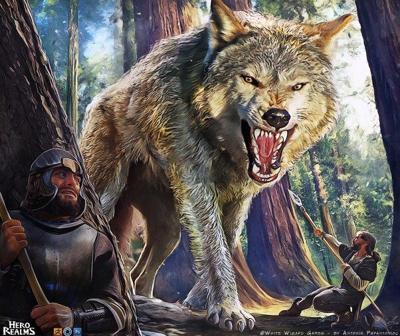
They could grow up to become some of the most formidable predators on the planet.
Dire wolves went extinct about 11,700 years ago, give or take a couple thousand years, just as the most recent ice age came to an end, ushering in the Holocene Epoch in which we currently reside.
They were as much as 20% larger than modern gray wolves — or timberwolves, as they’re sometimes called.
Along with that extra body mass came more physical power, especially in their jaws. They may have been even faster than modern wolves as well. And like the wolves we know, these beasts hunted in packs.
They were 150-pound, 5-foot-long killing machines, and could bring down prey many times their size.
My mind swirled with possibilities. If scientists can de-extinct one species, maybe they could do it with others.
Perhaps we could salvage enough DNA from the dire wolves’ contemporaries to eventually bring back an entire faunal ecosystem.
A wildlife preserve with ice-age giants? Yes, please.
Walking alongside the dire wolf could be monsters like the short-faced bear — 12 feet long, 5 ½ feet tall at the shoulder, 2,500 pounds for the largest males. Much longer legs than modern bears, capable of running as fast as a horse.
Maybe the smilodon — better known as the saber-toothed cat — could stalk the plains again, the size of a tiger but even more muscular, equipped with its signature, 11-inch daggers.
Or the American lion, the biggest cat that ever lived, 12 feet long and pushing half a ton — twice the size of the current king of the jungle, who would be a mere jester in the court of its American cousin.
And what about the prey animals the members of that murderer’s row hunted?
The giant long-horned bison dwarfed modern buffaloes. It was 7 ½ feet tall at the shoulder and weighed 3,500 pounds.
The stag moose, with antlers 6 feet wide.
An enormous ground sloth called the megatherium — 20 feet long and four tons.
And the monarch of them all — the mammoths, as many as three separate species of them. The biggest, the Columbian mammoth, was 13 feet tall and weighed 10 to 12 tons.
As overwhelming as they were, the Pleistocene Titans were doomed.
They were already dealing with drastic climate change when the most vicious, ruthlessly effective predator the world has ever known began to proliferate in the Americas.
The new killer was small, slow, and weak. It had exceedingly poor senses of smell and hearing compared to its competitors. It had no fur to protect it against the cold. Its young were born helpless and needed years of care before they could look after themselves.
But it had a brain, and fire, and spears with razor-sharp flint heads, and a sophisticated means of communication. That was more than enough to drive the majestic megafauna into extinction.
What a story of redemption, of reparation, if that same marvelous brain could undo the damage, it caused all those thousands of years ago.
It sounded too good to be true.
That’s because it is.
A little digging into the dire wolf’s return revealed it isn’t as much of a resurrection as Colossal — a billion-dollar company which has its sights set on bringing back the mammoth and the Tasmanian tiger — would have us believe.
Colossal itself admitted the alterations to the puppies’ genetic makeup consists of changes to only a fraction of the genome: 15 traits, all of them connected with phenotype — the animals’ observable appearance.
Romulus and Remus, though unique, aren’t true dire wolves, according to some other scientists who don’t work for billion-dollar companies.
They’ll be big wolves. Robust wolves. Powerful wolves. But Romulus and Remus aren’t dire wolves. Not really.
Still, this feels like an important step.
Maybe it gets us a little closer to hearing the dire wolves howl and the smilodons roar and the mammoths trumpet in the frozen night.










(0) comments
Welcome to the discussion.
Log In
Keep it Clean. Please avoid obscene, vulgar, lewd, racist or sexually-oriented language.
PLEASE TURN OFF YOUR CAPS LOCK.
Don't Threaten. Threats of harming another person will not be tolerated.
Be Truthful. Don't knowingly lie about anyone or anything.
Be Nice. No racism, sexism or any sort of -ism that is degrading to another person.
Be Proactive. Use the 'Report' link on each comment to let us know of abusive posts.
Share with Us. We'd love to hear eyewitness accounts, the history behind an article.