


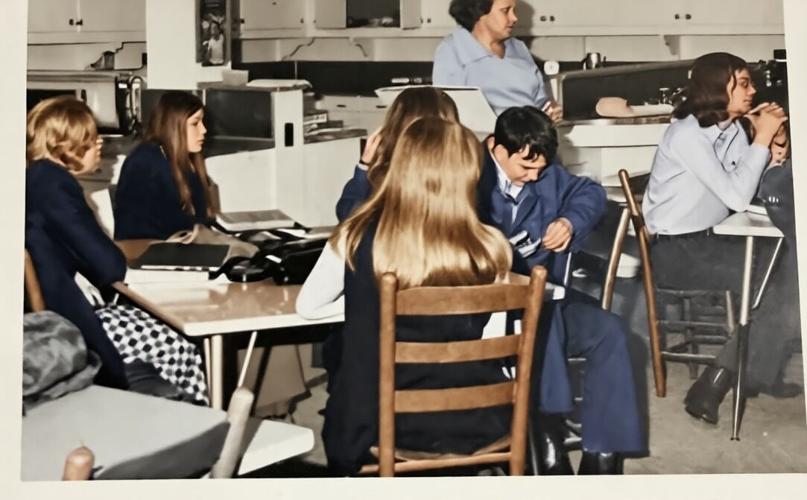

More than five decades ago, during my senior year at Drexel High School, I had the good fortune to be placed in a newly conceived class labeled Family Living/Personal Typing.
The class, as best I remember, was designed for the “smart kids” who were likely “going off” to college the following autumn and who might need some “real world” skills to at least slightly increase our odds of survival.
“Family and Consumer Science” had not been invented in the early 1970s, so our teacher for the Family Living part of the course was DHS’s home economics teacher, Lena Hollifield.
Mrs. Hollifield was tasked with teaching us, in a short four and a half months, how to:
Wash, dry, and fold a load of laundry and, when necessary, iron a shirt or a pair of pants.
Polish a pair of dress shoes.
Sew a button back on if it tumbled off your shirt or jacket.
Balance a checkbook. (Pretty exotic material, considering not one student in that class had yet opened a checking account.)
Set up and follow a simple family budget. Key lesson still with me more than 53 years later: don’t spend more than you bring home.
Consider, and openly talk about, our dreams for the future so far as jobs and families were concerned. (Perhaps not surprisingly, the girls talked more and more freely, than did the boys.)
And finally, the rudiments of cooking.
My mother had taught me many things before I arrived in that Family Living class in August of 1972, but how to cook was not one of them.
I knew how to wash dishes, rinse dishes, and put away dishes, but how to boil water, fry an egg, or grill a cheeseburger was beyond my expertise.
Mrs. Hollifield set out to change that for me and my classmates.
I remember she did indeed teach us how to boil water – carefully.
How to crack an egg – equally carefully.
How to follow a recipe. (Get your ingredients all lined up and ready to go before you start in order to avoid confusion, panic, and screaming later.)
How to shop for sales, look for bargains, and hunt out the good deals. (Newspaper grocery ads were a key part of this lesson.)
And finally, how to cook a little bit.
As I recall we made bacon and eggs and no one was burned by bacon grease.
A couple pans of brownies went into the oven with no wonky ingredients being slipped into the mix.
And, as our final activity before we sadly moved on into the Personal Typing half of the course, we cooked and consumed a full meal, even though I no longer have any memories of what it consisted of.
Later that spring, I, my fellow classmates, and those in the more traditional Home Economics classes took a 50-minute, 150-question exam as part of the Betty Crocker All-American Family Leader of Tomorrow competition sponsored by General Mills.
According to promotional material from long ago, topics covered on that multiple-choice exam included “family relationships, spiritual and moral values, child development and care, health and safety, utilization and conservation, money management, recreation and use of leisure time, home care and beautification, community participation, and continuing education.”
I scored the highest grade in the school and on graduation night, May 31, 1973, I dutifully strode to center stage and received my Betty Crocker Award to a chorus of hoots, haws, and cat-calls from my fellow male classmates.
My historical research tells me I should also have received a small scholarship, although I have no memory of any cash, checks, or bonds changing hands that evening.
More importantly, when I set off that autumn to begin learning the basics of journalism, I already knew the basics of home management and of cooking.
Before I received my diploma from The University of the People, I could cook a decent meatloaf, whip up a simple supper of spaghetti with meat sauce and salad, and even fry chicken to rival that of The Colonel.
Looking back more than half a century later, I realize that Family Living wasn’t really about laundry, checkbooks, or even frying chicken. It was about being quietly prepared for adulthood in ways that no standardized test could measure.
Long before life demanded those skills of me, Ms. Hollifield took the time to teach them – carefully, patiently, and without much fanfare.
In an era when we debate what schools should and should not teach, I remain grateful that, for one brief semester in 1972, Drexel High School decided that knowing how to live was just as important as knowing how to make a living.










(0) comments
Welcome to the discussion.
Log In
Keep it Clean. Please avoid obscene, vulgar, lewd, racist or sexually-oriented language.
PLEASE TURN OFF YOUR CAPS LOCK.
Don't Threaten. Threats of harming another person will not be tolerated.
Be Truthful. Don't knowingly lie about anyone or anything.
Be Nice. No racism, sexism or any sort of -ism that is degrading to another person.
Be Proactive. Use the 'Report' link on each comment to let us know of abusive posts.
Share with Us. We'd love to hear eyewitness accounts, the history behind an article.