



Article 1 Section 8 of the U.S. Constitution established Congress as the law-making branch of our federal republic.


Clark
Clause 11 grants Congress the exclusive power to declare war while a President acts as commander in chief of the military.
Passing over our early years, a Congressional declaration of war has occurred only five times in modern decades, sometimes expanded to include enemy allies.
War with Mexico started as a land dispute when Texas declared independence from Mexico to become the Republic of Texas. But Mexico never renounced its claim to that land.
After the United States added Texas as a state, Mexico attacked and Congress passed a declaration of war on May 12, 1846. The rest is history.
A brief war between the United States and Spain began and ended in 1898 as Cuba battled for its independence — and the USS Maine battleship mysteriously sank in Havana harbor.
With a public uproar, Congress passed a resolution recognizing Cuba’s independence and ordered Spain to back off, but Spain refused.
President William McKinley responded with a naval blockade of Cuba and sent more than 100,000 armed volunteers to enforce it.
Spain immediately declared war. Thereafter, the United States acquired Puerto Rico, Guam, and the Philippines among other concessions.
Approximately 2,246 American military deaths were recorded with an additional 260 killed on the USS Maine.
The First World War had been raging in Europe since 1914 with the United States sitting on the sidelines.
However, German submarines attacking international shipping changed public opinion so that President Woodrow Wilson, on April 2, 1917, asked Congress to declare war on Germany, citing its attempt to recruit Mexico.
Eight months later Congress expanded that declaration to include German’s ally Austria-Hungary. World War I ended at 11 a.m. on the 11th day of the 11th month in 1917.
American casualties were estimated above 300,000 with more than 100,000 deaths.
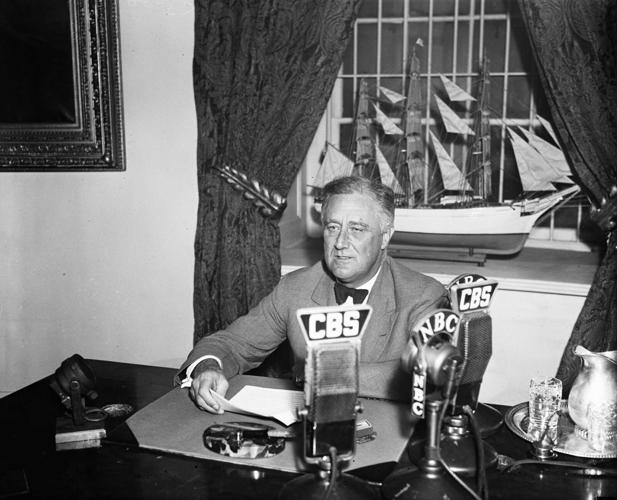
The day after Japan’s surprise attack at Pearl Harbor on Dec. 7,1941, President Franklin D. Roosevelt called upon Congress to declare a state of war now existed with Imperial Japan.
Four days later Adolf Hitler of Germany declared war on the United States and, in turn, his ally Mussolini in Italy declared war on us also.
Months later Roosevelt asked Congress to include the remaining four German allies: Hungary, Romania, Bulgaria, and Slovakia.
The United States endured more than a million casualties with deaths estimated above 400,000. These declarations of war are the last to be passed by the U.S. Congress.
Since then, something has dramatically changed in American politics between Congress (making laws) and the Executive Branch (following laws) — especially with the politics of warfare.
Our modern-day wars — Korea, Vietnam, Afghanistan and Iraq — were simply approved by a congressional “authorization for use of military force,” or in the case of Korea, not authorized by Congress at all.
One big difference after World War II was the so-called “Cold War,” a way of fighting your enemies without calling it a “real war,” just stirring-up the people to favor one side or the other.
The USA and Europeans were, of course, the good guys. Russia and
China were the bad guys. Europe experienced many “mini wars” as the United States and NATO and the Soviet Union struggled over those nations recently set “free” with the end of World War II.
Korea, however, quickly became a hot spot with the northern half watched over by a Russian/Chinese backed government and the south by an American/European backed government.
This “World War” broke-out along the 38th parallel in 1950 as North Korean troops charged southward.
The new United Nations got involved that day declaring it to be a “breach of peace,” eventually involving half a dozen nations to assist South Korea.
President Harry Truman was among the first to send troops.
Some explained Korea to be a civil war — although it was a proxy war with Russian and Chinese weapons and military staff against American/European weapons and military staff.
This war ended in 1953 with Korea still divided. More than 50,000 American service members died with more than 100,000 injured.
United States involvement in Vietnam also began in the 1950s following the Truman “Containment Doctrine” to resist Communism everywhere.
This war escalated under presidents Dwight D. Eisenhower, John F. Kennedy and Lyndon B. Johnson to finally end with Richard Nixon seeking a truce in 1973.
At home, opposition to this war was bitter and widespread. Over three million Americans had been sent to Vietnam where more than 58,000 military personnel were killed.
Upwards of one million Vietnamese deaths, both soldiers and civilians, is an estimate.
Shortly after the 9/11 New York attacks in 2001, President George W. Bush declared a “War on Terror” and quickly led a multinational attack against Taliban-ruled Afghanistan.
After President Bush was reelected, U.S. troop levels in Afghanistan reached 30,000. Next, under President Barack Obama’s 2009 “surge” strategy, more than 100,000 were sent to Afghanistan — but gradually declined to the end of his term.
The war now passed to President Donald Trump who passed decision making to the Pentagon and eventually to a newly elected president, Joe Biden. His rapid pull-out of troops in 2021 led to current day problems.
The Iraq War of 2003 had two parts under President G.W. Bush’s declared “War on Terror.” The first invasion was a three-month land and air attack by the United States and several allies that quickly defeated Iraqi forces and captured its strongman Saddam Hussein.
This created a political vacuum that required U.S. troops to reenter and face prolonged battles with Iraqis opposed to being occupied.
As tensions eased, the United States gradually reduced its presence to eventually leave 10years later. U.S. casualties: approximately 32,000 injured and 4,500 deaths.
And today, we have Iran ...


























(0) comments
Welcome to the discussion.
Log In
Keep it Clean. Please avoid obscene, vulgar, lewd, racist or sexually-oriented language.
PLEASE TURN OFF YOUR CAPS LOCK.
Don't Threaten. Threats of harming another person will not be tolerated.
Be Truthful. Don't knowingly lie about anyone or anything.
Be Nice. No racism, sexism or any sort of -ism that is degrading to another person.
Be Proactive. Use the 'Report' link on each comment to let us know of abusive posts.
Share with Us. We'd love to hear eyewitness accounts, the history behind an article.