



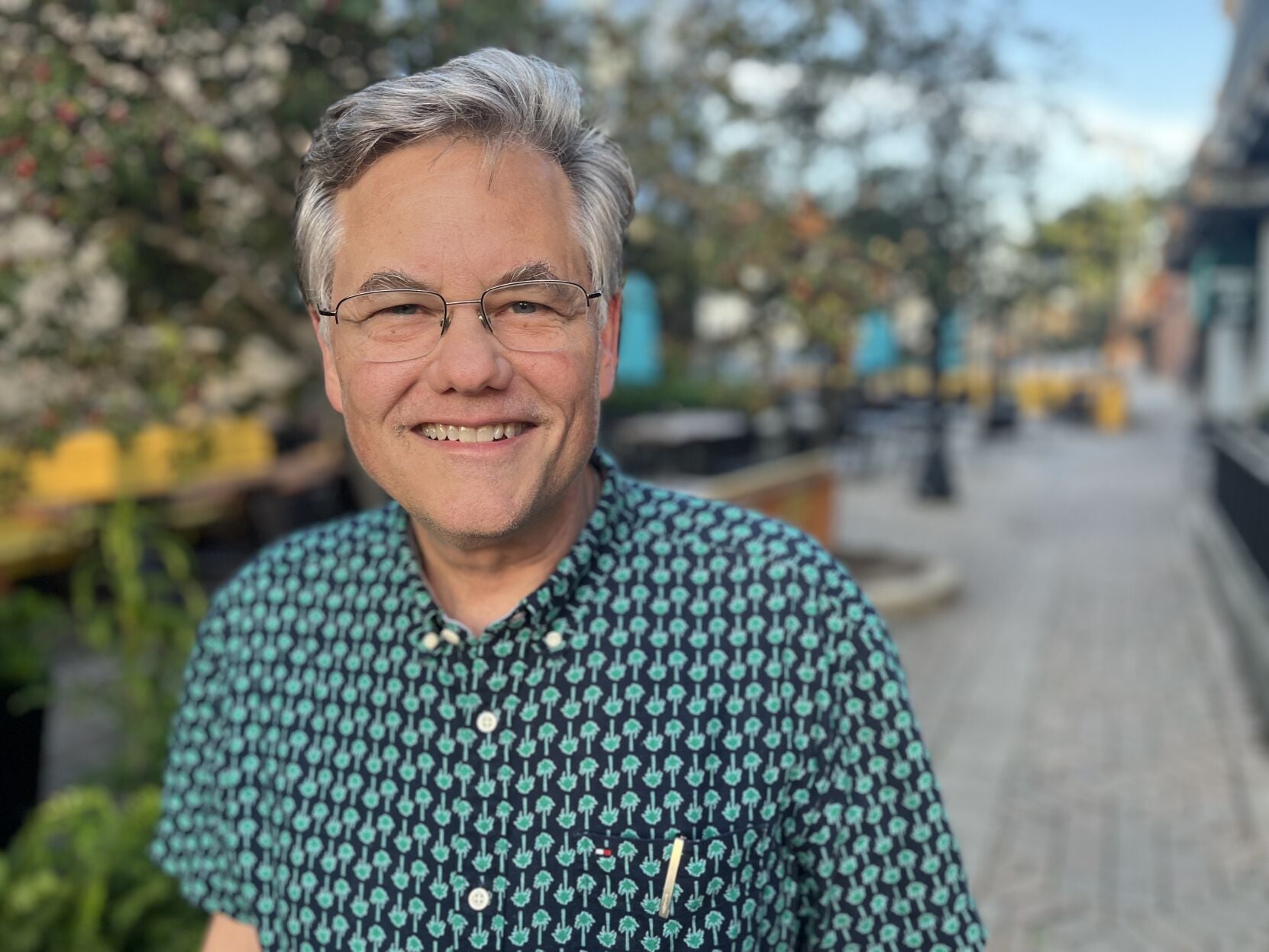
At the Community Foundation of Burke County’s 2025 annual meeting, the organization celebrated its first quarter century of operation. Chip Black, the keynote speaker, highlighted some of the foundation’s accomplishments. Black was a member of the board of directors for a total of 24 years, serving twice as chairman. Here are some of his remarks from that event:
In the fall of 1999, I received a call from my friend, John Ervin, a prominent Morganton attorney. I knew that he and a small group had been working on the possibility of establishing a community foundation.
Their discussions focused on whether it was feasible, and if it would be beneficial, to affiliate with an established regional foundation, like the Community Foundation of Western North Carolina.
I was not surprised when John stated, “We’ve decided to start our own foundation, and it’s going to be called The Community Foundation of Burke County.”
Here we are 26 years later, and I’m standing before a roomful of nonprofit leaders and donors. The nonprofit leaders have helped us with our mission to address the most important needs in Burke County, and the donors have helped us reach $60 million in assets. That’s quite a success story!
When we began, there was no guarantee of success. We’re a rural county with a population of less than 100,000 , no dominant industry or employer, and no four-year university in the middle of town.
We lacked most of the characteristics you would look for before starting a community foundation. In the next several paragraphs, I want to mention some historical details about our first quarter-century, pointing out four specific elements or actions which I believe contributed to our success.
The first element of success began with the people who were on the initial board. The four names which are on the corporate charter were Jim Rostan, Harold Mitchell, Mike Fulenwider, and Jack Kirksey.
The remainder of the initial 14 board members included John Branstrom, Sterling Collett, John W. Ervin Jr., Elizabeth C. (Betty) Ervin, Charlie Horton, Jim Lowdermilk, Nettie McIntosh, Barbara Norvell, Rob Turner, and myself.
These people all had one thing in common. They were busy successful people. They already had a full plate, but recognized the importance of having a community foundation, and were willing to contribute their time and talent to get it started.
The second element for success is found in the by-laws, which is the organizational framework reflecting what the founding members thought was important.
They wanted this to be the community foundation for all of Burke County. They wanted the board to reflect the diversity of our population, including characteristics like age, gender, ethnicity, and religion, to name a few.
They did not want the organization to be controlled by a bunch of old, white, Presbyterian men, like me!
Further, the by-laws state that half the board members should reside in the eastern part of Burke County, with Drexel being the dividing line, and half in the western part.
And, the board should alternate its monthly meetings between a location in the east and a location in the west. Building a governing board that meets all of these qualifications can be a challenge, but such broad representation on our board and committees has been an important component of our success.
The next strategic element requires some historical background. The foundation was started with $20,000 and I was the first Treasurer. Jim Rostan and I discussed this recently and neither of us could recall details about the $20,000.
We think the hat was passed among the initial board members. What I know for sure — it’s a long way between $20,000 and $60 million.
It took six months, June of 2000, before we received our very first permanently endowed fund: the “Francis and Emily Grill Fund,” created by Emily Pascal Grill from Valdese.
Roughly a year later, the foundation made the initial distributions from the Francis and Emily Grill Fund.
Those grants went to Habitat for Humanity of Burke County, Southmountain Children’s Home, Hospice of Burke County and several others which Mrs. Grill named in her fund agreement.
The Grill Fund is a permanently endowed fund and we promised Mrs. Grill that the foundation would fund her charitable interests in perpetuity. That could be a really long time, so we need a good management plan.
Here’s how it works: The donor contributes cash or stock to fund the endowment. We invest this initial contribution and allow it to grow. After a year, we start distributions to the charities.
Our current spend policy says 4½% of the endowment value will be distributed each year. If we can achieve an 8% or higher growth rate, there will be undistributed gains left in the endowment to compensate for inflation.
In future years we want to make increasing charitable distributions which maintain the same amount of buying power. Another important part of this arrangement is the 1% of fund value which the Foundation retains each year to cover our operating expenses and make special grants.
Here’s your math problem for today: At 1% per year, how much money in endowments would we need to have to cover $100,00 in operating expenses? The correct answer is $10 million. We only had $20,000!
Clearly, it was going to take some time before our endowments grew to a size that could sustain foundation expenses. The first officers and directors recognized this problem.
Most nonprofits rely on recurring fundraising activities to cover their operating expenses. Our founding members preferred that our board focus their energies on developing relationships with potential donors and addressing the most important needs of our county.
In January 2002, CFBC kicked off the “Today Forever Campaign,” chaired by Sterling Collett. The objective was to have a “one and done” fundraiser that would cover the cash flow shortfalls until our assets grew large enough to be self-sustaining.
The Today Forever campaign was done in two phases and ultimately raised over $400,000 which insured the long-term mission of the organization.
The last element of success was a favorite talking point for John Ervin, who regularly reminded us about the importance of having undesignated or “unrestricted” funds.
When a donor decides to establish an endowment, they usually come with a list of nonprofit organizations or a field of interest they want to support. Our staff helps the donor complete a fund agreement which details the recipients or the charitable purpose of the distributions.
The example of changing needs that John often cited was polio. It was a major problem in the 1950s and 60s, and then it was eradicated. The same thing will happen to many of the issues we face today.
Community needs change rapidly. That’s why we encourage donors to earmark some or all of their endowed fund as “unrestricted,” allowing the board to direct those funds to the most pressing issues. Let me offer some examples:
In 2008-09 we experienced the Great Recession. The stock market lost 35% of its value. Many of our citizens lost their jobs and their homes. Remember that our foundation had only been around for eight years at that point.
We established the “Recession Response Fund,” and seeded it with $50,000 of CFBC undesignated funds. We wanted to address the sudden demand for food, shelter, utilities, medical and mental health services. Our donors contributed generously, and over the next year we distributed almost $100,000.
Does anybody remember the major event at the end of 2019 and early 2020? In March of 2020 we established the “COVID 19 Community Emergency Response Fund.” The foundation was able to distribute $283,000 to tax-exempt nonprofit agencies who were addressing humanitarian needs in Burke County.
In September of 2024 we were visited by Hurricane Helene. Your Community Foundation established the “Burke County Disaster Relief Fund,” with $100,000 from CFBC undesignated funds.
We’ve received more than $90,000 of donations, and have made grants to 22 nonprofit organizations so far. The process is ongoing. People in this community know that the foundation is going to step up when we have a crisis, and with the availability of undesignated funds, we can be flexible and effective.
Here are a few other milestones in our first quarter century:
Year One — June of 2000, we convinced Caroline Avery to be our first executive director, and she led our organization during the first 12 years.
Year Three — March of 2002, we acquired our first “Non-Profit Endowment Fund,” established by Blue Ridge Community Action. We now have 45 nonprofit endowments.
If you know of a charitable organization, church or school that would like to have assistance in managing their investments and reducing their administrative burden, ask us about our nonprofit endowments.
April of 2002 — We acquired our first “Endowed Scholarship Fund,” the Drexel Alumni Association Scholarship Fund. We now have 51 scholarship funds and this year granted over $122,00 in scholarships.
March of 2007 — Our foundation became accredited by the Council on Foundations for meeting National Standards, the nation’s highest philanthropic standards for operational quality, integrity and accountability. You should not underestimate the importance of achieving this credential, nor the work required to maintain it.
2009 — We received a request from 15 women asking us to sponsor the Burke Women’s Fund. Their plan was to get 150 women from around Burke County to contribute $1 per day, $365 a year, to make grants for women and family issues.
There were a couple members of our board, including me, who thought we were already making grants for women and family issues. I dismissed the idea as one of good intentions, but unlikely to succeed.
Thanks to some strong women, they’re still here and since 2009 the Burke Women’s Fund has awarded nearly a half million dollars in grants. I must humbly apologize to all the members of the Burke Women’s Fund for my initial short sightedness.
February 2013 — Nancy W. Taylor became our second executive director and in an action that was overdue, the board changed the title of that position to “Chief Executive Officer.”
Having seen the success of the Burke Women’s Fund, in 2016 we created a new group to educate and promote philanthropy among young people. Burke Youth Organized Philanthropists (BYOP) was created and Sara Black Moses accepted the challenge to develop a model, recruit student leaders, and teach them how to make grants focused on youth issues. We’ve all been amazed and inspired by the creativity and passion of our youth philanthropists!
It only took 20 years for our foundation to cross the $25 Million mark in assets. Even more remarkable is that it only took four more years to double that to $50 million, and we celebrate our first quarter century with $60 million in assets.
In 1999 John Ervin shared with me, “We’ve decided to start our own foundation, and it’s going to be called The Community Foundation of Burke County.”
I know he would be proud of how we’ve worked together to make a positive impact on our community. We honor all of those who have contributed to our success in the first quarter-century. With your help, our foundation will continue to improve the lives of people in Burke County, in perpetuity.

















(0) comments
Welcome to the discussion.
Log In
Keep it Clean. Please avoid obscene, vulgar, lewd, racist or sexually-oriented language.
PLEASE TURN OFF YOUR CAPS LOCK.
Don't Threaten. Threats of harming another person will not be tolerated.
Be Truthful. Don't knowingly lie about anyone or anything.
Be Nice. No racism, sexism or any sort of -ism that is degrading to another person.
Be Proactive. Use the 'Report' link on each comment to let us know of abusive posts.
Share with Us. We'd love to hear eyewitness accounts, the history behind an article.