



Three conversations, one from last week, one from 30 years ago, and one with the workers of the future:
A guaranteed job for life
Don Peach Sr., known to many in Burke County as “The Peach Man” from his many years in the pawn shop business, stopped by The Paper’s downtown office to pick up a copy of a recent edition.
Office Manager Extraordinaire Lilly Brown was out to lunch when Don came through the door, so I moved from my desk to wait on him. Giving me a friendly version of the old fisheye, he asked, “You’re Bill Poteat, aren’t you?”
I offered up my usual reply, “Depends. How much money does he owe you?”
Don and I got to talking and it turns out he was in the newspaper game decades ago, preceding even me into the business.
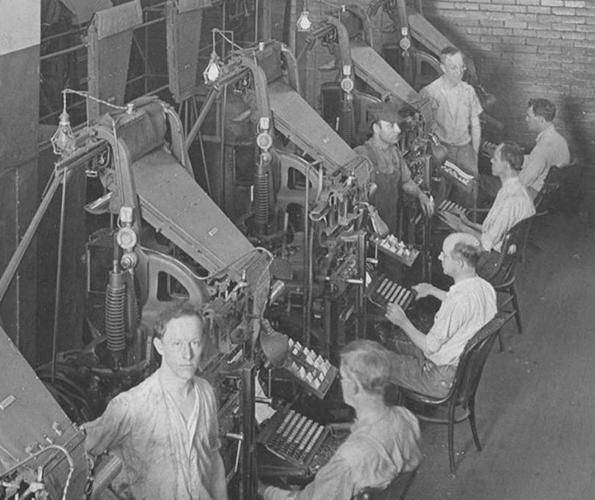
“I trained as a linotype operator at The News Herald,” Don told me. “I worked for (Production Superintendent) Jim Cornwell. Jim told me that if I learned how to set type, I would guarantee myself a job for the rest of my life.”
I laughed and wondered if the folks who once labored at the buggy whip factory had received the same assurance from their employer just before the last horse went to the glue factory.
By the time I began my first job as a reporter at a weekly rag in Georgia in 1977, linotype machines were museum pieces, and linotype operators had either learned different skills, or, like Don, moved on to new careers.
“Hot” type was out. “Cold” type was in. Crude computers, which were little more than word processors, had stepped into the production department door and would soon enter the newsroom as well.
The world had changed.
Dawn of the Internet
I can’t remember with certainty if this conversation came in 1994 or 1995 — either way, it was at least three decades ago.
Kelly Winters, a young, energetic, and talented reporter was in my office at The News Herald pitching a story idea. What Kelly was proposing was a series of stories on something she called “The Internet.” As in when it might be coming to Burke County, who would provide access to it, and how it might impact business and government.
The 40-year-old guy behind the desk had absolutely no idea what the young reporter was talking about. And he had no better concept of what “The Internet” was when the conversation ended than when it began.
It wasn’t just small-town hicks in the newspaper industry who were caught unprepared. My old friend and former co-worker Ben Estes was an editor at the Chicago Tribune at the time.
“We thought it (The Internet) was some kind of fad that would peter out and disappear,” he told me decades later over a plate of Burke County barbecue. “Sort of like CB radio.”
The world was changing, and neither I nor thousands of other newspaper editors across the country had any idea how massive that change would be or how quickly it would occur.
Of course, a few years after my conversation with the young reporter, I was fired from my job at The News Herald and a couple of months later began a nearly two decades long stint as an English teacher with the Burke County Public Schools.
Talking With Young People
For the past several years, I’ve had the honor of being a frequent speaker for The Industrial Commons’ Hometown Walkabout program.
Over the past two years, at the behest of the program’s primary facilitator, Thea Yang, I’ve spoken with educators, law enforcement officers, medical interns at UNC Health Blue Ridge, and professionals new to the county.
On Monday morning, my audience was a bit different — a couple of dozen young people, all of them recent high school graduates and all of them now participants in the Work in Burke program, a collaborative effort involving The Industrial Commons, Burke County Public Schools, Western Piedmont Community College, and Burke Development Inc.
The goal of the program is simple but difficult: give people, primarily young people, the skills and guidance they need to find their place in the Burke County workforce.
My assignment from Thea, who was my student more than 20 years ago: Talk about my education, my jobs, and the keys to a successful career.
I started to open with the old Woody Allen line, “90% of life is just showing up,” but instead talked about how my love for newspapers sprouted at age 8 when I began delivering The Hickory Daily Record after school and flourished into full bloom the first time I saw the Record’s giant printing press spouting out nearly 30,000 newspapers in less than an hour.
I wanted, I told them, to see my byline on the front page. I wanted to see my photo next to my columns on the editorial page. And, in the vernacular of the 1960s, I wanted to make a difference.
I asked how many of them had parents who did not go to college. Nearly every hand in the room was raised, and I assured them that neither of my parents came close to finishing high school.
I told them my Abe Lincoln story of working my way through college, not mentioning that the cost of attending Chapel Hill 50 years ago was but a small fraction of what it is today.
I urged them to find work that they enjoyed and could take pride in, otherwise the daily grind would grow very grim, very quickly.
And finally, I told them they had to keep updating their skills and learning new ones, that they should never pass up a chance for additional training, that they would probably change employers and even careers several times over the next five decades.
What I Didn’t Tell Them
My time with the young Work in Burke participants was limited to 20 minutes for talking, five minutes for answering questions, and almost as soon as they walked out the door and into the July heat, I thought of more things I should have said.
I should have confessed that over the past 40 years, I have learned new uses for technology only when I have been absolutely forced to. I would be happy to still work on a manual typewriter and slide my “copy” through a slot in the wall into the production department.
I should have said that here at The Paper we are swimming against the tide — working so very hard to provide a quality local news product for our community — both in print and digitally — but also working so very hard to convince that community that such a product is needed and should be supported. I also should have warned them that they face a harder path to economic security than I ever did as a young man. Housing, food, transportation, utilities, health care, everything costs more than it did when I was young and prices continue to rise higher and higher.
And finally, I should have told them that unless the direction of our national government changes, they are going to reap the harvest that our President and his minions in Congress are now planting — crushing national debt, catastrophic climate change, and a fragmented populace that has lost its common vision and common purpose.
But then I remembered a basic truth. The young seldom listen to the old no matter what the message is. And given the mess we oldsters are passing along to them, I can’t say as I blame them one bit.








(0) comments
Welcome to the discussion.
Log In
Keep it Clean. Please avoid obscene, vulgar, lewd, racist or sexually-oriented language.
PLEASE TURN OFF YOUR CAPS LOCK.
Don't Threaten. Threats of harming another person will not be tolerated.
Be Truthful. Don't knowingly lie about anyone or anything.
Be Nice. No racism, sexism or any sort of -ism that is degrading to another person.
Be Proactive. Use the 'Report' link on each comment to let us know of abusive posts.
Share with Us. We'd love to hear eyewitness accounts, the history behind an article.