



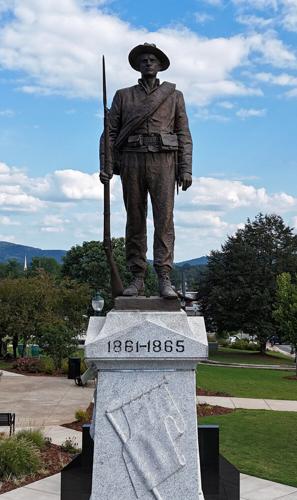
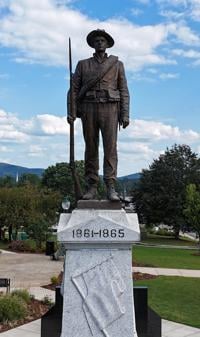
Morganton’s Confederate monument, standing tall on the square of the Historic Burke County Courthouse, is a source of pride for some White folks.
Others, like former schoolteacher Candace Yount, see only anguish and devastation when they gaze upon the 9-foot-tall statue of a Southern soldier atop a granite platform.
There are several hundred names etched into stones that surround the base of the monument.
All of them were Confederate soldiers from Burke County, some of whom came home from the war and some of whom didn't. One who did not return is Benjamin Clark, Candace Yount’s great-great grandfather.
Yount is quick to tell you she doesn’t know the stories of all the men whose names are immortalized on the memorial, which has been the epicenter of contention between groups who want to preserve it and others who want it removed from public property.
But thanks to her family’s tradition of passing down old stories, she knows the tale of Benjamin Clark extremely well.
Her grandmother told her how Benjamin, a poor subsistence farmer like many of his contemporaries, was forced to join the army and leave his family.
Even though he was in his mid-30s and taking care of a houseful of dependents, Benjamin was forced from his home on the Johns River and pressed into service.
Local partisans, Yount said, had ways of making men fight whether they wanted to or not.
“They shamed you, bullied you,” she said. “And then of course, they would come after you.
“He had a family. A bunch of little kids. And his wife’s brother was living with them. They had a houseful. And they took him anyway.”
That was in 1861, not long after the war began. Benjamin was captured once and eventually paroled. He returned to duty, but was captured again, in 1864 at Cold Harbor, Va.
Benjamin was stuffed into a boxcar and transported north to a newly opened prison camp in Elmira, NY.
You may never have heard of “Hellmira” as it came to be called.
You’re probably familiar with Andersonville, though. The brutal conditions at that Georgia camp for Union prisoners are well-documented.
The South had Andersonville. The North had Hellmira.
The camp beside New York’s Chemung River held more than 12,000 Confederate POWs in its one year of existence. Almost 3,000 prisoners, Benjamin Clark among them, are still there, their final resting places marked with snow-white gravestones bearing their names and ranks.
As wartime prison camps are wont to be, Elmira was riddled with disease. Cholera. Smallpox. Dysentery. Diphtheria. Typhoid fever, which is listed as Benjamin’s cause of death.
The local sexton, a freed slave named John W. Jones, patiently cataloged the death of each prisoner, boxed up their meager belongings, and sent them home. His compassion toward the captured soldiers showed in his work – only seven of the 3,000 men interred in that far-away garden of stone remain unidentified.
After Benjamin died on Oct. 1, 1864, Mr. Jones sent his overcoat home.
Benjamin’s wife wore it as she worked in the garden that fall. Family lore holds that the coat was contaminated, and she caught one of the many contagious diseases that circulated at the prison camp.
Shortly thereafter, she died.
Now orphaned, the children were shuffled off to whichever local family could scrape enough money together to feed one more mouth in exchange for a new farmhand or nanny. Yount’s great-grandmother was sent to live with the Sparks clan on Smoky Creek.
What little the Clark family had ever owned was gone.
Nearly 160 years later, Yount’s voice trembles as she recounts the story of her ancestors. She knows the slaves had it worse, of course, and it’s obvious their needless pain and suffering at the hands of slave owners cause her grief.
But the plight of those like Benjamin Clark was tragic, too.
As is the case with every conflict ever fought, this was a rich man’s war and a poor man’s fight.
So, forgive Candace Yount if her heart doesn’t swell with pride when she looks at the statue some hold so dear.
“When I look at that monument, I do not see Confederate glory,” she said, her voice trailing off to nearly nothing. “I see pain and suffering, heartache, and a family destroyed. That’s what I see. That soldier means nothing to me.
“When Black people look at it and feel pain, they’re not the only ones. That’s not to diminish what they went through. But there are (White) people who look at it and see something besides Confederate glory and the Lost Cause. That was never taught in my family.”
Yount’s family was instead taught a far more profound lesson.
War is Hell let loose on Earth. It is not glorious. It is not venerable. Its horrific ramifications last for decades, sometimes centuries. It is not something to be remembered with fondness.
“That’s how my family feels, and me in particular,” she said. “I had to say something about it. If they took that soldier off, it wouldn’t bother me one bit. If they moved the rest of that stone part to a cemetery somewhere, it wouldn’t bother me. And that’s the only monument we have of him unless we want to go all the way to New York and see that little stone tablet that some people erected finally on those graves.”
There are others who share Yount’s sentiments. They may not be as vocal as those who defend the statue, but their voices should be heard just as loudly.
“We’re proud of being Southerners,” she said. “But that source of pride comes from the community of people and the land itself. It doesn’t come from a war.”
Marty Queen is the senior reporter for The Paper. He may be reached at 828-445-8595 or at marty@thepaper.media.













(0) comments
Welcome to the discussion.
Log In
Keep it Clean. Please avoid obscene, vulgar, lewd, racist or sexually-oriented language.
PLEASE TURN OFF YOUR CAPS LOCK.
Don't Threaten. Threats of harming another person will not be tolerated.
Be Truthful. Don't knowingly lie about anyone or anything.
Be Nice. No racism, sexism or any sort of -ism that is degrading to another person.
Be Proactive. Use the 'Report' link on each comment to let us know of abusive posts.
Share with Us. We'd love to hear eyewitness accounts, the history behind an article.