



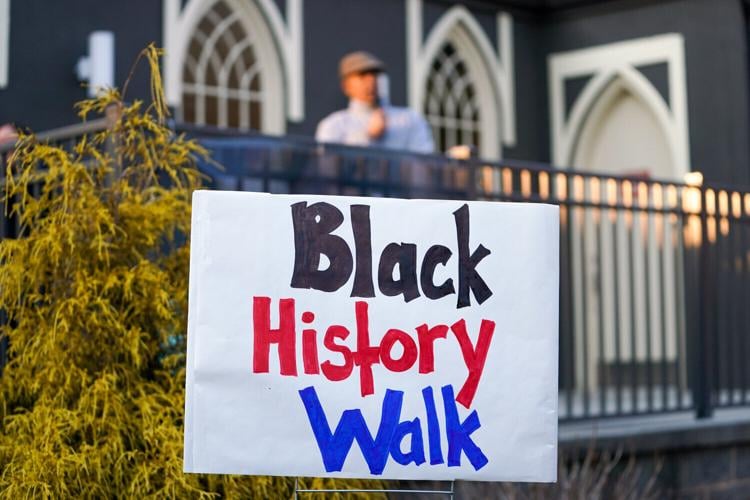

The schizophrenic personality of late February was on full display last Tuesday in Morganton — frosty cold in the morning, warm and mild in the afternoon, cold once again as evening began to fall.
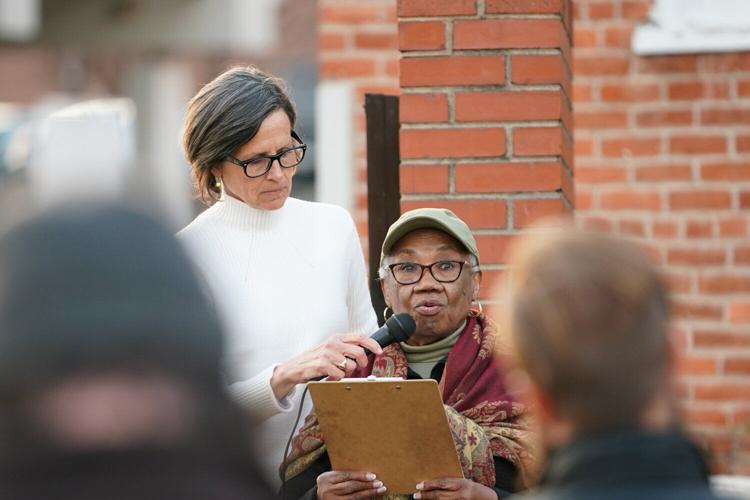
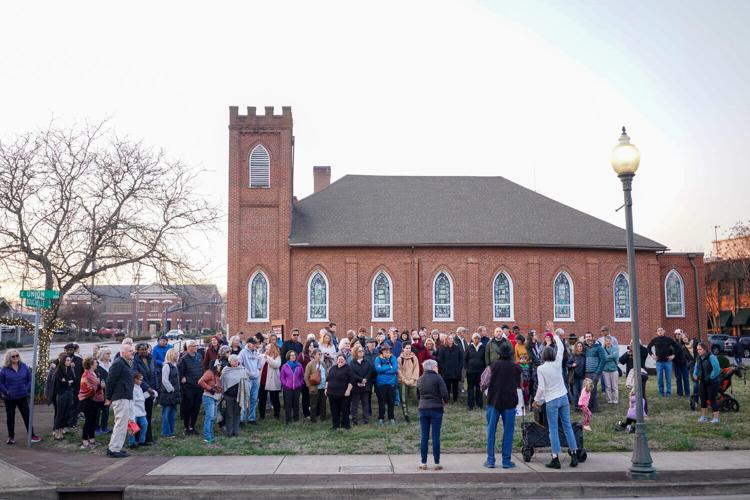
But neither the impending darkness nor the approaching chill served to deter the more than 100 walkers who participated in the Black History Walk sponsored by the Burke Coalition for Reconciliation.
The walkers, who gathered at 5:15 p.m. at the site of the old St. Stephens Episcopal Church, were a reflection of Burke County’s diversity — Black and White, Asian and Hispanic, male and female, young and old.
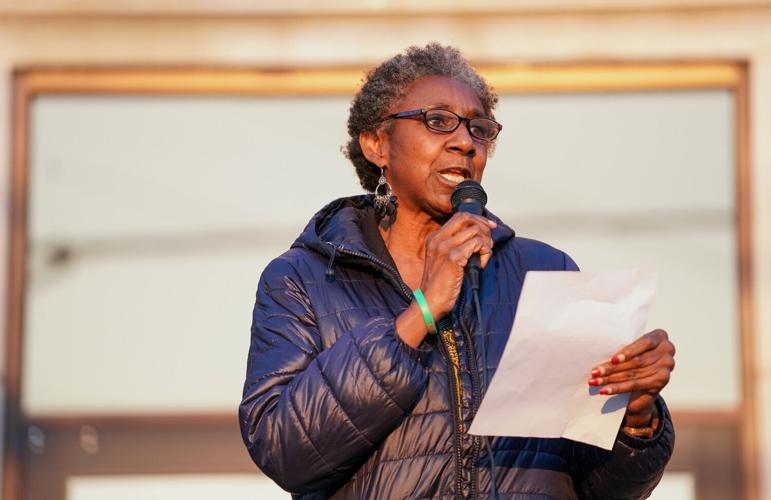
The walk included eight stops — St. Stephens, the old Avery Avenue Grammar School, now home to county offices, Morganton City Hall, Slades Chapel AME Zion Church, Gaston Chapel AME Church, the Historic Courthouse Square, the Legacy Mural on South Sterling Street, and the Burke County Courthouse.
At each site, walkers learned something about the history of Black people in Burke County but were also educated as to the ongoing efforts to build a more united and cohesive community in which equity, fairness, and kindness are the governing principles.
St. Stephens Episcopal Church
Burke County native Allen Fullwood spoke here of the struggles to build independent Black churches in the county in the years following the Civil War and sustaining those churches into the 20th century.
“I grew up in this neighborhood and this church was important in my life. I was not a member, but I participated in many activities here,” he said.
Due to a small congregation and limited resources, the existence of St. Stephens was a tenuous one and in 2008 the decision was made to merge the church with St. Mary’s Episcopal.
“The blending of St. Stephens and St. Mary’s was the first time that a Black church had united with a White church in the history of the Western North Carolina Diocese,” Fullwood noted.
Avery Avenue Grammar School
Standing in front of the primary Burke County government office building, Carla Kincaid explained the birth of the Burke Coalition for Reconciliation and its first goal — “the removal of the Confederate monument at the heart of our downtown.”
Since its inception in 2021, more than 200 community members representing the coalition have addressed the Board of Commissioners asking that the monument be removed.
In addition to removal of the monument, Kincaid explained, the coalition urges the county to “actively engage in true racial equity and proactively build a community of love, justice, and reconciliation.”
Morganton City Hall
Mayor Ronnie Thompson spoke first of the history of slavery in Burke County, noting that just before the Civil War began, 30 percent of the population was enslaved.
“We are still trying to better understand our racial history,” Thompson said, “and to attract more qualified African Americans to leadership positions in Morganton. Yet, it has been challenging.”
Thompson noted that the city established a Human Relations Commission in 1993 to work for a more equitable government.
“Thank you for caring about our community,” Thompson told the walkers. “Our City Council fully supports this work.”
Slades Chapel AME Zion
Gary Harbison, a Morganton native, spoke of how the historically Black church served as a focal point for the civil rights struggles of the 1950s and 1960s.
“Black men and women attended NAACP meetings (here) to strategize ways to bring about social change,” Harbison said. “Black mothers mobilized to provide transportation to school and access to public facilities for their children, and Black students gathered on the steps to protest the discrimination and racism they faced in the public education system.”
Last year, Harbison pointed out, the church was honored with one of 50 markers across the state honoring the struggle for equality along the N.C. Civil Rights Trail.
Gaston Chapel AME Church
Doris Fullwood explained that this church was established in 1863, two years before the end of the Civil War, even though White leaders discouraged the building of Black churches.
In 1872, the church was named in honor of the Rev. Mose Gaston.
“The brick structure that stands today was finished in 1912 with a fellowship hall added in the latter part of the century,” Fullwood said. “Gaston Chapel is officially recognized as a historic structure. It is the oldest historically Black church in Burke County and is the second oldest church building in Burke County.”
Historic Courthouse Square
Standing on the sidewalk in front of what was once the Burand’s building on Union Street, the Rev. Wesley Hendrix gave a dispassionate review of how the Confederate monument came to be.
“The original monument, dedicated in 1911, did not include the statue, which was added in 1918,” he said. “There have been questions about the authenticity of the Confederate statue. The statue has also been a gathering place for racial strife.”
Reflections of Legacy Mural
At the mural on South Sterling Street, Carol Ervin explained the history of the massive mural and what it represents.
“The vision for this and three other murals in Morganton came from The Old School Studio, a nonprofit organization that is part of The Industrial Commons. The goal was creating public art that tells community stories that had not been told,” Ervin said.
The mural, Ervin noted, weaves together local stories of Black residents and events in Black history, as well as the accomplishments of musicians and athletes from Olive Hill High School, a renowned, all-Black secondary school in Morganton before the school system was integrated in the 1960s.
Burke County Courthouse
By the time the walkers reached their final stop, full darkness had descended and the air was growing increasingly chill. But the Rev. Alicia Connelly was filled with excitement and enthusiasm as she reviewed the history of the Burke County NAACP.
“The charter for the Burke County NAACP was granted on Feb. 11, 1935,” Connelly said. “Our mission is to achieve equity, political rights, and social inclusion by advancing policies and practices that expand human and civil rights, eliminate discrimination, and accelerate the well-being, education, and economic security of Black people and all persons of color.”
Noting that 2024 is a pivotal election year, Connelly said, “We need you to get out and vote. Your vote is your voice. It took years of intimidation, murders, and advocacy before Black people were allowed to vote.”
Noting the diversity of the group, Connelly concluded by saying, “We need you! Stand with us! We are advocates united for the fight to end racism and inequality!”
Final Reflections
As I made my way back to my car at the walk’s conclusion, I thought about how I wished more people had made the short journey, which was both a practical history lesson and a symbolic act of unity.
As a White man, I was reminded once again of the hatred and injustice and discrimination that those who are Black have endured simply because of the color of their skin.
As a father and a grandfather, I was reminded that all of us have a duty to teach our children about our history, no matter how unsettling or unsavory the past may be.
And, as a resident of Burke County and a citizen of this country, I was reminded again that although much has been accomplished, much remains to be done, and it is incumbent upon each of us to do all we can.
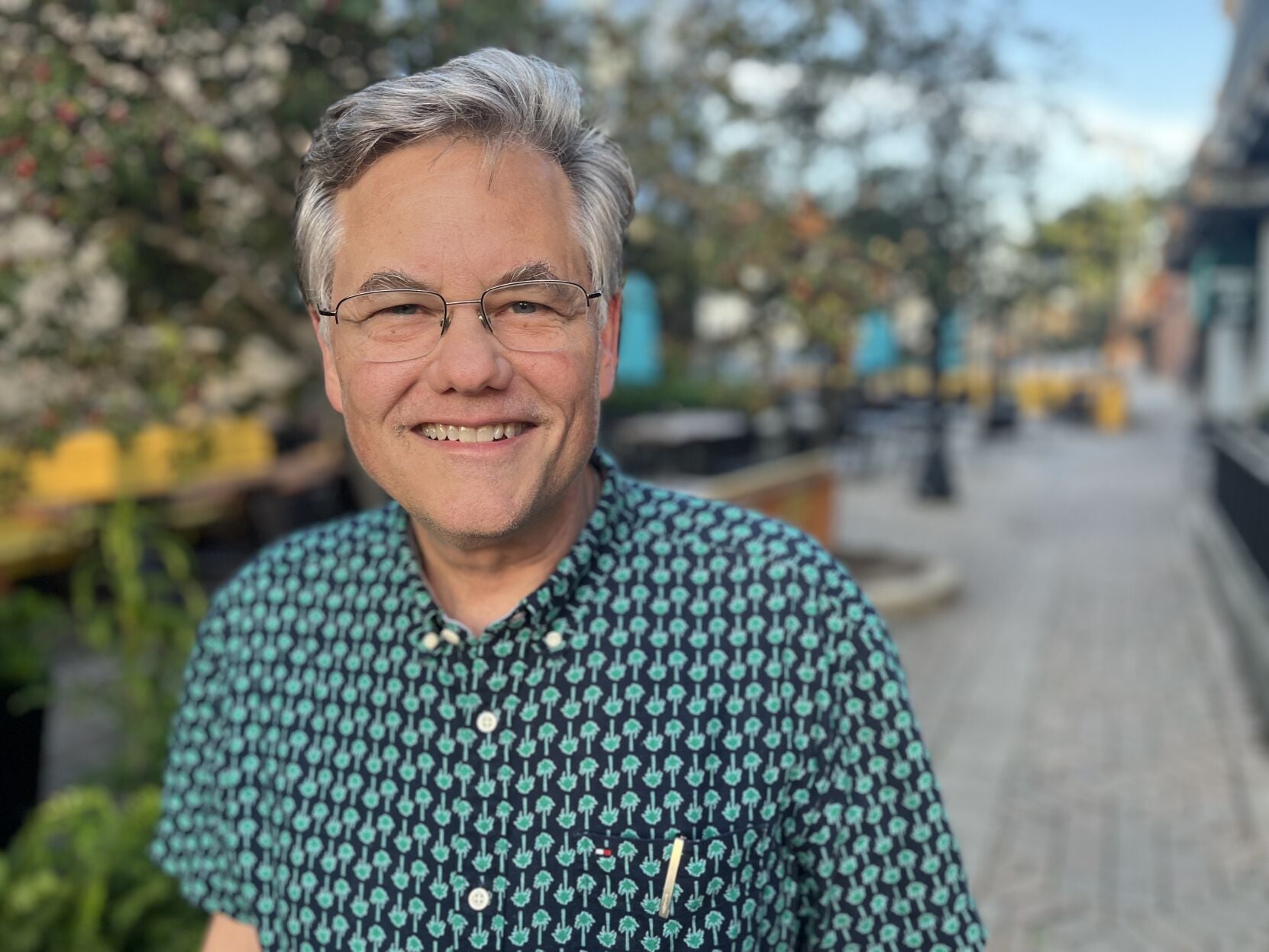
Bill Poteat, who attended segregated schools and lived in a segregated world as a youngster, is editor of The Paper. He may be reached at 828-445-8595 or via email at bill@thepaper.media.









(0) comments
Welcome to the discussion.
Log In
Keep it Clean. Please avoid obscene, vulgar, lewd, racist or sexually-oriented language.
PLEASE TURN OFF YOUR CAPS LOCK.
Don't Threaten. Threats of harming another person will not be tolerated.
Be Truthful. Don't knowingly lie about anyone or anything.
Be Nice. No racism, sexism or any sort of -ism that is degrading to another person.
Be Proactive. Use the 'Report' link on each comment to let us know of abusive posts.
Share with Us. We'd love to hear eyewitness accounts, the history behind an article.