


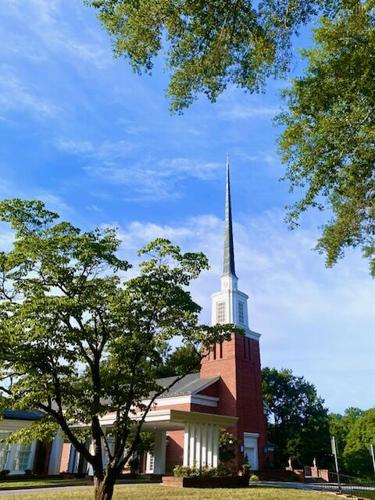
The First Presbyterian Church of Morganton is the focus this week in my ongoing series of columns featuring local churches. I am indebted to Jimmy Ervin, former justice of the N.C. Supreme Court, for much of this material regarding First Presbyterian history.
The oldest church within city limits
First Presbyterian is the oldest church within the city limits of Morganton, with Quaker Meadows Presbyterian Church, which was established in 1774, being the oldest church in Burke County.
Ervin explains, “Although the Scots-Irish settlers of Burke County were ancestral Presbyterians, the Presbyterian insistence upon an educated ministry made it much more difficult for Presbyterianism to grow in what was then the frontier. This is compared to Methodism, which perfected the circuit-riding system that allowed ministers to serve multiple churches, and Baptists that autonomously allowed each congregation to select a minister, often from among their own congregation.”
A Presbyterian congregation of some sort appears to have been meeting in Morganton as early as the late 1780s. The Presbyterian governing body records indicate that, in 1797, John McKemie Wilson was called to serve as the minister at First Presbyterian in addition to continuing his work at Quaker Meadows.
Church buildings over the years
After Rev. Wilson left First Presbyterian in 1801 to accept a call to serve a church in Mecklenburg County, the church does not appear to have had a regularly-called pastor until 1824, when the Reverend Chauncy Eddy was called to serve First Presbyterian.
The first Presbyterian church building in Morganton, which was also used by the Methodists and Baptists, was completed during Rev. Eddy’s pastorate.
The first church building stood on the site of what is now the First Citizens Bank until 1961, when it was demolished following the construction of the present facility on Silver Creek Road. The “old church” was built in the 1820s and remodeled around 1910 to include what was referred to as the “bustle,” a structure that expanded the sanctuary by the addition of more seating on the side.
The “old church” had a number of stained-glass windows, some of which can still be seen at the current facility and was surrounded by a cemetery. The “old church” also had an educational building that was built in 1926 and located on the site of the present First Methodist Church fellowship hall building. It also had a building that contained the church offices and adult Sunday School rooms across the street in the structure that now houses the Bowers Insurance Agency.
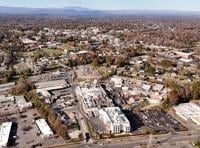
The move from the “old church” downtown to the present facility that dominates a hill at the intersection of West Union Street and Silver Creek Road resulted from a long process of church expansion. After struggling financially and otherwise during the post-Civil War period, the church began to grow in the early 20th century and, by the 1920s, the “old church” building was too small for the existing congregation.
Ervin elaborates, “Although fundraising efforts to construct a new facility began in 1944, the process did not begin in earnest until the pastorate of the Rev. John D. Smith, which began in 1955 (the year in which he baptized me) when the present site, which had been the location of the Taylor house, was selected.”
After a period of fundraising, construction of the new facility, which was to occur in two stages, was authorized in 1957. A groundbreaking ceremony for the educational wing was held in 1958.
After a final Sunday morning worship service held in the “old church” on Dec. 13, 1959, the educational wing was occupied, with the first worship service held in the “new church” taking place in the fellowship hall on December 20, 1959.
The construction process was resumed in 1963, when ground was broken for the sanctuary wing. The sanctuary was dedicated on March 14, 1965, and the entire debt associated with the construction process had been paid off by the late 1960s.
Prominent members
During its long history, First Presbyterian has had many members who played leading roles in our community. A sampling of congregants, who were active in the broader community, would include:
Alphonso C. Avery — an officer in the Confederate army, member of the General Assembly, a delegate to the 1875 constitutional convention, a judge of the Superior Court, an Associate Justice of the Supreme Court of North Carolina, and the author of the first history of First Presbyterian.
Joy Chandler Bowers — a teacher at the North Carolina School for the Deaf who served First Presbyterian from 1930 until 1991 in many capacities, including pianist, organist, youth group leader, youth choir director, editor of the newsletter, and wedding director.
Sam J. Ervin Jr. — a decorated veteran of World War I, a member of the North Carolina House of Representatives, a Superior Court judge, a member of Congress, an Associate Justice of the Supreme Court of North Carolina, and a United States Senator, who famously chaired the Senate Watergate hearings in the 1970’s.
Harriett Inscoe — active in many parts of the First Presbyterian’s work in the community and the first woman elected as an elder in the church’s history.
Edward W. Phifer Jr. — long-time surgeon in Burke County who also served as the founding President of the Burke County Historical Society, wrote many articles on the history of Burke County, and authored the leading book on Burke County history, Burke: The History of a North Carolina County.
Samuel McDowell Tate — the colonel of a Confederate regiment that contained a large number of Burke County soldiers before being severely wounded at the Battle of Cedar Creek, a leader in the establishment of the Western North Carolina Railroad and what is now Broughton Hospital, a member of the General Assembly, and State Treasurer.
















(0) comments
Welcome to the discussion.
Log In
Keep it Clean. Please avoid obscene, vulgar, lewd, racist or sexually-oriented language.
PLEASE TURN OFF YOUR CAPS LOCK.
Don't Threaten. Threats of harming another person will not be tolerated.
Be Truthful. Don't knowingly lie about anyone or anything.
Be Nice. No racism, sexism or any sort of -ism that is degrading to another person.
Be Proactive. Use the 'Report' link on each comment to let us know of abusive posts.
Share with Us. We'd love to hear eyewitness accounts, the history behind an article.