


Burke County’s population has inched upward since 2020, but new Census data suggest the bigger story is not growth. It is age.
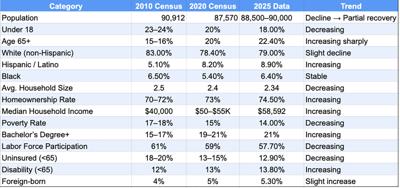
After adding about 1,085 residents since 2020, bringing its population to 88,655, Burke County appears to be leveling off and, by most projections, may be headed toward gradual decline, according to U.S. Census Bureau study released Thursday.
The latest Census estimates show Burke County’s population has grown 1.2% since 2020, following a decade in which the county lost more than 3,000 residents between 2010 and 2020.
The reason is simple and hard to reverse: Burke County is getting older, not younger, and not fast enough to replace itself, according to the data. Long-term trends point toward an older, slower-growing community.
Collectively, the data indicates that Burke County is no longer growing from within. Its future depends on who moves in, not who is born here.
But the apparent recovery masks a deeper shift. Census data and long-term projections indicate Burke County has likely reached a population plateau, with gradual decline expected in the coming years, according to studies from the N.C. Office of State Budget and Management.
The reason is demographic: The county is aging faster than it is replacing itself.
Residents aged 65 and older now make up more than 22% of the population, while children under 18 account for about 18%. A decade ago, those figures were reversed.
The shift reflects a broader trend seen across many rural counties, according to the data, where lower birth rates and longer life expectancy are reshaping population structures.
Population growth slowed in a majority of the nation’s 3,143 counties and the District of Columbia between July 1, 2024, and July 1, 2025, according to the Vintage 2025 population estimates released Thursday by the U.S. Census Bureau.
That said, the Bureau reported that geographically, many of the fastest-growing counties were in states along the southeast coast of the United States in Florida, Georgia, South Carolina, North Carolina, and Virginia.
In Burke County, the imbalance is affecting core institutions.
Public schools are among the first to feel the change. With fewer children in the population, enrollment pressures are expected. The Burke County School board is immersed in difficult decisions about staffing, programming, and facility use.
At the same time, the county’s workforce is tightening. The data reveals that a smaller share of Burke County adults are working or actively looking for work. Labor force participation has declined to below 58%, driven in part by retirements, an aging population, fewer residents under 18 years, and fewer people entering the workforce.
For employers, particularly in manufacturing and health care, that trend presents an ongoing challenge. It can be harder to find workers, it can limit the ability to recruit new businesses, and there’s more demand for health care and senior services. Consequently, fewer working people translates into a weaker labor supply, less housing demand from young families, and more pressure to shift county spending toward aging-related services.
Economic developers have long emphasized workforce availability as a key factor in attracting new industry. While Burke County has seen some population gains since 2020, those increases have been driven largely by older people, many retirees, moving into the area rather than by natural growth. Births are not keeping pace with deaths, making migration the primary source of new residents.
An older population tends to generate interest in smaller homes or aging-in-place options and less demand for large, family-oriented developments. Over time, that can influence both the type and pace of residential construction.
The county’s tax base remains stable for now, supported by high homeownership rates and rising property values. However, slower population growth could limit future expansion. At the same time, service demands are likely to evolve, with increased need for health care and senior services and comparatively less demand for school-related infrastructure.
The Census Bureau’s estimates are based on a combination of administrative records, birth and death data, and migration patterns, and are updated annually. The latest release includes population changes for counties, metropolitan areas, and micropolitan areas across the United States.
Nationally, the data shows population growth slowing, particularly as international migration declines from recent peaks. In many smaller counties, including those in Western North Carolina, growth is increasingly tied to domestic migration rather than natural increase.
For Burke County, that places added importance on quality-of-life factors, job opportunities, and housing affordability in determining future population trends.
Despite recent gains, projections from state demographers suggest Burke County’s population could begin to decline again by the end of the decade, slipping slightly below current levels by 2030 and continuing a gradual downward trend through 2040.
The latest Census figures do not signal an immediate drop in population. Instead, they point to a county at a crossroads — one that has stabilized after years of decline but now faces a future shaped less by growth than by demographic change.
Whether Burke County grows, holds steady, or declines in the coming years will depend largely on who chooses to move in — and whether enough younger residents arrive to balance a rapidly aging population.


















(0) comments
Welcome to the discussion.
Log In
Keep it Clean. Please avoid obscene, vulgar, lewd, racist or sexually-oriented language.
PLEASE TURN OFF YOUR CAPS LOCK.
Don't Threaten. Threats of harming another person will not be tolerated.
Be Truthful. Don't knowingly lie about anyone or anything.
Be Nice. No racism, sexism or any sort of -ism that is degrading to another person.
Be Proactive. Use the 'Report' link on each comment to let us know of abusive posts.
Share with Us. We'd love to hear eyewitness accounts, the history behind an article.