

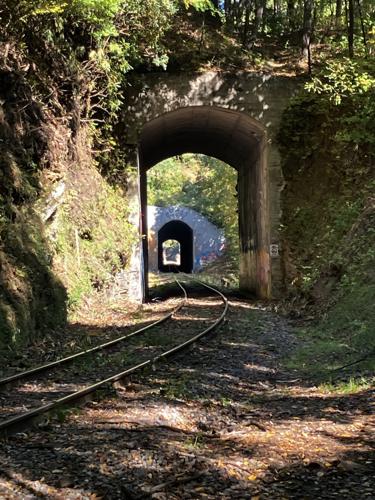

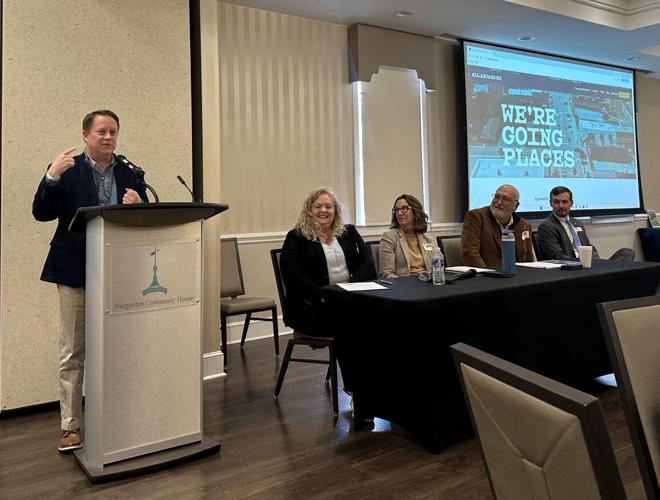


A $665 million plan to bring passenger rail back to Western North Carolina is gaining traction, but its future depends on solving a funding puzzle between local, state, and federal governments.
Federal funding would make up the lion’s share — $532 million — but the project depends on whether the non-federal funding match of $133 million is secured, which will likely take a combination of local and state funds.
“We call it skin in the game. If you want to go to your state legislature and ask them to help contribute, they’re going to want to know ‘what are you contributing,’” said Julie White, NCDOT deputy secretary for multi-modal transportation. “If it’s that important to you, what are you bringing to the table?”
Whether it was a Transit-Oriented Development grant or a Mobility Hub grant, White said every grant that was utilized for the S-Line from Raleigh to Richmond, Va., had a local match instead of a state match, which added up to be about $60 million, not counting Wake County’s contribution.
“These don’t have to be significant contributions, but you’ve got to show that you’re serious by bringing money,” White said.
At this point, it’s uncertain how local governments will decide how much to contribute. Will it depend on who can pay the most to receive a stop? Will it depend on which local governments have the largest populations? These are all questions that Morganton City Manager Sally Sandy said are up in the air.
She expects that local governments throughout the region will do heavy consulting with Metropolitan Planning Organizations like the Western Piedmont Council of Governments and Rural Planning Organizations like the Foothills Regional Commission to figure out what the local shares will be.
But first will be making the business case to the North Carolina General Assembly and determining what’s a reasonable amount of funding to ask of state legislators, Sandy said.
“You’ve got to be able to deliver, you’ve got to have credibility, and that’s got to be sustained over time,” said Jim McClesky, North Carolina Washington Office Director. “That starts with a solid team at home.”
The Western North Carolina Rail Committee, a 25-year-old nonprofit committed to restoring passenger rail service between Asheville and Salisbury, has been working to restore passenger rail service to the region since the 1990s.
In 2021, traction picked back up with the passage of the 2021 Bipartisan Infrastructure Law. Co-authored by U.S. Sen. Thom Tillis, the law included $66 billion for new rail projects across the country, including the Asheville to Salisbury route.
The restoration of passenger rail to Western North Carolina is expected to create more than 300 jobs annually, generate $20 million in annual employee earnings, and produce nearly $60 million in economic output for the region, according to the 2023 Western North Carolina Passenger Rail Feasibility Study.
In December 2023, the Federal Railroad Administration selected the route to go through the U.S. Department of Transportation’s Corridor I.D. program. The first step of the program came with $500,000, given to each of the state’s seven corridors, to develop a scope, schedule, and cost estimate for bringing back the line.
The next step is completing the Service Development Plan, which is planned to be completed in 2027. The plan will identify projects/needs for constructing the line, which includes crossings, stations, and stops along the route.
Once the plan is finished, environmental clearance and engineering is expected to take 2-3 years to complete before construction can begin. Local governments will have to match federal funding at 20% to complete the process, but the big question is how that will be split between the state, local governments, and private individuals, who may want to contribute.
Once the local match is secured, the project will start to come together, White said. With the S-Line, which is in development, she said the local communities were the ones that really stepped up.
Restoring passenger rail to Western North Carolina is one of the most bipartisan-supported movements today, which is rare in our country’s polarized politics, said Jeffrey Howard, board member for Morganton Waiting for the Train.
“We just need to keep pressuring our elected officials and help community leaders understand how much better life can be, for everyone, when passenger trains get rolling through this beautiful region again,” Howard said.












(0) comments
Welcome to the discussion.
Log In
Keep it Clean. Please avoid obscene, vulgar, lewd, racist or sexually-oriented language.
PLEASE TURN OFF YOUR CAPS LOCK.
Don't Threaten. Threats of harming another person will not be tolerated.
Be Truthful. Don't knowingly lie about anyone or anything.
Be Nice. No racism, sexism or any sort of -ism that is degrading to another person.
Be Proactive. Use the 'Report' link on each comment to let us know of abusive posts.
Share with Us. We'd love to hear eyewitness accounts, the history behind an article.