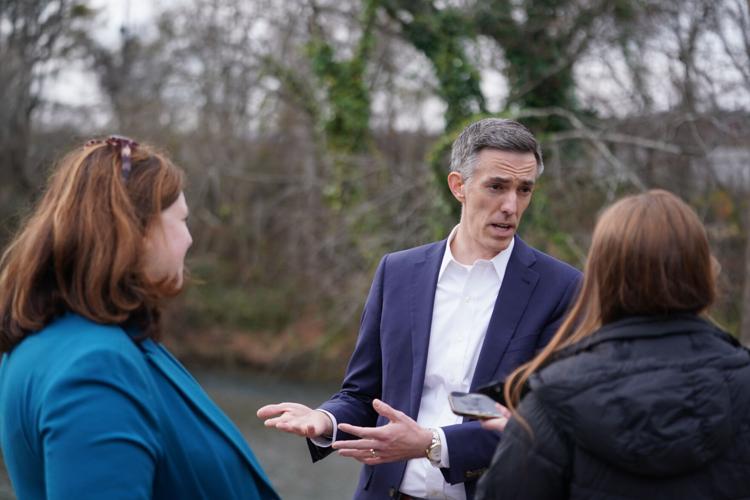
Matt Calabria and Emily Gangi with GROW NC explain how the process for receiving FEMA reimbursements has been delayed and challenges that local governments in western North Carolina are facing in the process.
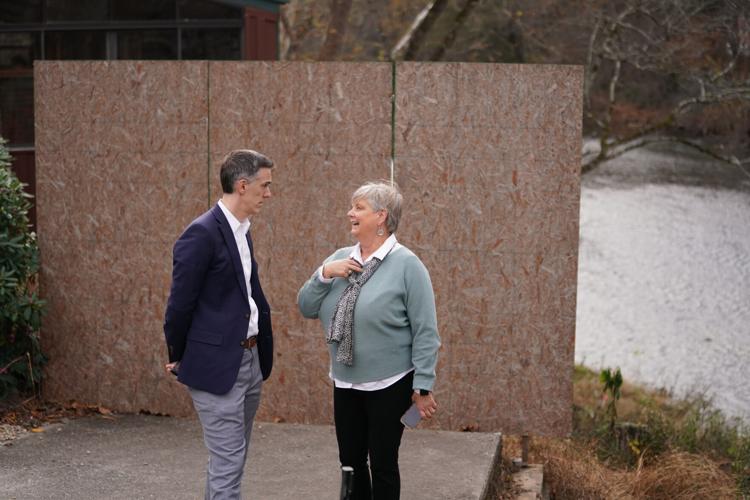
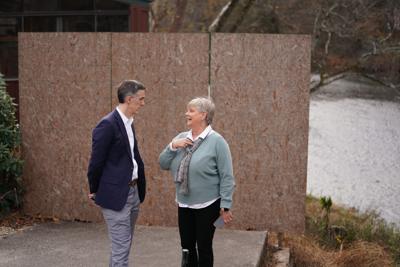
GROW NC Director Matt Calabria chats with Morganton City Manager Sally Sandy at River Village Thursday afternoon. He and Emily Gangi paid a visit to take a tour of the city’s most Helene-affected areas.
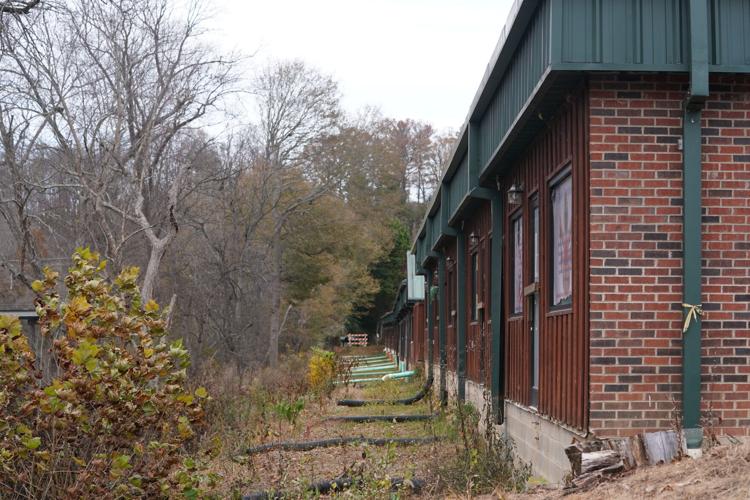
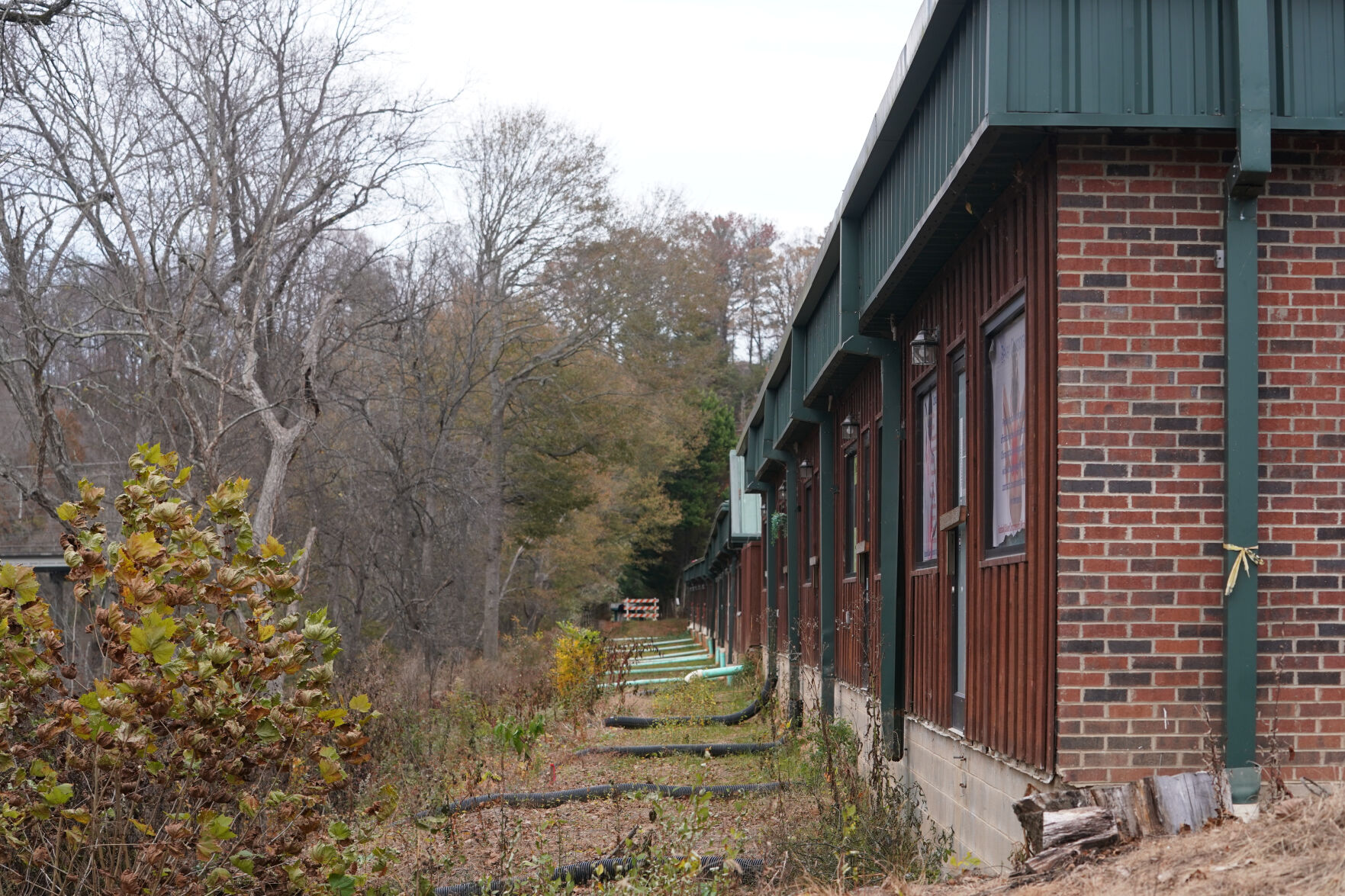
The Catawba River Greenway’s boardwalk connector was destroyed by Hurricane Helene. Its replacement will be one of the City of Morganton’s main priorities in 2026.
GROW NC Director Matt Calabria chats with Morganton City Manager Sally Sandy at River Village Thursday afternoon. He and Emily Gangi paid a visit to take a tour of the city’s most Helene-affected areas.
Recovery officials from NC Gov. Josh Stein’s office walked the River Village flood-scarred corridor Thursday, surveying collapsed banks and missing boardwalk, and assuring local leaders that with fresh funding and a fast-tracked rebuild, the quiet riverfront should feel less abandoned by spring.
Matt Calabria, director, and Emily Gangi, chief deputy director, with the Governor’s Recovery Office for Western North Carolina, took a tour of Morganton’s most Helene-devastated areas Thursday afternoon from Catawba Meadows Park to River Village.
The goal of the office is to advocate for accelerated Helene recovery, which Calabria said includes playing matchmaker when it comes to grants, and working closely with North Carolina-based FEMA officials.
The boardwalk replacement is close to a third of the way funded by $1 million from the Small Business Infrastructure Grant Program (SmBIZ). City officials received notification in July from the North Carolina Department of Commerce that they would receive the funding.
SmBIZ is a $55 million fund that’s designed to rebuild damaged infrastructure that small businesses rely on to thrive. The boardwalk was an obvious choice as businesses in River Village are missing the foot traffic that the Catawba River Greenway boardwalk connector previously provided.
River Village is slowly but steadily regaining its role as an entertainment and tourism destination with its store fronts lining the popular Catawba River boardwalk, restaurant, and bike trails.
River Village co-owner and developer L.H. Kirksey said, “The last word (about reopening) that I heard was next spring. Town Tavern has been open since May. We have 21 bays for businesses and there are nine left.”
City Manager Sally Sandy, Assistant City Manager Rob Winkler, and Parks and Recreation Director Bryan Fish took Calabria and Gangi to the Rocky Ford Access, where portions washed away; Catawba Meadows, where athletic fields and maintenance facilities were ruined; and to River Village, where Morganton’s popular boardwalk remains missing.
The Catawba River Greenway’s boardwalk connector was destroyed by Hurricane Helene. Its replacement will be one of the City of Morganton’s main priorities in 2026.
LISA PRICE / THE PAPER
According to Sandy, bids are expected to be posted for the boardwalk within a matter of days, with the goal to award a contract in January, and an estimated spring completion. The city is still waiting to receive additional funding from FEMA, but the improved design will feature more resilient features, said Winkler, who has been heading the project.
Running into delays with FEMA reimbursement is a conversation that Calabria and Gangi are all too familiar with. Their tour followed hours-long conversations with leaders from the City of Morganton, Burke County, and the Town of Valdese.
Calabria and Gangi explained that FEMA reimbursements are taking longer than expected because several federal processes must be completed before funds are released. For example, Gangi said that Homeland Security Secretary Kristi Noem created a new rule where she has to personally sign off on all FEMA contracts over $100,000.
Most Helene-related reimbursement requests, Gangi said, are over that amount. Noem also maintains a demanding travel schedule for her position, and because her personal signature is required, the process has not been as efficient as it could be.
Matt Calabria and Emily Gangi with GROW NC explain how the process for receiving FEMA reimbursements has been delayed and challenges that local governments in western North Carolina are facing in the process.
LISA PRICE / THE PAPER
Another process called “Defend the Spend,” which is an initiative from the Department of Government Efficiency (DOGE), has also contributed to slowing down the process. After Noem signs off on the particular set of funding, Calabria said that members of Congress are notified, and then the state’s Emergency Management Division has to take the paperwork provided to FEMA, and download it, reformat it for DOGE, and upload it to a separate server.
That process is shorter now, Calabria said, adding that it takes about a week for the additional step, but as of a few months ago, it would have been weeks or months before that final step was completed.
“But what we are trying to do is work as collaboratively as we can with FEMA to make sure that we are understanding why projects are getting hung up, “Calabria said. “We want to make sure that we add communication to the mix so that everybody understands what stage of the process each project is in.”
The FEMA employees that have been on the ground in North Carolina, Calabria said, have been very communicative and collaborative, “but we are working within a system that has many steps, and is not always intuitive, and so we do the best that we can to advocate on behalf of our residents.”
In addition to discussing reimbursement delays, Calabria said local government officials also spent time talking with them about major infrastructure projects, including the boardwalk.
“We are at a transition point in the recovery where we know that we are going to continue to build houses as quickly as we can and repair homes, repair roads and bridges of all kinds,” Calabria said, “but the nature of recovery is such that there are large infrastructure projects that just take years.”
Calabria said that GROW NC’s job is to accelerate those projects by maximizing federal funding and coordinating with state and local partners to get work done. “It’s so helpful to hear from local leaders about the amazing work that they’re doing, and this directly informs our advocacy and our programmatic development.”
Madison Lipe is the municipal reporter for The Paper. She can be reached at 828-445-8595 or madison@thepaper.media.
Keep it Clean. Please avoid obscene, vulgar, lewd,
racist or sexually-oriented language. PLEASE TURN OFF YOUR CAPS LOCK. Don't Threaten. Threats of harming another
person will not be tolerated. Be Truthful. Don't knowingly lie about anyone
or anything. Be Nice. No racism, sexism or any sort of -ism
that is degrading to another person. Be Proactive. Use the 'Report' link on
each comment to let us know of abusive posts. Share with Us. We'd love to hear eyewitness
accounts, the history behind an article.













(0) comments
Welcome to the discussion.
Log In
Keep it Clean. Please avoid obscene, vulgar, lewd, racist or sexually-oriented language.
PLEASE TURN OFF YOUR CAPS LOCK.
Don't Threaten. Threats of harming another person will not be tolerated.
Be Truthful. Don't knowingly lie about anyone or anything.
Be Nice. No racism, sexism or any sort of -ism that is degrading to another person.
Be Proactive. Use the 'Report' link on each comment to let us know of abusive posts.
Share with Us. We'd love to hear eyewitness accounts, the history behind an article.