



From its stately perch on a hill south of town, Broughton Hospital, a state-established psychiatric care facility, has overlooked Morganton for more than 140 years.
Now, a new museum has been established in the Avery Building which tells the stories of doctors, nurses, patients, and the changes in mental health care which have developed since the facility was founded back in 1883.
The new museum opened its doors for the first time on Saturday, Sept. 27, to hospital staff and their families only. Chief Operating Officer Olga Propst hopes the museum will open to the public come November, offering an insight into the campus’ past.
“We really want the community to know that Broughton Hospital is part of our community,” Propst said. “We’re not just that scary building sitting on the hill.”
The freshly organized museum boasts an impressive collection of antique clothing, equipment, and art for visitors to admire.
The late Jon Berry, the Project Manager for the construction of a new main building at the hospital, preserved many artifacts during renovations and the late Steven Baker inspired the idea of a museum through years of post-retirement tours and educational sessions at the hospital.
Director of Volunteer Services Stephanie Smith cultivated the layout, hand-picking each exhibit’s many pieces and collaborating with the Burke County Public Library to gather history and photos not available on-campus.
“It’s going to be a wonderful opportunity to educate the public,” Smith said. “Not only about Broughton’s past, but also our present and our future, because they’re all unformed. I think the further that we look back, the further ahead we can see.”
As a “student of history,” Smith carefully leads visitors through each exhibit, detailing the intricacies of Broughton’s workers and patients.
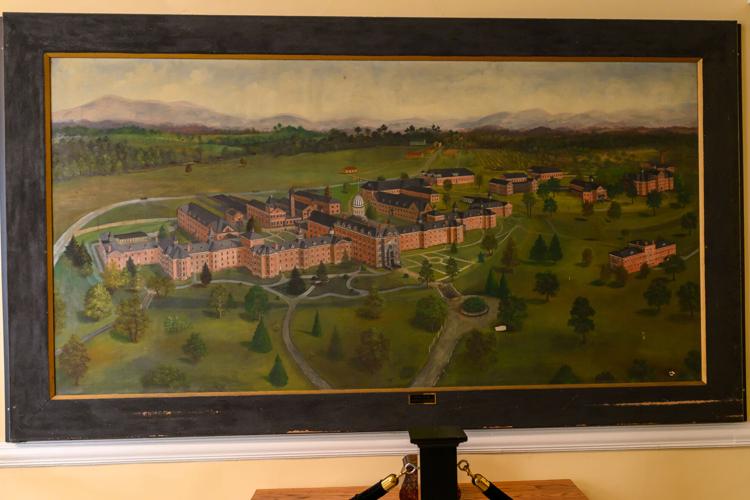
Adorning the beginning of the tour is a to-scale painting of the campus completed in 1906 by a patient, long before aerial photography could provide reference material — not to mention that the patient would not have been able to paint it from the distance and angle that it is shown due to their confinement to the hospital.
“We would love to be able to raise money or have the money to have that painting restored,” Chief Executive Officer (CEO) Vivian Streater said. “It needs it desperately. We’ve talked to various state agencies through the years, and we’ve just never gotten there.”
Moving from the precision of the painting to the documents room, visitors will get the opportunity to read historical inscriptions for themselves.
“Knowing they were written in the late 1800s is just an extraordinary experience,” Smith said. “You’re literally holding history in your hand … They combine both business that was conducted as well as some patient letters that are a very interesting read.”
Following the documents room, visitors pass through a medical room with instruments and a barrage of photos from the time of Broughton’s nursing school. Smith explained the brutal schedule for a nurse at that time: 24/7 care with one afternoon off, one evening off, and then, one full day off in a month.
In one corner, a glass cabinet contains a slew of items: combs, batteries, toothbrushes, razors, glass shards, aquarium rocks, and a variety of other palm-sized items — all removed from intestinal tracts.
“We also wanted to feature this as a point of interest,” Smith said. “I refer to it as our pica cabinet. Pica is actually an eating disorder that’s characterized by a compulsive consumption of non-food items. There’s also another disorder called deliberate foreign body ingestion. So, if it can be swallowed or inserted, these are some of the things that have come out of our patients at one time or another.”
Despite the stomach-churning memorabilia, the medical equipment is extensive and features everything from wheelchairs to antique scales. The room adjoins a “Broughton of Yesteryears” room, displaying a multitude of staff photos from over the years.
“One of the things that I’m looking forward to as we begin to open to staff and conduct community tours is really hearing the family stories,” said Smith.
Among the stories already present in the museum are a collection of reproduced case files that hang on the wall in a second medical equipment room. Patient names have been replaced with numbers, but the case files reflect the medical records of the late 1800s that were sorted and digitized by a previous intern.
The case files hang opposite a section exemplifying the hospital’s colony system, developed by Dr. Patrick Murphy — the first superintendent — to create a self-sustaining campus.
From sewing machines to bread slicers to fire department equipment, Broughton functioned autonomously for decades until the last part of their dairy program was phased out.
At the time, patients could work in the gardens, kitchens, and sewing room. They were paid in tokens and cigarettes at first, eventually receiving money before the state removed work obligations.
As part of the hospital’s current mission to provide recovery opportunities, the creative expressive arts program allows participants to develop visual media for the final room in the museum.
Smith said, “I thought it was an interesting way to end the tour because, again, we wanted to go from past into present … Obviously, there’s still a lot of stigma associated with mental illness. We’re here to dispel those myths and open up our doors to our history and open up our doors to our present to be a source of education for our community.”
While several of the current pieces displayed were in different parts of the hospital previously, the exhibit will be rotational, shifting as new art is created by the patients.
Hoping to offer guided tours to the community once each month, admission will be free and available via reservation only. To reserve, contact bh.historicmuseum@dhhs.nc.gov.






















(0) comments
Welcome to the discussion.
Log In
Keep it Clean. Please avoid obscene, vulgar, lewd, racist or sexually-oriented language.
PLEASE TURN OFF YOUR CAPS LOCK.
Don't Threaten. Threats of harming another person will not be tolerated.
Be Truthful. Don't knowingly lie about anyone or anything.
Be Nice. No racism, sexism or any sort of -ism that is degrading to another person.
Be Proactive. Use the 'Report' link on each comment to let us know of abusive posts.
Share with Us. We'd love to hear eyewitness accounts, the history behind an article.