

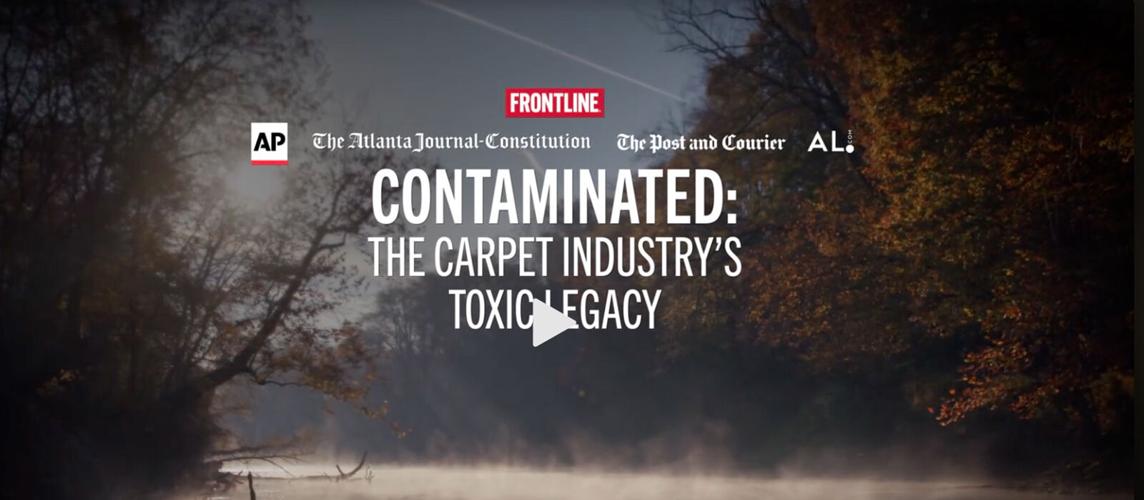



Dana Miller Ervin, a Morganton resident and veteran investigative journalist, helped produce a national investigative documentary examining how decades of chemical use by the Southern carpet industry contaminated drinking water and left entire communities exposed to substances now linked to serious health risks.
Ervin served as a producer on a PBS FRONTLINE documentary “Contaminated: The Carpet Industry’s Toxic Legacy,” aired for the first time time earlier this week on PBS. Check your local listings for the time and channel for rebroadcasts.
The film investigates the use of PFAS, commonly known as “forever chemicals,” by carpet manufacturers in northwest Georgia and the long-term environmental and health consequences that followed.
The documentary is a joint investigation by FRONTLINE, the Associated Press, The Atlanta Journal-Constitution, The Post and Courier, and AL.com.
“The film is about communities in northwest Georgia whose water has been polluted by carpet companies that used so-called forever chemicals to stain-proof their carpets,” Ervin said. “Many people there have high levels of PFAS in their blood.”
“We learn that it’s a failure of accountability at every level, federal, state and local, that’s left these people at risk,” Ervin said.
Scientists have linked PFAS exposure to a range of illnesses, including several forms of cancer, kidney and liver disease, thyroid problems, suppressed immune response, and decreased infant and fetal growth, according to the documentary and peer-reviewed research cited in the film.
The investigation traces how chemical manufacturers and carpet companies continued using PFAS even as internal research and public studies raised questions about their safety. The film also examines how regulatory oversight failed to keep pace with the growing evidence of harm.
Although the documentary focuses on northwest Georgia, the issue extends far beyond a single region. PFAS have been used nationwide in products ranging from firefighting foam and clothing to food packaging, cosmetics and hygiene products.
“There are about 15,000 PFAS currently in the environment,” Ervin said. “The uses have multiplied, and we have no information on the health effects of most of them.”
For decades, federal regulators were slow to act, the film reports. That began to change in 2024, when the U.S. Environmental Protection Agency established drinking water limits for six PFAS chemicals and launched a national testing strategy to identify contamination in public water systems.
However, Ervin said much of that progress is now uncertain.
“After a quarter century of slow action, the EPA finally took meaningful steps,” she said. “Much of that is now being delayed or rolled back by the Trump Administration.”
Ervin brings extensive investigative experience to the project. She has worked as an award-winning journalist for 60 Minutes, Nightline and CBS This Morning, and spent 12 years as a congressional investigator for the U.S. House Appropriations Committee, where she examined federal spending and oversight. More recently, she returned to reporting under a grant-supported role with WFAE, a Charlotte-based public radio station.
FRONTLINE, which has aired investigative documentaries since 1983, is widely regarded as one of the nation’s leading long-form journalism programs. The series has won 110 Emmy Awards, 34 Peabody Awards and an Academy Award, among other honors.
The documentary is available to stream through PBS platforms.
“PFAS are in water supplies across the country,” she said. “This is not just their story. It’s everyone’s.”












(0) comments
Welcome to the discussion.
Log In
Keep it Clean. Please avoid obscene, vulgar, lewd, racist or sexually-oriented language.
PLEASE TURN OFF YOUR CAPS LOCK.
Don't Threaten. Threats of harming another person will not be tolerated.
Be Truthful. Don't knowingly lie about anyone or anything.
Be Nice. No racism, sexism or any sort of -ism that is degrading to another person.
Be Proactive. Use the 'Report' link on each comment to let us know of abusive posts.
Share with Us. We'd love to hear eyewitness accounts, the history behind an article.