









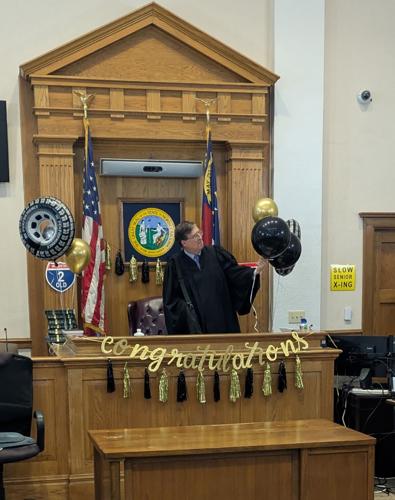

Recently retired Superior Court Judge Bob Ervin grew up in a remarkable environment.
His grandfather, Sam J. Ervin Jr., was a decorated hero of World War I, a graduate of Harvard Law School, a former justice on the N.C. Supreme Court, and of course, the U.S. Senator who helped to topple the presidency of Richard Nixon through his chairmanship of the Senate Watergate Committee.
His father, Sam J. Ervin III, known to friends and family as Three I, was also a graduate of Harvard Law School, a former N.C. House representative, a Superior Court Judge, and for the final 19 years of his life, a judge on the U.S. Fourth Circuit Court of Appeals.
His mother, Betty Ervin, was a respected and beloved history teacher at Freedom High School and a tireless civic leader devoted to improving life for the residents of Morganton and of Burke County.
So, Bob, what was it like to be a part of that household?
“I never knew anything different,” Ervin replies with a soft laugh. “The most important aspect was watching how my parents and grandparents interacted with people. They treated everyone, truly everyone, with courtesy and respect. They took very seriously their responsibilities as role models.”
SITTING DOWN FOR A CHAT
Bob stepped down from his seat as a Superior Court judge earlier this autumn, marking an end to his 22 years of service on the bench. He recently sat down in the offices of The Paper with Editor Emeritus Bill Poteat to discuss his life and career.
Now 65, Bob looks much as he did when he became a judge in 2002. His hair has but a touch of gray, his face is unlined, and he has yet to develop the “Ervin jowls” for which his grandfather was well known.
Bob brings the same calm and affable demeanor to The Paper’s conference room that he brought to the bench. The man is utterly without pretense, comfortable with who he is and open to talking about it.
Nattily clad in a crisp blue button-down shirt and tan dress pants, Bob doesn’t need to wear a robe to give him the dignity befitting a man of his stature — it comes naturally.
Born in 1960, Bob made his way through the Burke County Public Schools — Mountain View Elementary, Morganton Junior High, and Freedom High School. That journey was interrupted only for the first semester of his ninth-grade year when he served as a page in the U.S. Senate and attended school in Washington.
Bob’s grandfather retired from the U.S. Senate in December of 1974 and he and his wife Margaret moved home to Morganton.
“I got to see him a lot more after his retirement,” said Bob. “I got to spend more time around him and my grandmother. He didn’t really fit a conventional mold. He was generally a conservative, but he also had a libertarian bent and was fiercely protective of the rights of the individual.”
Of his father, Bob remembers, “He was more like his mother than his father. More understated. Quieter. He was not the storyteller that my grandfather was. But his people skills were absolutely impeccable as a judge.”
Sen. Ervin died in April of 1985 at the age of 88, and his funeral, held at Morganton’s First Presbyterian Church, was attended by a host of state and Washington dignitaries.
Judge Ervin died in September of 1999, felled by heart disease at the age of 73.
AN EDUCATIONAL FOUNDATION
When asked what kind of student he was at Freedom High School, Bob laughed and said, “A pain in the rear.” Pressed on the subject, however, the “pain in the rear” could not recall a single time he was ever in trouble.
Of course having his mother Betty in the school might have put a damper on any hijinks by young Bob, especially when he was a student in her classroom.
Bob served in student government at Freedom and was a member of the debate team. But at what point did he make the decision to follow not only his grandfather and father into the law profession, but also his older brother Jimmy?
“I gave some thought to teaching and to the foreign service,” Bob responded. “But the law was what I had grown up with, it was what I was familiar with. The law business was the family business.”
Bob proceeded to follow in his father’s footsteps, first earning his bachelor’s degree at Davidson College.
“I was familiar with the campus,” he said. “Our dad had taken us to a lot of basketball games there. Academically, it was a very strong school and prepared me well.”
Davidson prepared Bob to seek his law degree at Harvard Law, but without the intervention of his grandfather, he might have attended law school at Chapel Hill rather than Cambridge.
“It was early in 1982 and I was discussing my plans,” Bob said. “I told him I had been accepted by Chapel Hill but had not yet heard from Harvard. Unknown to me, the next day, he picks up the phone and calls the admissions office.
“They were embarrassed,” Bob went on, “because they couldn’t find my application. Apparently they turned the place upside down and found it. I’ll never know if his phone call got me in.”
HARVARD LAW AND BEYOND
Although Bob had been impressed by the academic strength of Davidson, he found that Harvard Law operated on a different plane entirely.
“I was amazed at how bright some of the people there were,” Bob explained. “There were folks there who were playing on a different field entirely. We’re talking not only people from all over the country but all over the world.”
Bob thrived in the academic climate at Harvard Law but found the outside climate a little less to his liking.
“Snow,” he answered when asked what he remembered. “Constant snow. And they don’t really plow the streets. They put down some kind of melting agent, so you end up walking through this constant gray slush.”
After receiving his law degree in the spring of 1985, Bob joined a large law firm in Charlotte. Although he gained a lot of experience there, Bob wanted a more hands-on, working with clients environment.
He received exactly that when he joined the law firm founded by brothers Joe and Bob Byrd in 1988.
“Bob (Byrd) believed in the ‘sink or swim’ method with young lawyers,” Bob recalled. “Of course, I learned a lot just from watching him at work in the courtroom.”
Of his years with the firm, Bob said, “Most of what I did was courtroom work. I was very much a generalist. Both civil and criminal cases. I did work several capital defense cases where the state was seeking the death penalty. That is sobering work.”
In 2002, at the age of 42, Bob sought election as a Superior Court judge for the 25th Judicial District. He was re-elected in 2010 and 2018. He chose not to seek reelection in the upcoming 2026 election.
As noted earlier, Bob was known in court for his calm demeanor, keeping things cool in his courtroom even when things grew heated between contesting lawyers.
Another writer once wrote of Bob’s courtroom style, “He’s got valium in his veins.”
“My philosophy was simple,” Bob said. “I always recognized that being in court was bad enough. You don’t need the judge making it worse.
“I wanted to create an environment in the courtroom where everyone thought they were getting a fair shot,” he continued. “I wanted to give the lawyers space and freedom to make their case.
“I wanted to be known as a lawyers’ judge,” he concluded. “Of course, that’s a lot easier to do with good lawyers than it is with bad ones.”
FINAL THOUGHTS AND THE FUTURE
North Carolina’s judicial elections have gone back and forth from partisan to nonpartisan numerous times over the past 150 years. Superior Court, District Court, and Supreme Court seats all became subject to partisan elections in 2018.
“Injecting partisan politics, especially at the district and superior court levels, truly serves no purpose,” Bob said. “We’re simply following the statutes set up by the legislature. We have no freedom to step outside those bounds.”
Bob, of course, has now stepped outside the bounds of the judiciary and of the daily practice of law. So what does the future hold for a healthy, 65-year-old man with a wealth of valuable experience?
“I’m not sure yet,” he answers honestly. “I’m waiting to see what happens right now. The truth is, I’m a lot better at consistently working than I am at consistently having fun.
“I am doing some mediation work,” he continued. “I’m enjoying the freedom to socialize more. We’ll just see what the future brings.”
And will that future be here in Morganton?
“Morganton is and always has been home,” he responded. “Whether it will be home for the rest of my life, I simply don’t know.”
With the interview completed, Bob works the room like the skilled politician he is as he makes his exit, joshing with Publisher Allen VanNoppen, greeting new reporter Mica Banks and courts reporter Jacob Christopher with a warm handshake and a smile, being his usual gracious self.
As the door closes behind him and Bob makes his way up Sterling Street in the bright November sunshine, the Editor Emeritus thinks to himself, “That’s a native son that this community can be proud of.”


























(0) comments
Welcome to the discussion.
Log In
Keep it Clean. Please avoid obscene, vulgar, lewd, racist or sexually-oriented language.
PLEASE TURN OFF YOUR CAPS LOCK.
Don't Threaten. Threats of harming another person will not be tolerated.
Be Truthful. Don't knowingly lie about anyone or anything.
Be Nice. No racism, sexism or any sort of -ism that is degrading to another person.
Be Proactive. Use the 'Report' link on each comment to let us know of abusive posts.
Share with Us. We'd love to hear eyewitness accounts, the history behind an article.