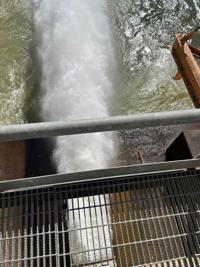
Water is discharged into the Catawba River at the Bridgewater Hydro Station. With both large turbines back in operation, engineers can better control the level of Lake James. Just below the walkway that runs the width of the building are the metal air vents through which flood waters entered in September from Hurricane Helene. An enormous amount of water careened down from the numerous high-country tributaries of the Catawba and Linville rivers and Paddy’s Creek, and into Lake James, the westernmost of the 11 reservoirs in Duke’s Catawba-Wateree system. Read more about how the powerhouse fared during the hurricane on 14A.
Water rushes through the ring-jet valve at the Bridgewater Hydro Station at Lake James. Underneath the surface, water is also being released from the station’s two enormous turbines. The powerhouse is operational again after Duke Energy repaired damages sustained from flooding during Hurricane Helene last September.
Duke Energy’s David Bumgardner points to the high-water mark on the third-floor landing of the Bridgewater Hydro Station. Water climbed 24 feet in the building during the hurricane.
One of the air vents on the downstream side of the Bridgewater Hydro Station. Water backed up into the tailrace during Helene, and poured into the station through the vents.
Water rushes through the ring-jet valve at the Bridgewater Hydro Station at Lake James. Underneath the surface, water is also being released from the station’s two enormous turbines. The powerhouse is operational again after Duke Energy repaired damages sustained from flooding during Hurricane Helene last September.
MARTY QUEEN / THE PAPER
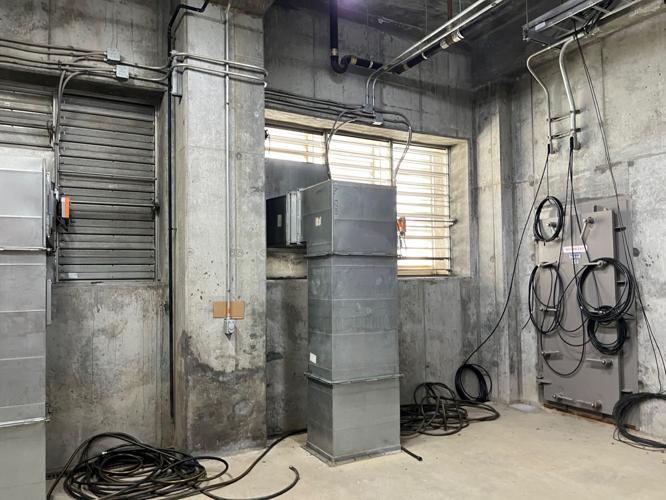
This photo shows some of the machinery inside the hydro station that was flooded during Helene.
MARTY QUEEN / THE PAPER
One of the air vents on the downstream side of the Bridgewater Hydro Station. Water backed up into the tailrace during Helene, and poured into the station through the vents.
MARTY QUEEN / THE PAPER
David Bumgardner points to an electronic panel inside the powerhouse. Much of the machinery inside sustained heavy damage during the hurricane.
MARTY QUEEN / THE PAPER
Large spools hold some of the miles and miles of electrical cable that will need to be reinstalled at the powerhouse.
Squinting through the grates of a metal stairway, you can barely make out the concrete floor of the Bridgewater Hydro Station three stories below you.
All around, the sturdy building vibrates with raw power. A torrent from the bottom of Lake James surges through two massive turbines before being discharged violently into the Catawba River tailrace with a deafening roar.
If you had been in the same spot on the morning of Sept. 27, 2024, you’d have been fighting to stay afloat amid an eerie silence.
That morning, the turbines were literally dead in the water.
Duke Energy’s David Bumgardner points to the high-water mark on the third-floor landing of the Bridgewater Hydro Station. Water climbed 24 feet in the building during the hurricane.
MARTY QUEEN photos / THE PAPER
Inside the powerhouse, the water rose 24 feet above the structure’s floor. Duke Energy crew members drew a line at the high-water point and scrawled the date beside it.
They’re planning to hang a plaque there to permanently memorialize the spot.
Historic flooding from Hurricane Helene’s rampage through Western North Carolina that day raised Lake James to the highest level in its century-long history: 110.75 feet, easily surpassing the previous record of 107 set during Hurricane Frances in 2004.
“The U.S. Geological people told us it was a 1,000-year flood,” said David Bumgardner, Duke Energy senior project manager, as he stood on the third-floor landing and pointed out the mark. “These just don’t happen. It was one for the record books, and I hope we never see it again.”
The deluge Helene delivered was — at least as far as recorded history is concerned — completely unprecedented for the Blue Ridge Mountains, nearly 500 miles from the Gulf of Mexico where the hurricane formed.
The storm dumped as many as 30 inches of rain in some spots.
A soaking rain from a stalled front the week before had already saturated the ground, and there was nowhere for the excess water to go.
An enormous amount of it careened down from the numerous high-country tributaries of the Catawba and Linville rivers and Paddy’s Creek, and into Lake James, the westernmost of the 11 reservoirs in Duke’s Catawba-Wateree system.
It was more than enough to swamp the sensitive, computerized machinery that controls the turbines. Without them, the powerhouse can’t generate power, and engineers in Charlotte — the station is normally controlled remotely from 80 miles away — can’t regulate water flow out of the 6,800-acre reservoir.
A smaller third turbine unit on the ground floor of the building was completely submerged.
Water flows from the ring-jet valve at the Bridgewater Powerhouse on Lake James.
MARTY QUEEN photos / THE PAPER
Even the ring-jet valve — essentially just a pipe that carries water straight through the dam and into the river below — was out of commission.
Like nearly every other component of public infrastructure in the mountains that weekend, the powerhouse was offline.
It stayed that way all winter while Duke scrambled to complete repairs, a process company spokesman Ben Williamson said will cost in excess of $10 million.
ASSESSING THE DAMAGES
The first order of business when workers returned to the powerhouse Sept. 28 was getting the minimum-flow, ring-jet valve operable.
“That was our first objective in the recovery: getting that min-flow pipe in service so we could get some flow passing through the station,” Bumgardner said. “It took us until the first of November to get the ring-jet pipe open so we could pass some flow.”
On a late winter day five months removed from the catastrophe, a gusher jetted from the mouth of the pipe, thundering so loudly it made conversation any softer than a shout inaudible.
It seems counterintuitive to think the release of so much water could have only a modest effect on the lake level, but it’s true.
“That really doesn’t give you control of the reservoir level because it’s not passing enough flow,” Bumgardner hollered while pointing at the pipe. “I’m basically getting flow in up there faster than I can pass it out down here.”
With the valve working, crews turned their attention to the turbines.
Fortunately, no heavy rain events occurred while they were out of order, allowing Duke to work uninterrupted.
For employees, that meant months of overtime.
The company called in every available worker, even convincing folks like one recently retired staffer who asked not to be named, to jump back in the fray. The man laughed and shook his head when talking about the culture shock of going from retirement to working six or seven, 12-hour days a week.
MAKING IT ALL WORK
Manpower was at a premium, as were replacement parts.
Much of the equipment inside the station is specialized, which makes finding parts difficult.
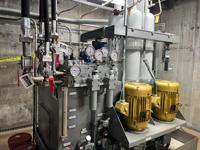
This machine, one of two that lubricates the turbines at the hydro station, was damaged by the flood. Both units had to be replaced.
MARTY QUEEN / THE PAPER
Each turbine is lubricated by an independent machine, festooned with gauges, hoses, and electrical connections. Both were fully submerged and had to be replaced.
The station’s auxiliary transformer was also ruined, and Bumgardner searched until he found a used unit in good working order to take its place. A new one is on order.
In the days following the storm, the powerhouse’s only electricity came from portable generators. Bumgardner strung up rows of patio lights so work could continue in the otherwise darkened station.
Getting the big wheels turning again was an urgent mission.
“The company wanted to make that happen as soon as possible,” Bumgardner said. Still, it took months.
Workers got the first unit up and running in early February, and engineers immediately started lowering the lake level. The second turbine was operational a week later.
Their restoration allowed Duke to draw the lake down from full pond (100 feet) to nearer its target level (95.3) in anticipation of spring rains. As of this week, it stood at 96.3 feet.
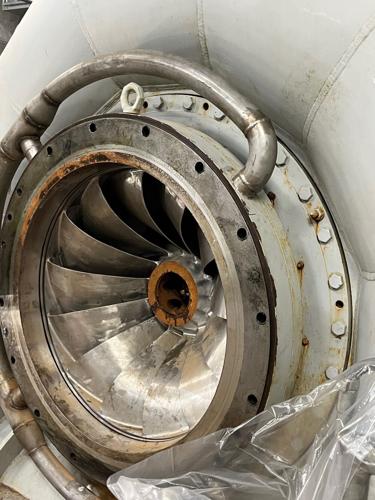
The turbine of the minimum-flow unit at Bridgewater is shown. The entire machine was submerged during the flood.
MARTY QUEEN / THE PAPER
The minimum-flow unit — whose primary purpose is to pass enough flow to support aquatic life downstream, especially the brown trout that flourish in a popular tailrace fishery — sustained so much damage it will be down for another year.
No fish kills were reported during the shutdown, and the increased current from the restored turbines should keep the trout happy for the foreseeable future.
As serious as the damage was, it could have been much worse: The facility’s generators could have been submerged.
“It (water) was 24 feet up in the occupiable space in that powerhouse,” said Jeff Lineberger, Duke’s director of water strategy and hydro licensing. “If it would have been 25 feet up, we would not be talking about having generation at Lake James until next spring.”
Lineberger knows what that timeframe looks like from experience.
When Hurricane Florence hit the Yadkin/Pee Dee Basin seven years ago, the Blewett Falls powerhouse was flooded. Twelve feet of water covered the generator. It took 20 months to recover the station.
One of the two large turbines (upper middle) spins at the powerhouse.
MARTY QUEEN / THE PAPER
HOW DID THE POWERHOUSE FLOOD?
Situated where it is — on the downstream side of an earthen dam that performed exactly as it should have in a catastrophic event — the hydro station wouldn’t seem a likely candidate for flooding.
And ordinarily, it wouldn’t be.
But Helene was anything but ordinary.
Todd Bennick lives on the lake and has been around it his entire life. His company, Bennick Grading and Excavation, is currently working its way through a mountainous backlog of dock repairs and replacements on lake-front homes.
He has heard folks ask how the powerhouse could have flooded.
“People were saying, how did the powerhouse flood? It’s downstream from the dam,” Bennick said. “But shoot, they don’t realize it (the water) backed up in there.”
Lineberger confirmed that’s exactly what happened.
During and after the storm, a 10-foot wall of water poured over the top of the Catawba Spillway 3 miles east of the powerhouse. It surged down the original stem of the Catawba, which is typically nearly dry, and into Muddy Creek.
Less than a mile below the powerhouse, the Catawba and Muddy Creek converge. As the creek emptied its enormous volume of runoff into the river, a “water dam” began to form.
Water couldn’t escape downstream quickly enough, so it formed a barrier that caused water upstream to rise precipitously.
“Those releases (from the hydro station) are very small compared to what’s coming over the spillway and what’s coming out of Muddy Creek,” Lineberger explained. “What happens is, there is a sort of water dam that gets built there. Big, big flows from the spillway and Muddy Creek, relatively small flows coming from the powerhouse. That backs up.
“So much water was backing up from downstream that it backed up into the tailrace.”
Look closely at the downstream side of the powerhouse. Just beneath the narrow walkway that leads to the door are four, metal, fresh-air vents — the lowest apertures on that side of the building.
Water is discharged into the Catawba River at the Bridgewater Hydro Station. With both large turbines back in operation, engineers can better control the level of Lake James. Just below the walkway that runs the width of the building are the metal air vents through which flood waters entered in September from Hurricane Helene. An enormous amount of water careened down from the numerous high-country tributaries of the Catawba and Linville rivers and Paddy’s Creek, and into Lake James, the westernmost of the 11 reservoirs in Duke’s Catawba-Wateree system. Read more about how the powerhouse fared during the hurricane on 14A.
Helene’s daunting impact on the Bridgewater dam
MARTY QUEEN / THE PAPER
They aren’t watertight. No one ever expected the river to reach that high, but on Sept. 27, it did.
“It just had to keep backing up and backing up until the energy was equalized, and it just happened that it equalized above the vents that are coming into the powerhouse,” Lineberger said.
COULD DUKE HAVE BEEN BETTER PREPARED?
In the wake of such a disaster — more than 100 people died and costs to the state are estimated at more than $55 billion — blame invariably gets tossed around, and that’s been true locally where Duke is concerned.
Damage in the Bridgewater community, downstream from the dam, was immense, with houses and campers washed away and the once-shady riverbanks stripped of all but a few of the sturdiest — or luckiest — trees.
Some Burke County residents have wondered aloud if the company should have drawn the lake down further in anticipation of the storm to mitigate the effects downstream.
That doesn’t appear to be the case.
Lake level records in the days leading up to the hurricane’s arrival reveal the company pulled the water down to 96 feet, below its target for that time of year, 98 feet, and just above the minimum level of 95 feet.
Bumgardner explained lake-level decisions are handled by a group of engineers and are arrived at using “math that I don’t even want to think about.”
When preparing for heavy rain, the engineers rely on what they term an “actionable forecast,” one close enough to the event to accurately predict what will happen. Those forecasts are typically available only within two or three days of a storm.
In the run-up to Helene, Duke was still in the process of passing flow from the heavy rains that had fallen the previous week. As a result, it would have been nearly impossible to bring James down any further than it was.
Besides, if engineers drew the lake down too far, they ran the risk of exposing its water intakes in the event of a summer or autumn drought, a scenario that is becoming more prevalent as climate change disrupts traditional weather patterns.
“You can’t pull these lakes down 10 feet in two or three days,” Lineberger said. Still, Duke managed to get all its lakes below their target elevations that week.
“If that hurricane had hit 50 or 60 miles to the west, we would have had a high-water event, but nothing like this,” Lineberger said. “So, you wouldn’t want to start running everything hard a week or two ahead of time and running all this water out of the system hoping that the storm comes. If the storm does not come, you’ve created a water shortage for this coming summer by making a hasty decision.”
The Duke Energy Hydro Station at Bridgewater sustained extensive damage when water backed up and flooded the structure during Hurricane Helene.
MARTY QUEEN / THE PAPER
In addition, Duke had to be concerned with what might happen in the other reservoirs further down the chain, which, like Lake James, were already dealing with a high-water event.
“If you start moving a lot of water in the upper basin, expecting it to hit Lake James, you’re obviously sending a lot of that water into the lower portion of the system,” said Brett Hartis, project manager for the Catawba/Wateree System. “And if it misses, and hits the South Fork, we’re sending water to a place where we just sent a bunch of water to.”
While some may insist Duke erred, one longtime Lake James devotee said the company did all it could have done. Tony Davis of Nebo is an avid angler who has fished the lake year-round for the last 30 years.
He said Helene was uncharted territory for everyone.
“There was no way that Duke could have prepared for a disaster of that magnitude,” Davis said. “When we heard the warnings from the National Weather Service saying, ‘catastrophic flooding,’ we really didn’t know what that meant. Now, we do.
“We were dealing with something unknown — a variable nobody could account for.”
LOOKING TO THE FUTURE
More variables abound in the years ahead.
The hurricane changed the landscape in parts of Western North Carolina dramatically, thanks to the flooding and devastating winds that reached 60 mph.
Many of the creeks and rivers that drain into the Lake James watershed were drastically altered. Their banks have been stripped of the trees and vegetation that kept runoff at bay.
Waterway courses have changed, becoming straighter and wider than before Helene. They won’t stanch the flow as well during future flooding, which means water will run into the lake with more force.
Lineberger expects it will be some time before the full impact of upstream damage will become apparent.
“You don’t recover from a 1,000-year storm in a few months,” he said. “This has changed the river basin. One of the hunches I have is that future flooding events may behave differently. We manage the 11 lakes on the main stem, but all the streams in the watershed feed those at different rates at different times depending on where it’s raining and how hard it’s raining.”
That daunting math the engineers use promises to become increasingly complex.
But one formula employed by their predecessors in the early 1900s is still viable: Despite the damages to the powerhouse, none of the three earthen dams on the lake came close to failing.
Renovations conducted in recent decades have reinforced them, and a rigid inspection process makes sure they’re safe.
Likewise, the Catawba spillway was never in danger.
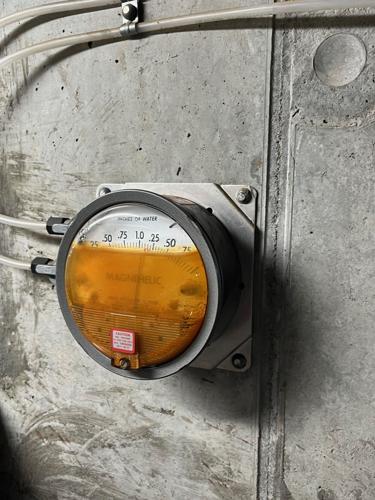
A gauge inside the powerhouse still holds water from the flood.
MARTY QUEEN / THE PAPER
Lineberger said the concrete structure was built to withstand a flow of 267,000 cubic feet per second, which means it will hold up even if 24 feet of water is pouring across it.
That’s nearly two and a half times what it saw during Helene.
Lineberger said that’s a good thing, because extreme events like the hurricane may be our new normal.
“Was this a big flood? Yes, it was,” he said. “Was it THE big flood? Oh no, it was not.”
Marty Queen is the senior reporter. He may be reached at 828-445-8595 ormarty@thepaper.media.
Keep it Clean. Please avoid obscene, vulgar, lewd,
racist or sexually-oriented language. PLEASE TURN OFF YOUR CAPS LOCK. Don't Threaten. Threats of harming another
person will not be tolerated. Be Truthful. Don't knowingly lie about anyone
or anything. Be Nice. No racism, sexism or any sort of -ism
that is degrading to another person. Be Proactive. Use the 'Report' link on
each comment to let us know of abusive posts. Share with Us. We'd love to hear eyewitness
accounts, the history behind an article.


































(0) comments
Welcome to the discussion.
Log In
Keep it Clean. Please avoid obscene, vulgar, lewd, racist or sexually-oriented language.
PLEASE TURN OFF YOUR CAPS LOCK.
Don't Threaten. Threats of harming another person will not be tolerated.
Be Truthful. Don't knowingly lie about anyone or anything.
Be Nice. No racism, sexism or any sort of -ism that is degrading to another person.
Be Proactive. Use the 'Report' link on each comment to let us know of abusive posts.
Share with Us. We'd love to hear eyewitness accounts, the history behind an article.