




Crabcakes, oysters, and okra.
I cannot contemplate this trinity of delectables without remembering my late mother. She was a good cook, and when she made this meal, she almost always fried it.
To eat this spread regularly would require me to place myself on the heart transplant list at the nearest university medical center.
She pan-fried the crabcakes in butter in the iron skillet. These cakes were mainly Chesapeake Bay blue crab palmed into patties with flour — not bread. Some recipes called for mustard, mayonnaise, or Old Bay Seasoning.
That’s the sort of crime they’d commit in Maryland, not Virginia. She chopped onion and boiled eggs and as many pounds of crab as she had. Fresh lemon was at the table, but no garnish, no fuss, and, of course, lots of butter.
She chopped the okra and put it in a paper bag with flour, salt, and pepper, gave it a vigorous shake, then dumped it into hissing oil. She’d drain the okra on paper towels and slap any hand trying to steal the batch piece-by-piece. She could not condone spoiling your dinner with too many handfuls of what many call southern popcorn.
She prepared the precious oysters the same way, except more gently. And though she protected them more fiercely, she could not keep the tasters from liberating one or two as she watched over batch after small batch in the Fry Daddy. Our greedy hands came at her from all angles.
Mom wasn’t a fancy cook. She was interested in neither French sauces nor anything raw. She served no coq au vin with clafoutis for dessert and definitely no seaweed-wrapped sushi.
We all wear cultural blinders, and her travels were limited by a tight budget and the practical need to nourish hungry family inexpensively. These were the days before ubiquitous television cooking shows, much less whole channels of them. She was a pro at tasty, no-frill cooking.
AnnieLaura Jaggers, a friend who had traveled the world and was known, sometimes, to be a culture snob, was impressed by how Mom could whisk a big meal to the table all at once for my dad’s perfectly timed prayer.
The hot stuff was hot, the cold stuff was cold, and the ice hadn’t yet melted in the rose point water glasses — not even in July. It was a feat of temperature and timing, and AnnieLaura was more than a little astonished.
Laid upon Mom’s dining table was what Dad often called a superfluity. There’s always room for one more guest, was my parents’ mealtime philosophy, and there was plenty of food for everyone. Each meal was another of Mom’s routine grandes merveilles.
It was not until I started cooking myself that I realized Mom’s gift.
Mom couldn’t comprehend the idea of “portions.” Filling one’s plate was a “serving.” Going back for thirds was the ultimate compliment. While there was enough okra to feed the proverbial army, she doled out the oysters like pirate treasure. Sometimes the okra was so abundant in the grocery, you could buy enough to fill a swimming pool.
Not so the oysters. Mom got those from Helene, our next-door neighbor who doubled as Mom’s hairdresser. These transactions happened by the glass quart jar by way of a Styrofoam cooler and a waterman who had a boat somewhere near Deltaville, Virginia, on the Piankatank River.
Dad and I always loved when Mom announced she was going to get a haircut. Perhaps to her chagrin, we were more interested in the possibility of blue point oysters on the menu than the perm on Mom’s beloved head.
On our recent trip to the South Carolina coast, our family of kids, dear cousins, and significant others piled into the bistro at the Brookgreen Gardens for lunch. I wasn’t expecting much.
The place was air conditioned and the waiter kept the water glasses full. That was success enough on an exceptionally hot afternoon.
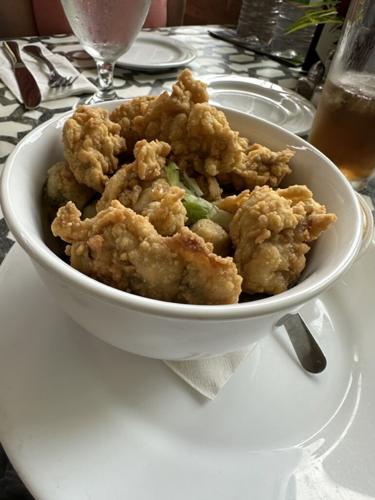
Rachel and I got a salad and split an order of fried oysters and okra. Restaurant-okra is often battered so thickly, one can’t even find the actual okra, much less taste it. Oysters often are ruined by over-battering in cornmeal.
Not these.
Nearly moved to tears, Rachel and I agreed that, somehow, Mom’s ghost was in that kitchen.
A good day is made better with friends gathered around a table of food. All the better when the food tastes good. We returned to this garden lunch spot later in the week and ordered the same thing. It was still good, and we almost wept again. Good food does that, particularly when it reminds you of your long-lost chef or table companion. Of the thousand photographs we snapped on this fortunate vacation, a picture of this meal made it to a prominent place in our vacation photo album.
The sharing of food is the holiest of communions.
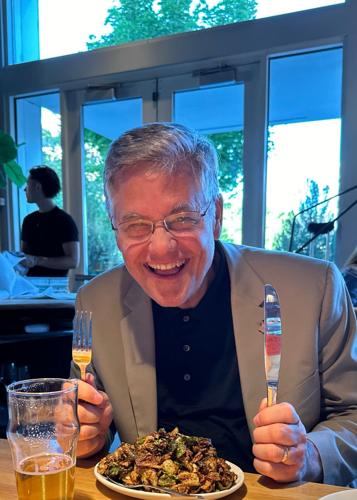
Butter on the lips make faces glow.
Eating good food together, unrushed, with plenteous gallons of sweet tea is bliss.
Cheers, and, please, pass the okra.









(0) comments
Welcome to the discussion.
Log In
Keep it Clean. Please avoid obscene, vulgar, lewd, racist or sexually-oriented language.
PLEASE TURN OFF YOUR CAPS LOCK.
Don't Threaten. Threats of harming another person will not be tolerated.
Be Truthful. Don't knowingly lie about anyone or anything.
Be Nice. No racism, sexism or any sort of -ism that is degrading to another person.
Be Proactive. Use the 'Report' link on each comment to let us know of abusive posts.
Share with Us. We'd love to hear eyewitness accounts, the history behind an article.