





Four gentlemen sit around the living room table in a comfortable home in Valdese on an early June morning cool enough to remind us that spring has not yet turned over her property rights to the oncoming summer season.
The men are united by age and experience — each of them is in his 80s and each of them has had a successful career.
More important for our purposes on this day, the four are united by a love for the Waldensian heritage upon which the town of Valdese was founded and by a passionate desire to see that heritage preserved.
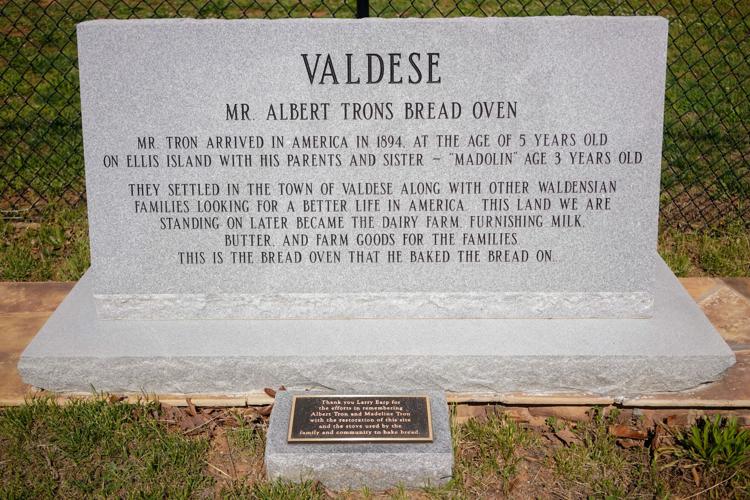
One of the men at the table, Steve Stroup, is the only living grandson of Albert Tron, who in 1894 at the age of 5 arrived with his parents on Ellis Island in New York Harbor and later settled in Valdese. Stroup’s two brothers, Johnny and Fred, died several years ago.
Tron went on to build an extraordinary record of success as a businessman and property owner, success primarily fueled, his grandsons say, by an extraordinarily strong work ethic and sense of responsibility to others.
A granddaughter, Diane Buffington Tron, now makes her home in Cary, and could not be present for the gathering.
A great-nephew of Albert Tron, Ronnie Bollinger, is present and is tremendously proud of his Waldensian heritage.
Another face at the table is that of Jim Jacumin, who was the driving force behind the establishment of the Trail of Faith, an outdoor museum which tells the story of the Waldensians’ longtime persecution in Europe and of their arrival in Valdese more than 130 years ago.
Finally, there is Larry Earp, who back in 1976 founded the iconic Valdese landmark restaurant known as Myra’s. Though now retired, he remains committed to preserving the heritage of the community whose support made him successful.
“We’re all gettin’ old,” Larry says as he looks around the table. “And we are all fearful that the heritage of this town will be lost. Our younger people need to know these stories and they need to remember these stories.”
A piece of the town’s story that is now secure and preserved for future generations to visit is an outdoor oven which Albert Tron built on his property more than a century ago.
Tron had developed the site as a dairy farm, and it provided milk, butter, cheese, and other farm products for the burgeoning town.
The oven, located just to the north of the Myra’s property on Faet Street NW, had fallen into disrepair in recent decades and was in danger of being torn down. Earp was determined not to let that happen.
“I recognized that it needed to be saved,” Earp said. “We restored the oven, cleaned up the property around it, erected a stone telling the history of Mr. Tron and the oven, and we have fenced the site to protect it from vandalism.”
The Tron oven, Jacumin noted, was based on the same philosophy of community connectedness as were the community ovens to be found in the valleys of the western Alps where the Waldensians lived for centuries.
“In the Old Country, they were known as community ovens,” Jacumin said. “The people would gather limbs and sticks and twigs each day to be placed in the oven. One oven could bake bread and other dishes for 10 or more families.”
Jacumin pointed out that other equipment from the Albert Tron farm could be found along the Trail of Faith, which is located just west of the site where the oven stands.
“It means a lot to me that the oven is going to be preserved for future generations to see,” said Bollinger. “My grandfather was an amazing man, and I think it’s important that we remember what he meant to this town.”
For Stroup, who actually lived in Tron’s house for a time as he was growing up, memories of his grandfather are especially strong.
“He was known as ‘The Meanest Man in Valdese,’” Stroup said, “but that’s only because he kept every baseball that was hit onto the farm from the school next door.”
In fact, Stroup said, “My grandfather was a generous man who did all he could to help others.”
“He got up at 4 a.m. every day and cooked breakfast and sometimes I would eat with him and then make his rounds with him,” Stroup added. “He owned stores, he owned rental property. He was a giant of a man even though he was only a little more than 5 feet tall.”
Jacumin said that Albert Tron, his work ethic, and his dedication to community are representative of what was required of the Waldensians to build a new and successful life in a new world.
“People had to come together to survive,” said Jacumin. “People had to not only build for themselves, they had to build a community for all. So many lessons we could learn from them today.”






















(0) comments
Welcome to the discussion.
Log In
Keep it Clean. Please avoid obscene, vulgar, lewd, racist or sexually-oriented language.
PLEASE TURN OFF YOUR CAPS LOCK.
Don't Threaten. Threats of harming another person will not be tolerated.
Be Truthful. Don't knowingly lie about anyone or anything.
Be Nice. No racism, sexism or any sort of -ism that is degrading to another person.
Be Proactive. Use the 'Report' link on each comment to let us know of abusive posts.
Share with Us. We'd love to hear eyewitness accounts, the history behind an article.