

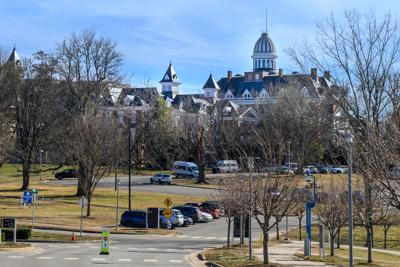


Psychiatric hospitals across the state are struggling to fill job vacancies, creating bottlenecks in Burke County emergency rooms and forcing potential patients to spend weeks, sometimes months, waiting for transfers.
More than 25% of the 1,272 positions at Broughton remain unfilled, and North Carolina Department of Health and Human Services (NCDHHS) officials point to diminished funding. According to NCDHHS, if all positions were filled, Broughton could open two additional adult units.
One unit typically contains 20 to 24 patients, requires 17 registered nurses, 42 health care technicians, and two psychiatrists, according to a NCDHHS presentation to the House Select Committee on Involuntary Commitment and Public Safety in December 2025.
More specifically, NCDHHS Press Assistant Kelse Edwards said, “Ideal acute inpatient psychiatric units target a 1:6 nurse-to-patient ratio with a 2:6 health care technician-to-patient ratio during waking hours to ensure safety.”
Furthermore, the presentation said that a lack of appropriate care options in the community also limits discharge options, especially for patients with a history of aggressive or sexualized behaviors.
With psychiatric stays across the state often stretching past 100 days, the beds don’t empty as quickly as they’re refilling.
WHAT HOLDS BROUGHTON BACK
Broughton Hospital is one of three state psychiatric hospitals in North Carolina, along with Central Regional (Butner) and Cherry Hospital (Goldsboro). Broughton staff provide mental health services for more than 35 western counties, including Burke.
As of Dec. 10, the most recent data available on the state’s psychiatric job market, Broughton had 332 position vacancies, forcing patient beds at the hospital to remain empty.
“The staffing shortage impacts the number of patients each hospital can serve,” NCDHHS Senior Media Relations Manager Summer Tonizzo said.
NCDHHS officials stated that Broughton provided services for 162 patients, as of Feb. 3. Admissions are managed based on staff capacity to prevent burnout, mitigate overtime, and maintain a low staff-to-patient ratio.
Although all three psychiatric hospitals in the state rolled out retention and recruitment efforts, Tonizzo cited North Carolina’s lack of a finalized state budget — “The only state in the country without a budget,” she said — as a limiting factor. This directly impacts employee raises and filling vacancies.
According to Tonizzo, NCDHHS’s biggest vacancies are in nursing and direct care, stemming from the growing competition of other health care systems in the area.
Edwards explained that the health care workforce shortage is a national issue that’s likely to continue to grow unless measures are taken to close the gap.
LOCAL HOSPITAL AFFECTED
While state psychiatric hospitals struggle to open beds, UNC Health Blue Ridge struggles to keep its 20 mental health spaces empty, often staying close to maximum capacity.
Officials at the hospital reported that they don’t frequently refer patients to Broughton because most patients can be stabilized and placed in alternative settings where other health care providers can accommodate their psychiatric needs.
However, when patients are ill enough to be transferred to Broughton, the wait can “easily” take several months, even when patients are told they’ve been accepted.
The bottlenecks, especially in the Emergency Department, create a patient care barrier, forcing the ripple effect out onto incoming patients.
UNC Health staff pointed to strict state admission criteria and a lack of adequate community and state-level resources, saying that state psychiatric facilities might see fewer referrals if community resources were more readily available.
STATE LEVEL EFFORTS
Patients coming in from the Department of Adult Corrections (DAC) often see even longer periods before they are admitted.
“The average wait time for placement in a state psychiatric facility for a person in jail experiencing mental health problems is nearly six months,” Gov. Josh Stein wrote in Executive Order No. 33, which he signed into effect on Feb. 5.
The executive order directs the Office of State Human Resources to assist the DAC, the NCDHHS, and the Department of Public Safety in expanding recruitment and retention practices to address the shortage of staff across state hospitals and prisons.
In an op-ed written by the governor that ran in the Raleigh-based The News & Observer on Feb. 8, Stein reflected on the series of deaths across the state tied to severe mental illnesses, including the stabbing of Iryna Zarutska in late 2025.
“In each case, innocent people were killed, breaking the hearts of family and friends,” he wrote. “In each case, our systems failed. … These tragedies demand that we do better. And we can. That’s why last week I signed an executive order to strengthen North Carolina’s behavioral health and criminal justice systems.”
The executive order seeks to close multiple shortfalls in current policy and support systems for people with mental health challenges by developing resources for training in public safety divisions, improving behavioral health response systems, dedicating a working group to reform involuntary commitment processes, and strengthening behavioral health treatment for the incarcerated.
“We have a talented and passionate workforce in public health and public safety,” Stein wrote. “But there aren’t enough of them, they don’t have the resources they need, and they aren’t as coordinated as they need to be. We need to get this right.”
BROUGHTON INCENTIVES
One of the ways Broughton is trying to “get it right” is through targeted sign-on bonuses for incoming employees. The hospital offers psychiatrists a $20,000 bonus; registered nurses, $10,000; health care technicians and CNAs (Certified Nursing Assistants), $2,000; and licensed clinical social workers, $5,000.
NCDHHS also increased health care technician starting pay from $15 per hour to $17 per hour, and registered nurse annual salaries from $64,000 to $70,000.
“Broughton Hospital is actively recruiting for its health care workforce,” Edwards said. “Broughton Hospital also participates in job fairs, offers walk-in-hiring opportunities, and engages in other recruitment efforts in the community.”


















(1) comment
Old school management style with too many internal promotions of unqualified people jnto positions
Welcome to the discussion.
Log In
Keep it Clean. Please avoid obscene, vulgar, lewd, racist or sexually-oriented language.
PLEASE TURN OFF YOUR CAPS LOCK.
Don't Threaten. Threats of harming another person will not be tolerated.
Be Truthful. Don't knowingly lie about anyone or anything.
Be Nice. No racism, sexism or any sort of -ism that is degrading to another person.
Be Proactive. Use the 'Report' link on each comment to let us know of abusive posts.
Share with Us. We'd love to hear eyewitness accounts, the history behind an article.