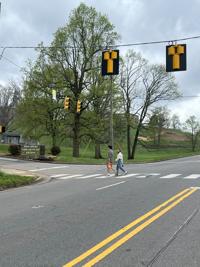
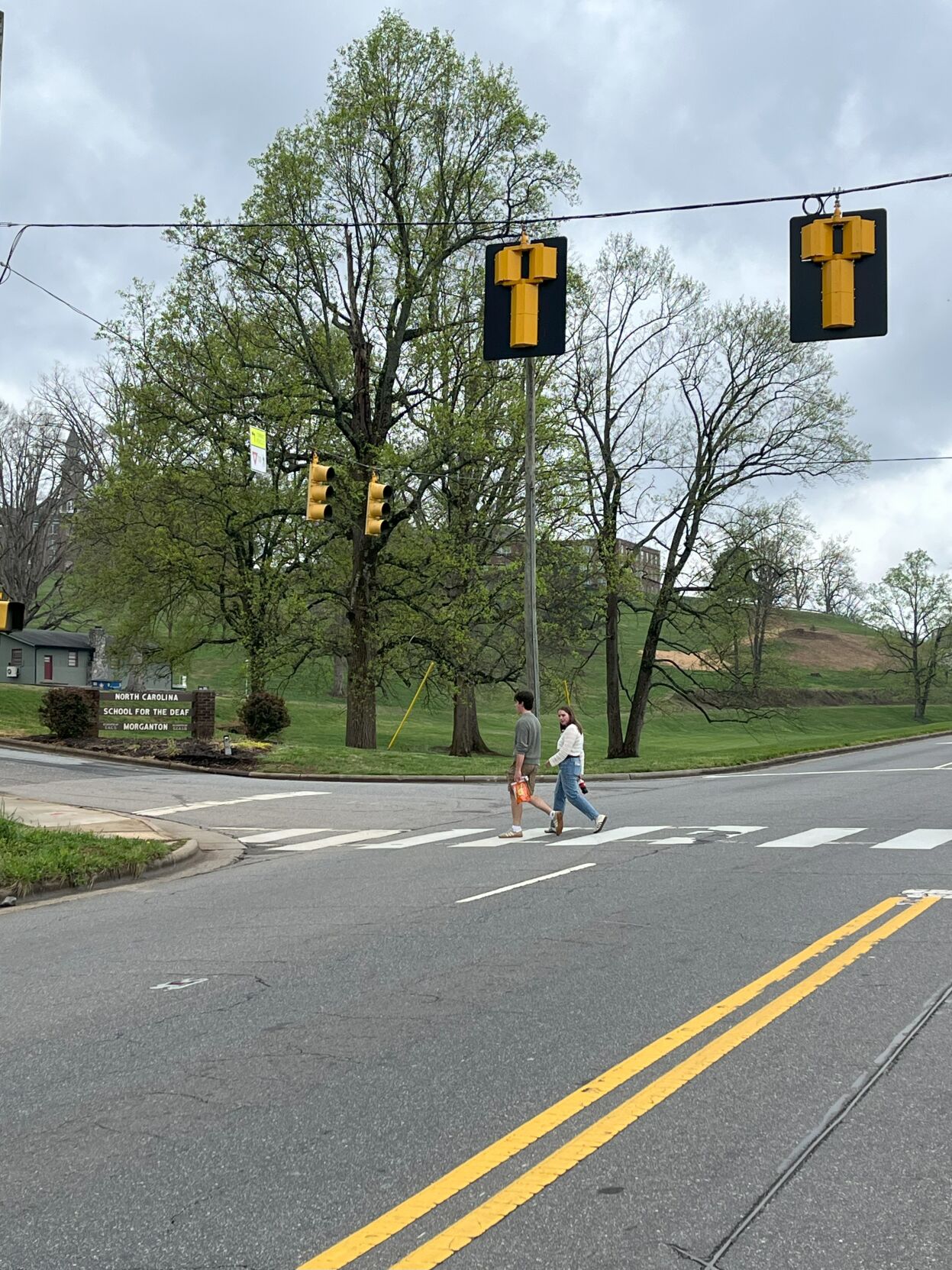
Two students cross Fleming Avenue at the entrance to NCSSM-M. Department of Transportation officials added sun shields to traffic lights and reduced the posted speed limit from 45 to 35 mph in an attempt to make the crosswalk safer for pedestrians.
The North Carolina Department of Transportation (NCDOT) has a message for drivers traveling Fleming Drive near the North Carolina School of Science and Math-Morganton (NCSSM-M): Slow down!
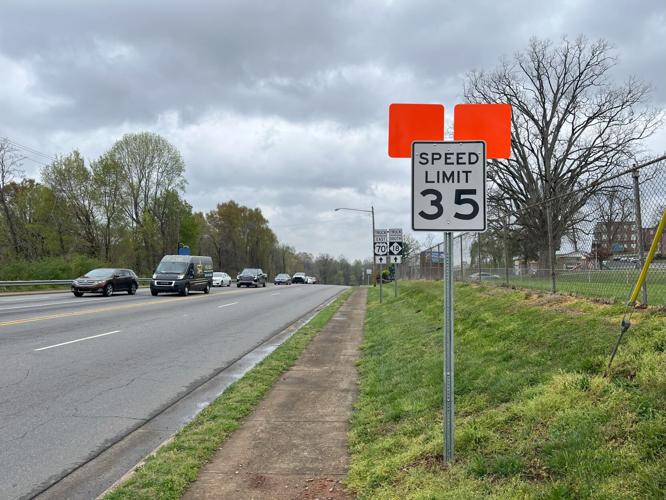
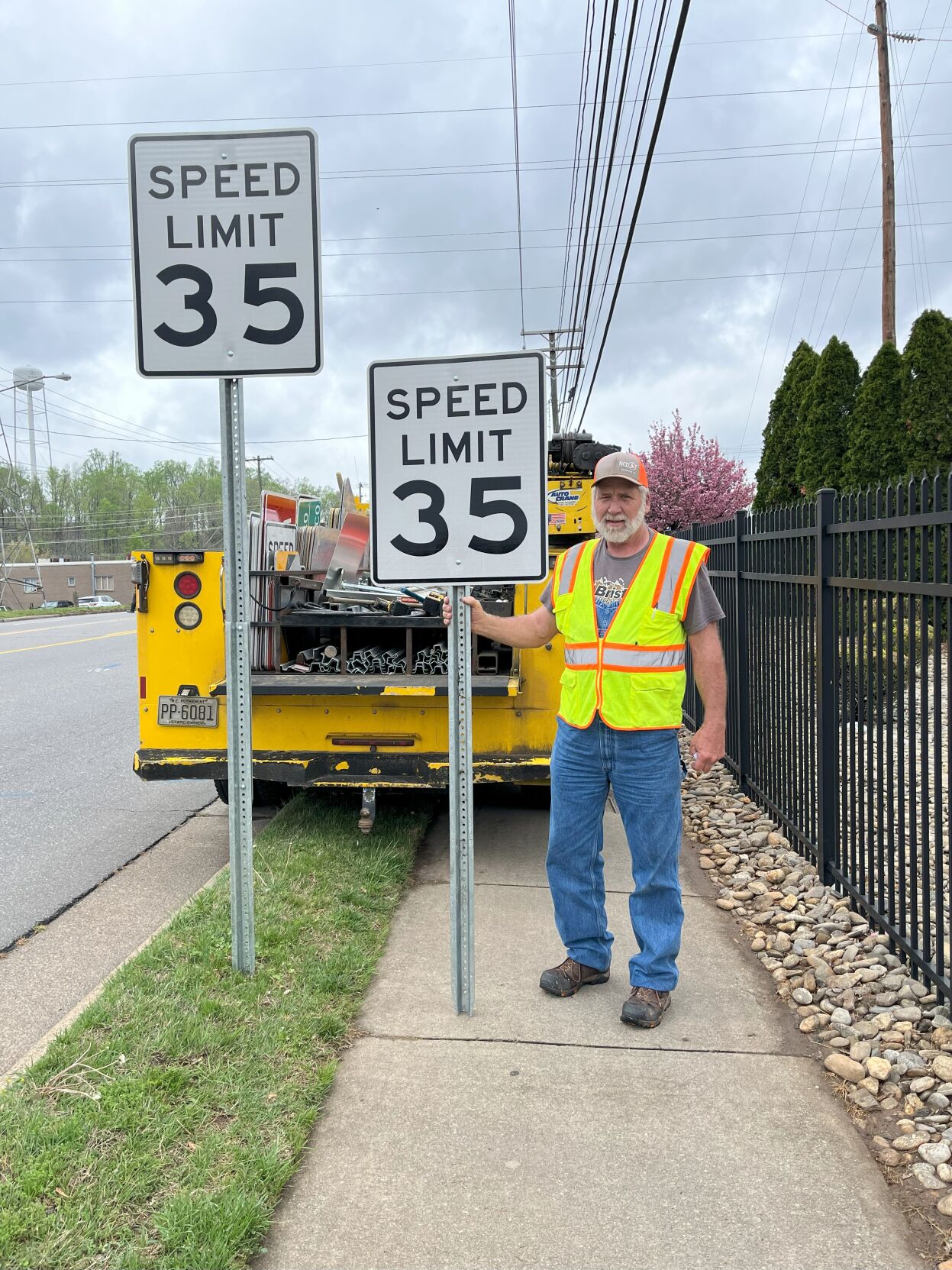
In the wake of an accident when two of the school’s students were struck by a car on Jan. 29, the NCDOT installed new 35 mph speed limit signs on the highway on Thursday, April 3. The speed limit had been 45 mph on that stretch of road.
New signs, reducing the speed limit on Morganton's Fleming Avenue, were installed last week.
By SANDRA WILKERSON QUEEN
sandra@thepaper.media
School, local, and state officials conducted a flurry of communications after the accident to better understand what happened and how it could be prevented from happening again.
The peril of crossing that road — even in a designated crosswalk with a traffic light — is not new. Before the first students stepped onto campus, creating a safe route off campus for students was explored, debated, and discussed.
Two students cross Fleming Avenue at the entrance to NCSSM-M. Department of Transportation officials added sun shields to traffic lights and reduced the posted speed limit from 45 to 35 mph in an attempt to make the crosswalk safer for pedestrians.
By SANDRA WILKERSON QUEEN
sandra@thepaper.media
But the January event spurred the North Carolina Department of Transportation to take action, calling it “one of their top priorities.”
“We are examining short-term opportunities — including a potential speed limit reduction — to improve safety at the crossing,” Randy Tritt, Division 13 traffic engineer said in February. “Traffic experts are also considering long-term options including infrastructure upgrades.”
Tritt noted recent DOT safety upgrades, but they failed to prevent this latest accident:
A High Visibility Crosswalk was installed on West Fleming Drive at Catalyst Way.
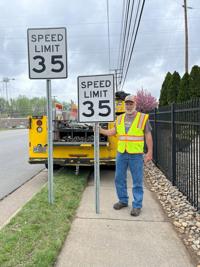
NCDOT employee Robert Lail was part of a crew installing new speed limit signs on Fleming Avenue in Morganton on Thursday, April 3.
Back Plates were installed on the traffic signal heads facing westbound motorists on West Fleming Drive.
A “Be Prepared to Stop” advanced warning sign flasher was installed Aug. 21, 2024, on West Fleming Drive. Lights flash when the traffic signal heads display yellow and red for westbound West Fleming Drive motorists.
In the immediate aftermath of the accident, the Morganton Department of Public Safety installed a radar sign and a speed survey device in that area.
MDPS has investigated other pedestrian/vehicle wrecks in the area, such as Case Farms employees running into traffic to go to the convenience store across the road. One of the accidents in the area was a fatality.
A similar pedestrian accident happened on Jan. 31, 2024, when NCSSM students were hit that afternoon by a car that ran a red light. The car was traveling west on West Fleming and hit the students as they crossed.
The changes just made are a positive step. The changes were needed years ago, going back to when the first stoplight was installed there. The NC Department of Health and Human Services, which oversaw NCSD at that time, paid for the light because NCDOT had determined the situation did not demand immediate attention. In addition to regular traffic, the location marks one of the entrances to both the NCSD and NCSSM campuses and many Deaf persons come and go there. They do not hear horns honking or brakes squealing. The blinding sun on some afternoons is just that - blinding - and presents a whole other set of dangers. Most schools have 35 mph speed limits on roads adjacent to their campuses, at least for some hours in the school day, but this is the first time the speed limit on the West Fleming side of the NCSD and NCSSM campuses has been lowered from 45 to 35. "Safety first" is more than a slogan - it is also a moral imperative.
Keep it Clean. Please avoid obscene, vulgar, lewd,
racist or sexually-oriented language. PLEASE TURN OFF YOUR CAPS LOCK. Don't Threaten. Threats of harming another
person will not be tolerated. Be Truthful. Don't knowingly lie about anyone
or anything. Be Nice. No racism, sexism or any sort of -ism
that is degrading to another person. Be Proactive. Use the 'Report' link on
each comment to let us know of abusive posts. Share with Us. We'd love to hear eyewitness
accounts, the history behind an article.



















(2) comments
I don't remember a traffic light being here before. Was there? If not, it was past time.
The changes just made are a positive step. The changes were needed years ago, going back to when the first stoplight was installed there. The NC Department of Health and Human Services, which oversaw NCSD at that time, paid for the light because NCDOT had determined the situation did not demand immediate attention. In addition to regular traffic, the location marks one of the entrances to both the NCSD and NCSSM campuses and many Deaf persons come and go there. They do not hear horns honking or brakes squealing. The blinding sun on some afternoons is just that - blinding - and presents a whole other set of dangers. Most schools have 35 mph speed limits on roads adjacent to their campuses, at least for some hours in the school day, but this is the first time the speed limit on the West Fleming side of the NCSD and NCSSM campuses has been lowered from 45 to 35. "Safety first" is more than a slogan - it is also a moral imperative.
Welcome to the discussion.
Log In
Keep it Clean. Please avoid obscene, vulgar, lewd, racist or sexually-oriented language.
PLEASE TURN OFF YOUR CAPS LOCK.
Don't Threaten. Threats of harming another person will not be tolerated.
Be Truthful. Don't knowingly lie about anyone or anything.
Be Nice. No racism, sexism or any sort of -ism that is degrading to another person.
Be Proactive. Use the 'Report' link on each comment to let us know of abusive posts.
Share with Us. We'd love to hear eyewitness accounts, the history behind an article.